Granite School District tells every incoming kindergartner the year they will graduate high school. It is a small ritual, meant to plant the idea that school is a place they belong for the next 13 years. But in Utah right now, nearly one in three of those five-year-olds is missing so much school that they qualify as chronically absent.
At 30.0%, kindergarten carries the highest chronic absenteeism rate of any grade in Utah, 6.2 percentage points above the statewide average of 23.8%. The gap is not subtle. It is the widest separation between any single grade and the state mean, and it sits at the front door of a child's academic career.
The curve no one wants
Utah's grade-level absenteeism data traces a shape familiar to attendance researchers: a U-curve. Chronic absence starts high in kindergarten, drops through the elementary and middle grades, bottoms out in seventh grade at 19.8%, then climbs back up to 26.1% by 12th grade.
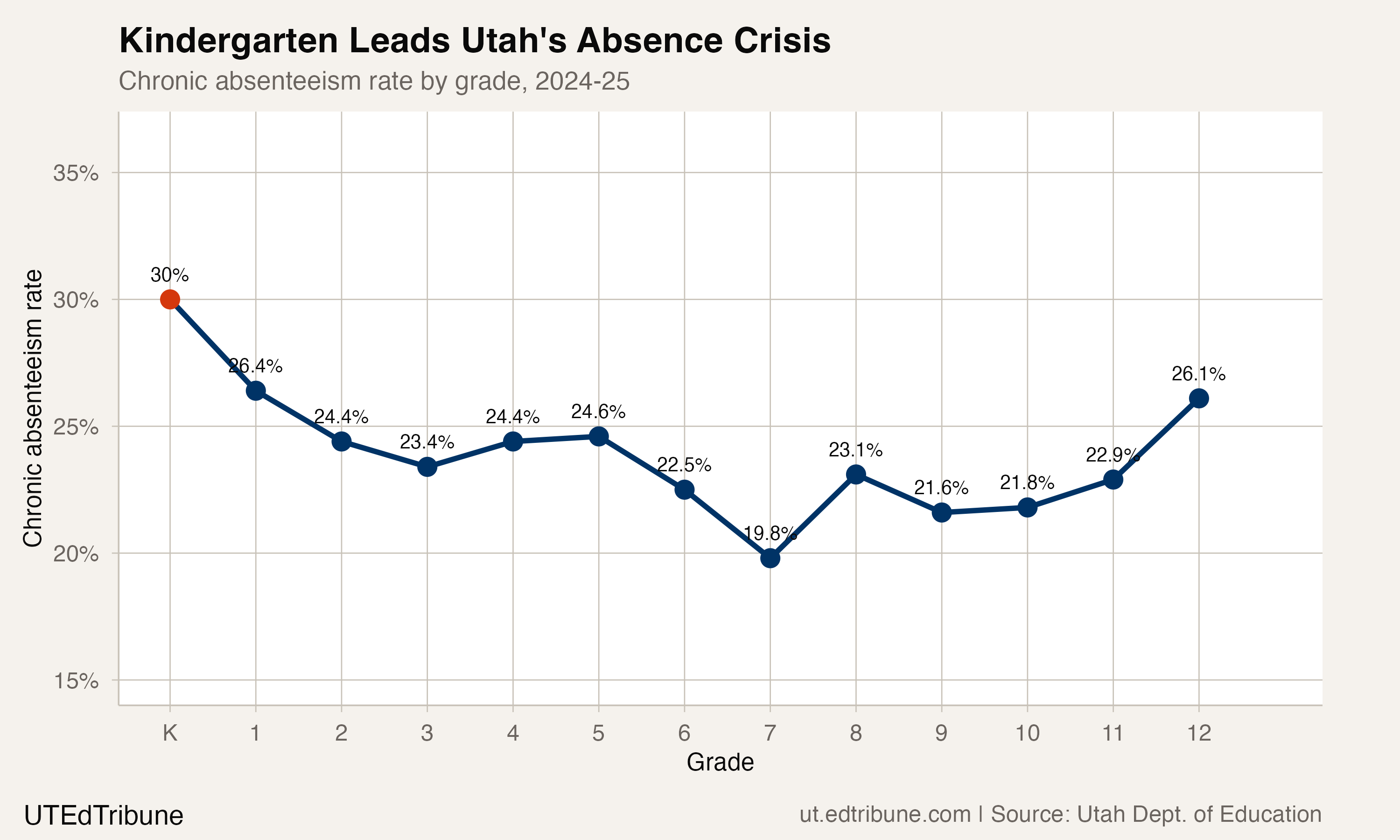
The trough-to-peak spread is 10.2 percentage points. Elementary school as a whole averages 25.5%, middle school 21.8%, and high school 23.1%. But kindergarten stands alone above all of them. First grade (26.4%) and 12th grade (26.1%) are the only other grades above 26%.
The pattern is not unique to Utah. Nationally, kindergarten consistently ranks among the worst grades for chronic absence, a New America analysis found. California's kindergarten rate hit 40.4% in 2021-22. What makes Utah's version notable is the structural context: the state funded kindergarten at 0.55 weighted pupil units for decades, roughly half of what it allocated per student in grades 1 through 12. That formula carried an implicit message about how much kindergarten mattered.
A funding signal and a reading pipeline
In 2023, the legislature passed HB 477 to expand full-day kindergarten statewide, appropriating $60 million to close the gap. Before that bill, only about 30% of Utah kindergartners had access to full-day programs, compared to 70-80% nationally, according to the bill's sponsor, Rep. Robert Spendlove.
The academic consequences of that half-day legacy are measurable. Sara Wiebke, USBE's literacy coordinator, told the Deseret News that reading scores for full-day kindergartners were "two to four times higher than peers attending half-day kindergarten." Washington County School District, which shifted to full-day programming, saw reading proficiency climb from 60% to 90% with a 94% parent opt-in rate.
Whether the half-day model also contributed to higher absence rates is harder to isolate. But the logic is straightforward: if a child attends school for only half a day, a single missed morning erases the entire school day. A parent weighing a doctor's appointment against a three-hour session faces a different calculus than one weighing it against a six-hour day.
The improvement that was not enough
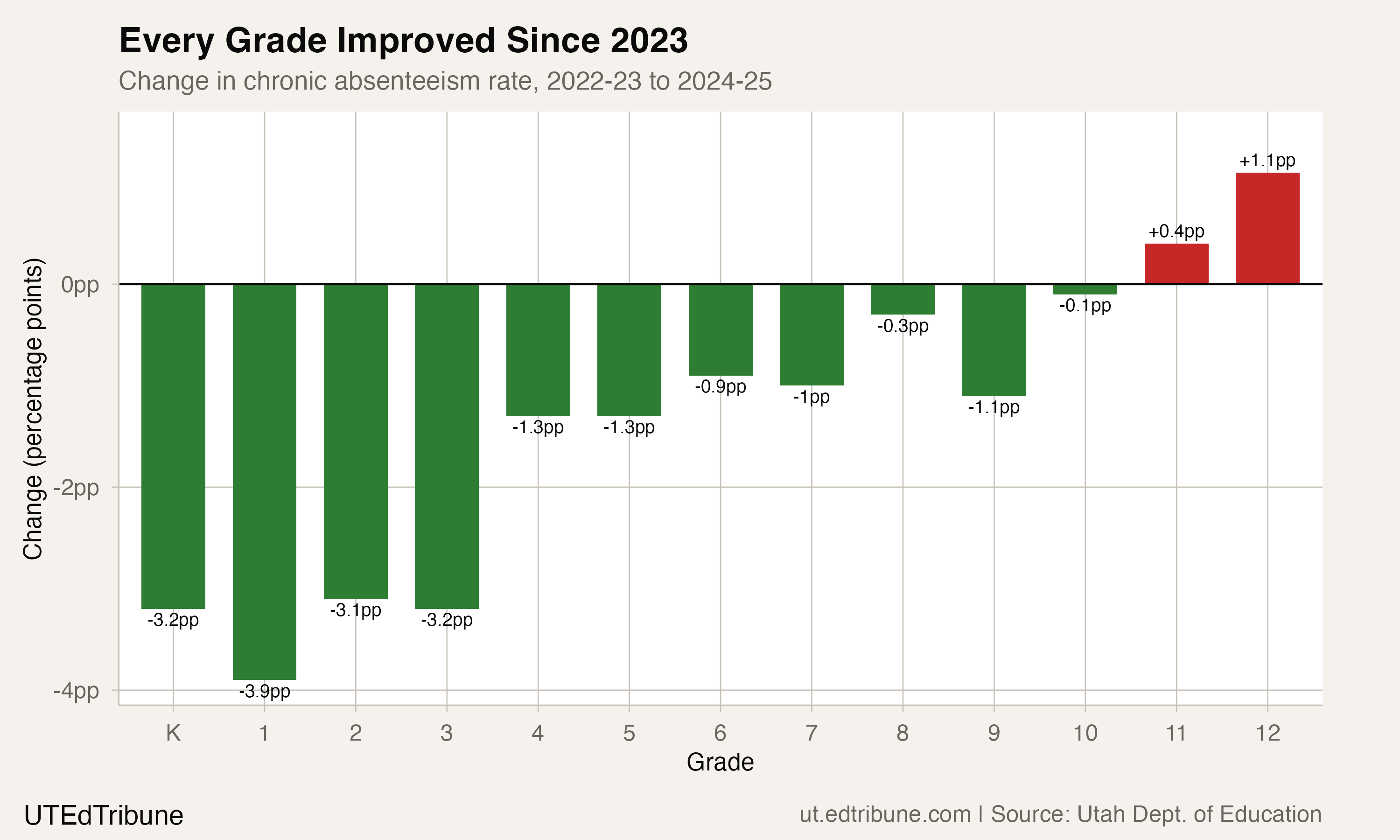
The kindergarten rate has come down. In 2022-23, it stood at 33.2%. By 2024-25, it had fallen to 30.0%, a 3.2 percentage-point improvement that outpaced the statewide decline of 1.4 points over the same period.
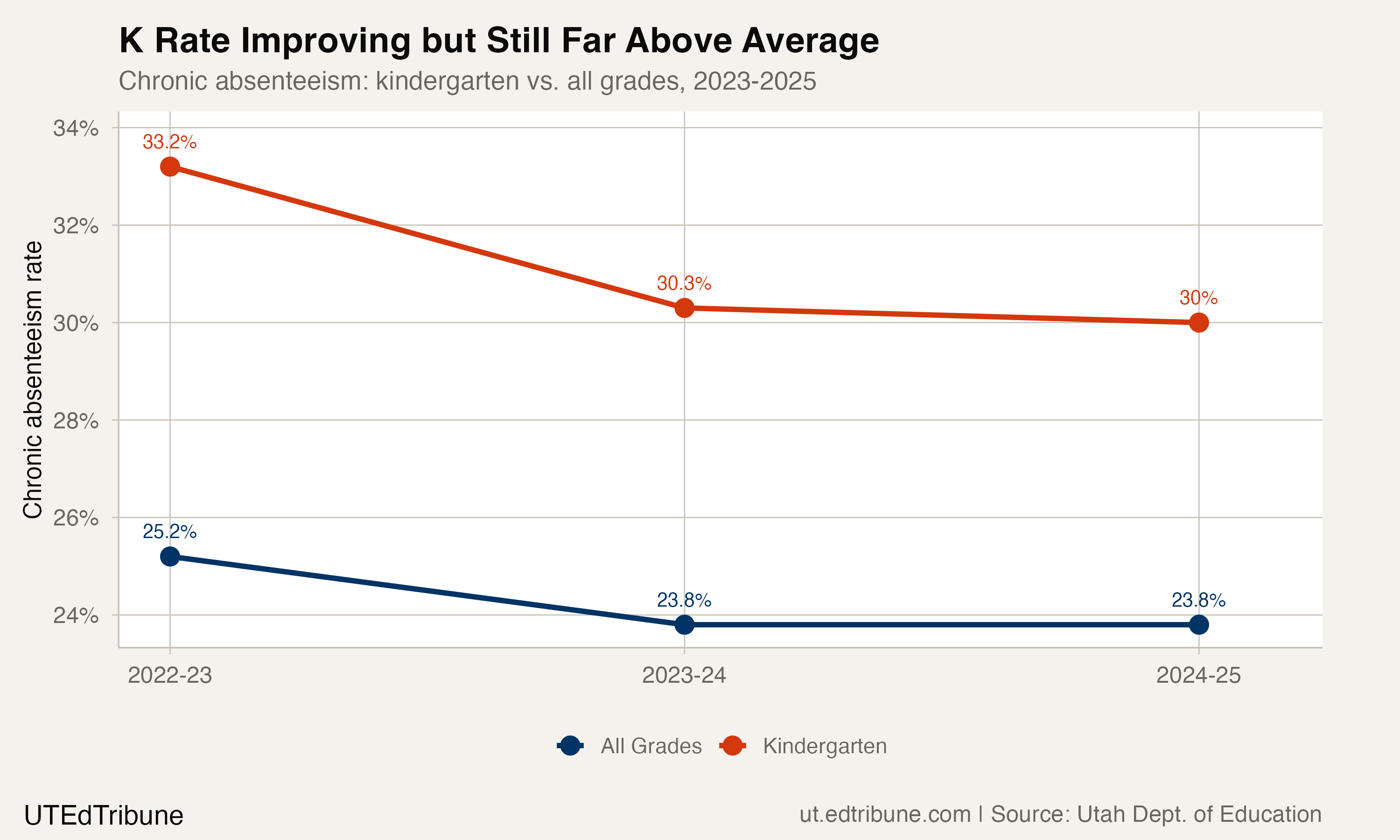
But the statewide average itself has stalled. Utah's overall chronic absenteeism rate was 23.8% in both 2023-24 and 2024-25, unchanged year over year. And the kindergarten gap, while narrower than it was two years ago, remains wide. Kindergarten is still 1.26 times the state average.
The improvement pattern across grades is uneven. Kindergarten through third grade saw the largest reductions, each dropping more than 3 percentage points since 2022-23. But 11th and 12th grades moved in the opposite direction, worsening by 0.4 and 1.1 points respectively. The senior-year spike to 26.1% suggests a different kind of disengagement, one driven by senioritis, early college enrollment, or work schedules rather than the family-driven factors that shape kindergarten attendance.
Who is missing the most
The demographic breakdown of chronic absence in Utah reveals a familiar pattern of compounding disadvantage. Pacific Islander students have the highest chronic absenteeism rate at 45.0%, nearly double the state average. Native American students follow at 39.8%.
Among service populations, the rates are similarly stark: English learners at 36.2%, economically disadvantaged students at 34.4%, and students receiving special education services at 30.0%. These categories overlap substantially with each other and with racial groups. Many English learners are also Hispanic (33.0% chronic absence), and many economically disadvantaged students qualify through programs that correlate with race.
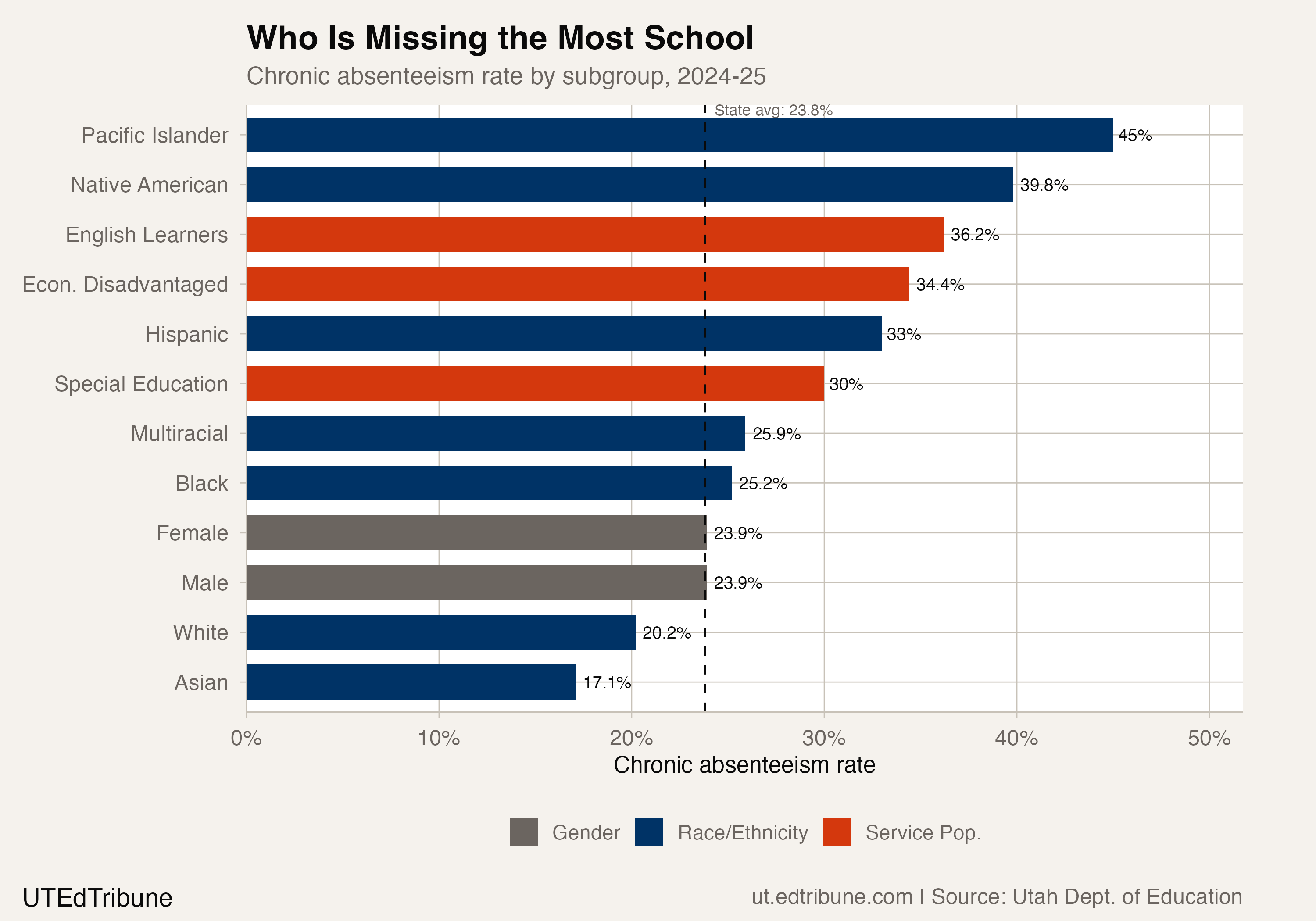
The gap between the highest- and lowest-rate racial groups is striking: Pacific Islander students are chronically absent at 2.6 times the rate of Asian students (17.1%). White students, at 20.2%, are the only large racial group below the state average.
Charter schools run higher than traditional districts, 27.3% versus 23.3%, and the charter rate worsened in 2024-25 (up from 24.5% the prior year) while traditional schools held steady. The divergence is worth watching but the data does not reveal whether it reflects different student populations, different attendance cultures, or different reporting practices.
The research is not ambiguous
The consequences of chronic kindergarten absence are among the most studied and least disputed findings in education research. A landmark study by Hedy Chang and Mariajosé Romero at the National Center for Children in Poverty found that only 17% of students who were chronically absent in both kindergarten and first grade read proficiently by the end of third grade, compared to 64% of students who attended regularly. Low-income kindergartners were four times more likely to be chronically absent.
More recent work by Gottfried and Ansari (2021), tracking 14,370 kindergartners through third grade, found that chronically absent kindergartners showed roughly 1 to 1.5 fewer months' gains in working memory compared to peers, a deficit that persisted for years. The effects were cumulative: every missed day compounded.
"Chronic absenteeism in kindergarten or first grade significantly reduces the odds of reading on grade level by third grade and quadruples the risk of eventually dropping out." Source: Deseret News, July 2025
Utah's own data reinforces this pipeline. A Salt Lake Tribune investigation found that students with chronic health conditions miss school at significantly higher rates, with type 1 diabetes driving 20% chronic absence and asthma 16%. The state has one school nurse for every 2,091 students. In Logan, it is one for roughly 5,000.
The state's response, and its gaps
USBE launched an attendance campaign in August 2025, deploying toolkits, parent handouts, and "attendance ambassadors" across the state. The campaign arrives after chronic absenteeism nearly doubled over a decade, from 12.2% in 2014 to 23.8% in 2024. A puzzling wrinkle: dropout rates fell over the same period, from 13.3% to 9%, meaning more students are technically staying enrolled while missing more school.
Garrett Russell, USBE's attendance specialist, pointed to the pandemic's role in reshaping school culture: "A lot of the schools went virtual. A lot of families had options for in-person v. online." The shift may have loosened norms around daily attendance, particularly for kindergarten, where compulsory attendance laws have historically been weakest.
On the legislative side, Rep. Andrew Stoddard's HB 106 initially proposed school-level chronic absenteeism data reporting. The broader attendance package moved through SB 58, which was signed on March 19, 2026, and establishes comprehensive student attendance monitoring, chronic absenteeism supports, and accountability requirements for local education agencies. Rep. Jason Thompson (R-River Heights), who sponsored SB 58 in the House, noted that districts measured attendance inconsistently, resulting in "inconsistent and unreliable" data.
That legislative debate points to a gap in this analysis. Utah's grade-level absenteeism data is available only at the state level, only for the last three years, and carries no student-count column. The 30.0% kindergarten rate cannot be decomposed to see which districts or schools drive it, whether it concentrates in rural or urban communities, or whether half-day versus full-day programs produce different attendance patterns. HB 106 did not become law, so that granularity remains a reporting question for future sessions.
The research on kindergarten absence has been settled for years. What Utah has not settled is whether a messaging campaign and SB 58's statewide attendance framework are proportional to a problem where nearly one in three five-year-olds is missing enough school to measurably damage their odds of reading by third grade.
Detailed code that reproduces the analysis and figures in this article is available exclusively to EdTribune subscribers.
Discussion
Sign in to join the discussion.
Loading comments...