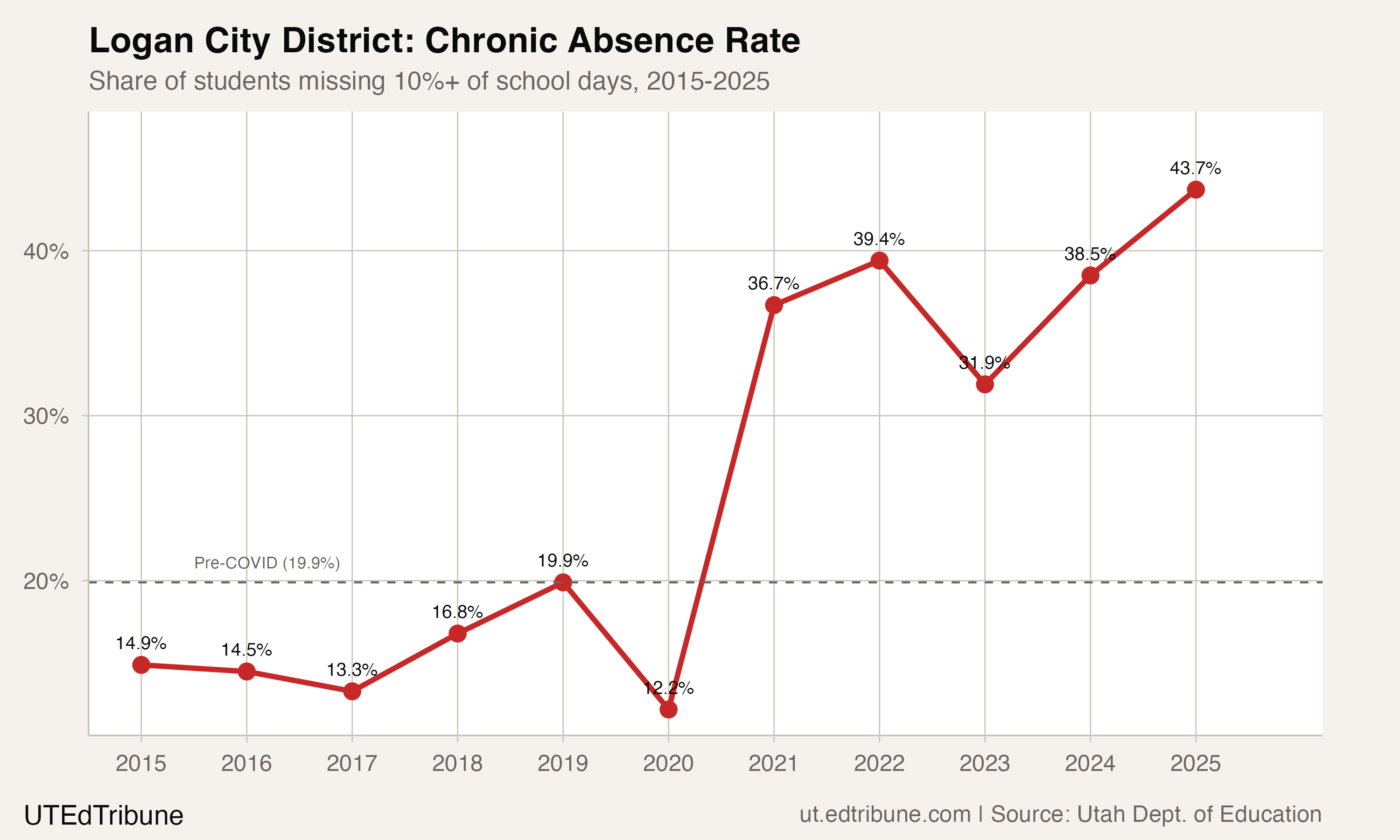
In 2023, Logan City District↗ET did something rare in post-pandemic Utah: it brought its chronic absenteeism rate down. The share of students missing 10% or more of school days fell from 39.4% to 31.9%, a 7.5-percentage-point improvement that suggested the worst was behind a district still recovering from the upheaval of 2020 and 2021.
Two years later, that recovery has vanished. Logan's chronic absence rate climbed to 38.5% in 2024 and then to 43.7% in 2025, surpassing the pandemic peak by 4.3 percentage points. Nearly half the district's 5,056 students now miss enough school to be classified as chronically absent, a rate that has more than tripled since 2017, when it stood at 13.3%.
A college town where attendance is collapsing
Logan sits in Cache Valley, 80 miles north of Salt Lake City, home to Utah State University and a growing refugee community that has resettled families from Burma, Eritrea, and Somalia over the past two decades. The district is smaller than its suburban Wasatch Front counterparts, but its demographics look nothing like the rest of Cache County: 45% of Logan's students are racial or ethnic minorities, compared to the county's roughly 12% Hispanic population.
What makes Logan's trajectory so striking is the contrast with Cache District↗ET, its next-door neighbor. In 2017, both districts sat in the low teens: Logan at 13.3%, Cache at 7.8%, a gap of 5.5 percentage points. By 2025, Cache had brought its rate back down to 16.3% after its own COVID surge. Logan, meanwhile, accelerated in the opposite direction. The gap between the two districts is now 27.4 percentage points, five times what it was eight years ago.
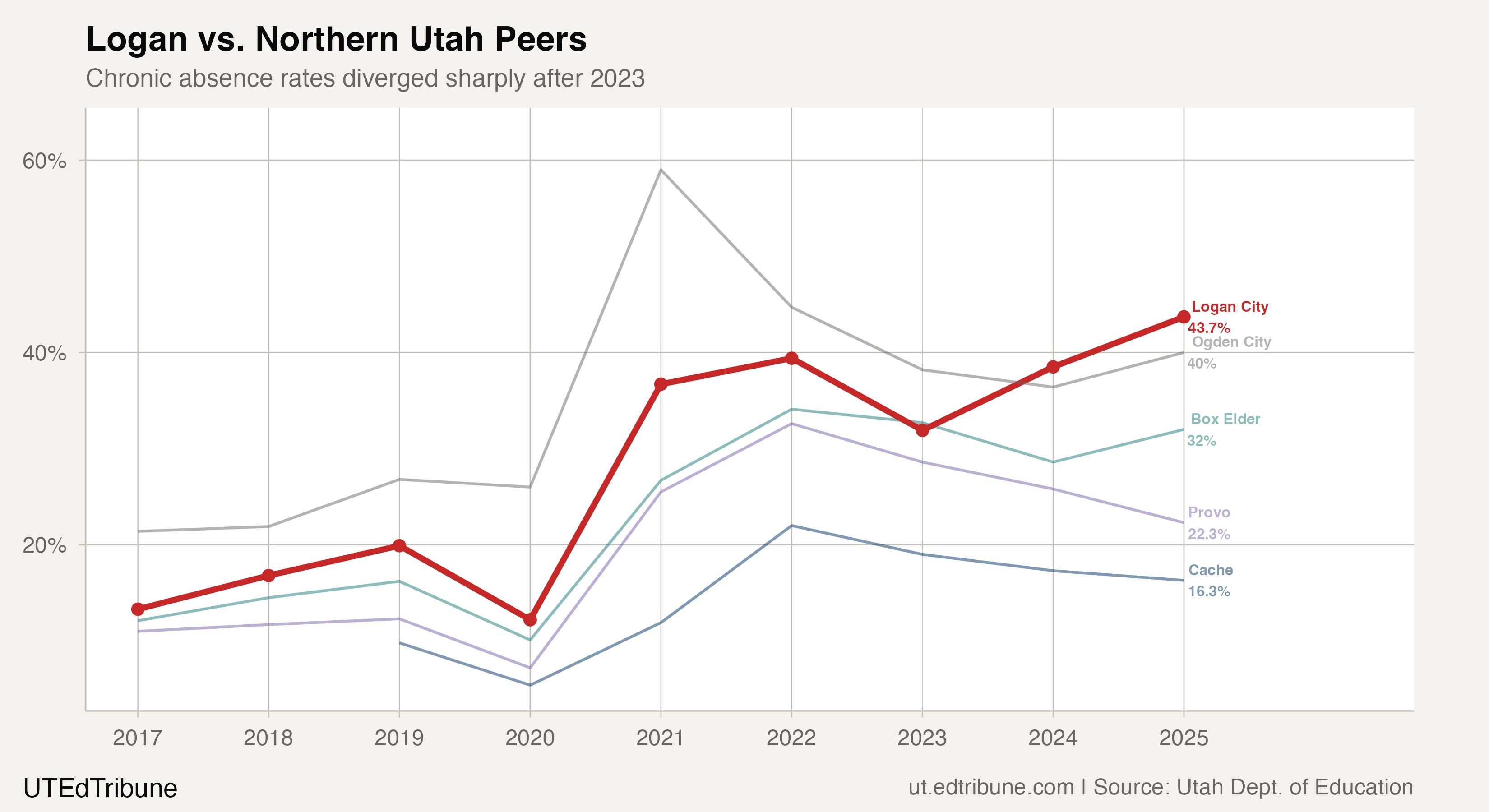
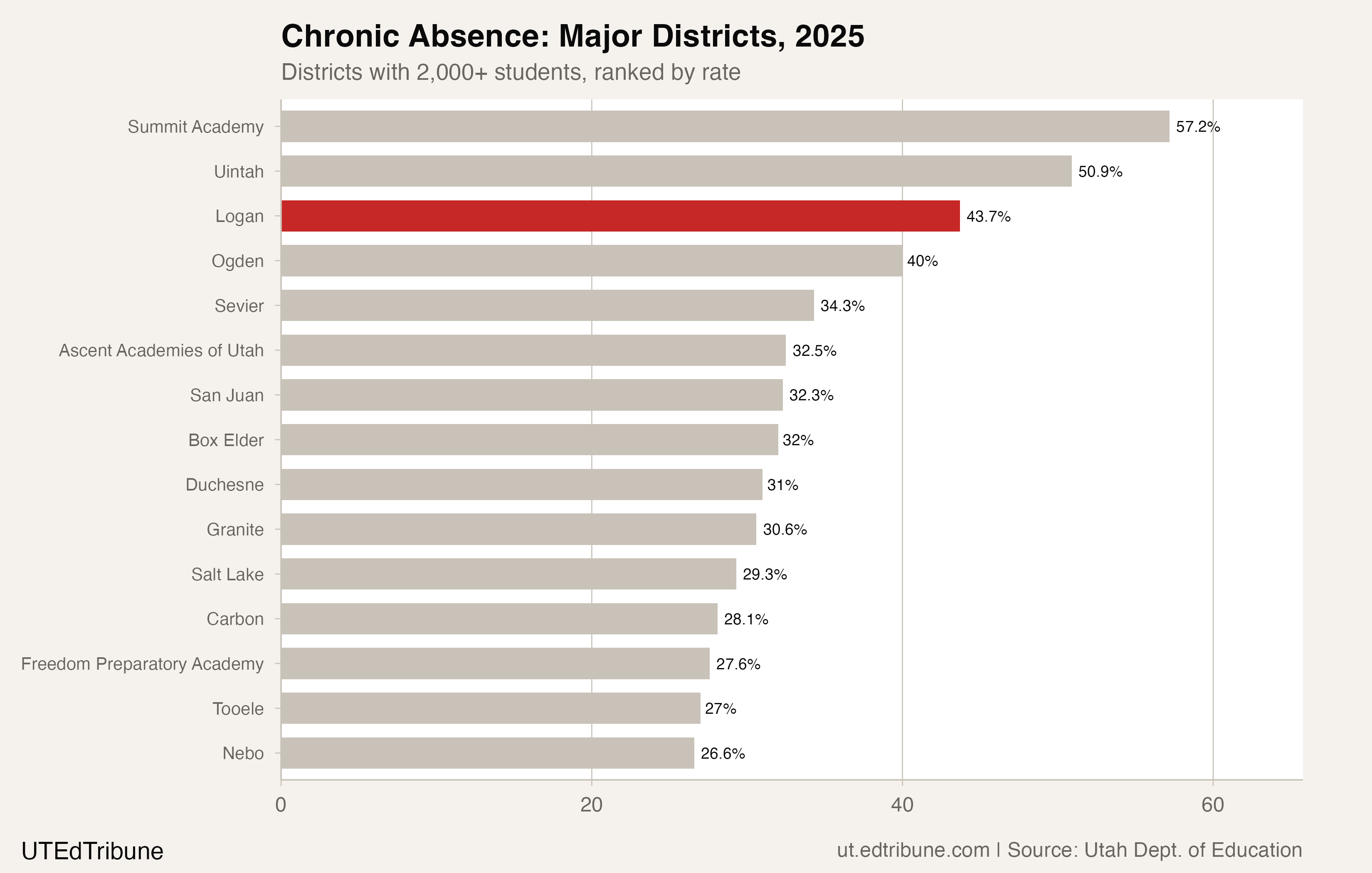
Among Utah's traditional districts with 2,000 or more students, only Uintah District (50.9%) posts a higher chronic absence rate. But Uintah is a rural district stretched across the Uintah Basin, serving a population shaped by oil-field economics and tribal communities. Logan is a city school system wrapped around a land-grant university. The comparison that cuts deepest is with Ogden City, a district with similar demographics and a chronic absence rate of 40.0%, 3.7 points lower than Logan's despite serving nearly twice as many students.
The reversal that wasn't
The year-over-year pattern tells a more complicated story than a simple climb. Logan's rate was trending upward before the pandemic: 13.3% in 2017, 16.8% in 2018, 19.9% in 2019. The district actually saw improvement in 2020, when Utah's decision to keep schools open pushed the rate down to 12.2%. Then came the delayed shock. In 2021, Logan's rate jumped 24.5 percentage points in a single year, the largest one-year increase in the district's data history, landing at 36.7%.
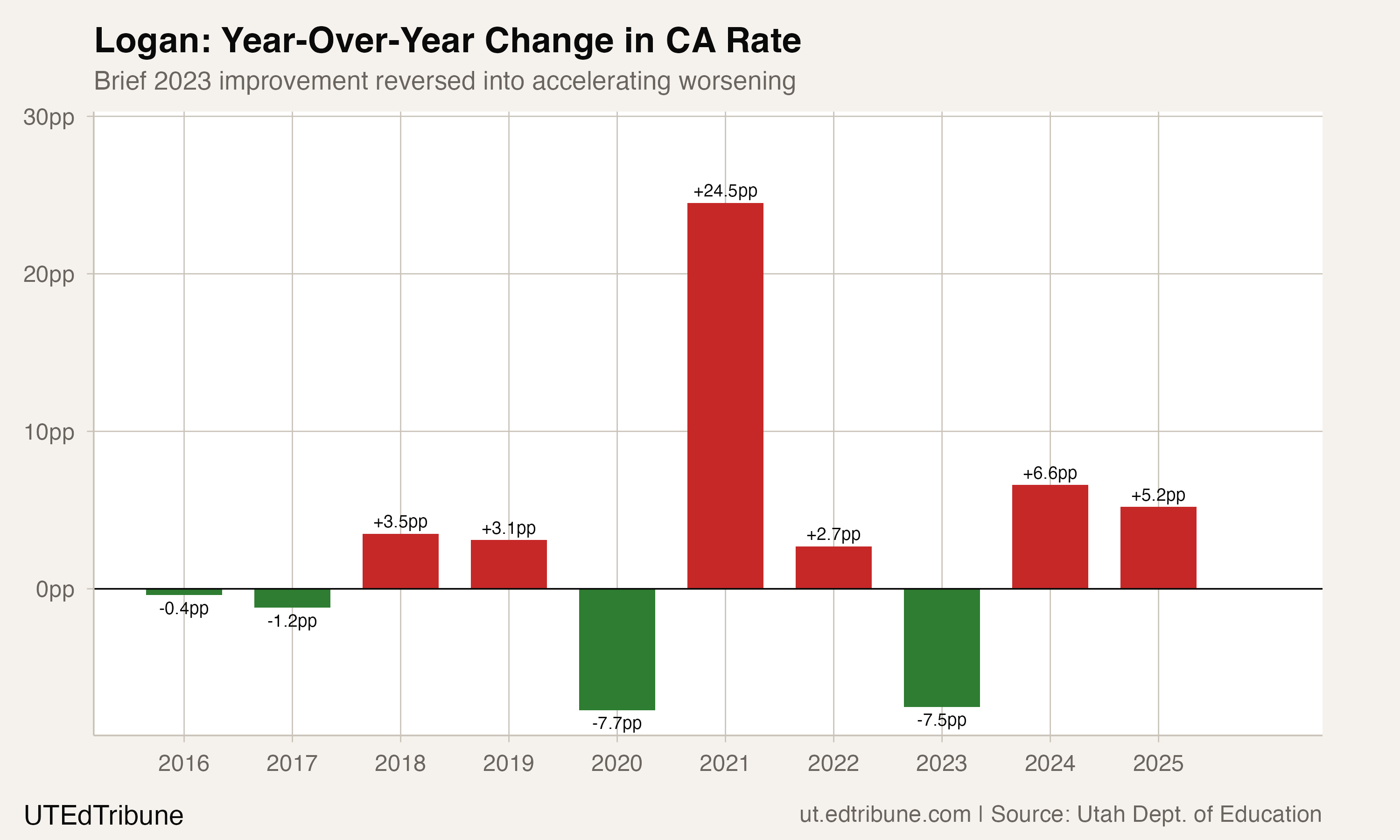
The 2023 dip to 31.9% looked like a turning point. It was not. The 6.6-point increase in 2024 erased the entire improvement, and the additional 5.2-point climb in 2025 carried the rate past its previous peak. Logan is one of 41 Utah districts where the 2025 chronic absence rate now exceeds the 2022 high. Statewide, about a third of districts with comparable data are in the same position.
What is driving this
The most likely explanation is structural, not episodic. Logan's pre-pandemic trendline was already rising, which means COVID amplified an existing problem rather than creating a new one.
The district's growing English learner population is one factor. Statewide, LEP students are the only demographic subgroup where the chronic absence gap is widening. Logan's LEP enrollment has grown substantially in recent years, fueled in part by refugee resettlement through the Cache Refugee and Immigration Connection, which helps families from Burma, Eritrea, and other countries establish themselves in Cache Valley. Transportation barriers, language isolation, and the challenges of navigating an unfamiliar school system all contribute to chronic absence among newly resettled families, though the state data does not break out absenteeism by subgroup at the district level.
A competing explanation is that the pattern reflects broader disengagement that accelerated during the pandemic and never reversed. Superintendent Frank Schofield has acknowledged that traditional attendance enforcement, like letters that "scold families," has limited effect, telling the Logan school board that the district is "much more successful when we are continually focused on building partnerships and building those positive relationships with parents."
A statewide problem with a local face
Logan's crisis is extreme, but it sits inside a broader deterioration. Chronic absenteeism nearly doubled statewide from 12.2% in 2014 to 23.8% in 2024. Nearly one in four Utah students is now chronically absent.
USBE launched a statewide attendance initiative in August 2025, deploying attendance ambassadors and toolkits. Whether those resources reach a district where the rate has climbed 11.8 percentage points in two years is unclear.
At the legislature, bipartisan bills introduced in January 2026, HB106 and SB58, would require the state board to collect and publish chronic absenteeism data and analyze root causes including socioeconomics, mental health, and family instability. Rep. Andrew Stoddard, the Sandy Democrat who sponsored HB106, framed the stakes directly: "Kids who aren't in school are not graduating."
What comes next for Logan
The district data does not reveal whether Logan's rising rate is driven by a growing number of students missing a few extra days or by a smaller group missing dramatically more. That distinction matters for intervention design: the first pattern suggests system-wide friction (transportation, scheduling, cultural barriers), while the second points to a concentrated crisis among families furthest from the school system.
What the data does show is that the 2023 improvement was not durable, and that the forces driving absenteeism in Logan are stronger than the forces working against it. Schofield, whose contract was extended through June 2027, has named attendance recovery as his top priority. The question is whether relationship-based strategies can reverse a rate that has tripled in eight years, or whether the structural conditions in a diversifying college town with a growing refugee population and a 43.7% chronic absence rate demand something more.
Detailed code that reproduces the analysis and figures in this article is available exclusively to EdTribune subscribers.
Discussion
Sign in to join the discussion.
Loading comments...