Correction: An earlier version of this article contained several incorrect figures. Ogden has lost 1,508 students since 2019 (a 13.1% decline), not 1,755 (15.2%); the 22.6-point improvement to 36.4% represented 70% recovery of the 32.2-point spike, not 59%; 55.2% of students qualify for free or reduced-price meals, not 62.7%; statewide enrollment grew 1.3% over the period rather than contracting; and Logan's rate has more than doubled since 2019 but did not rise every year. The article has been updated.
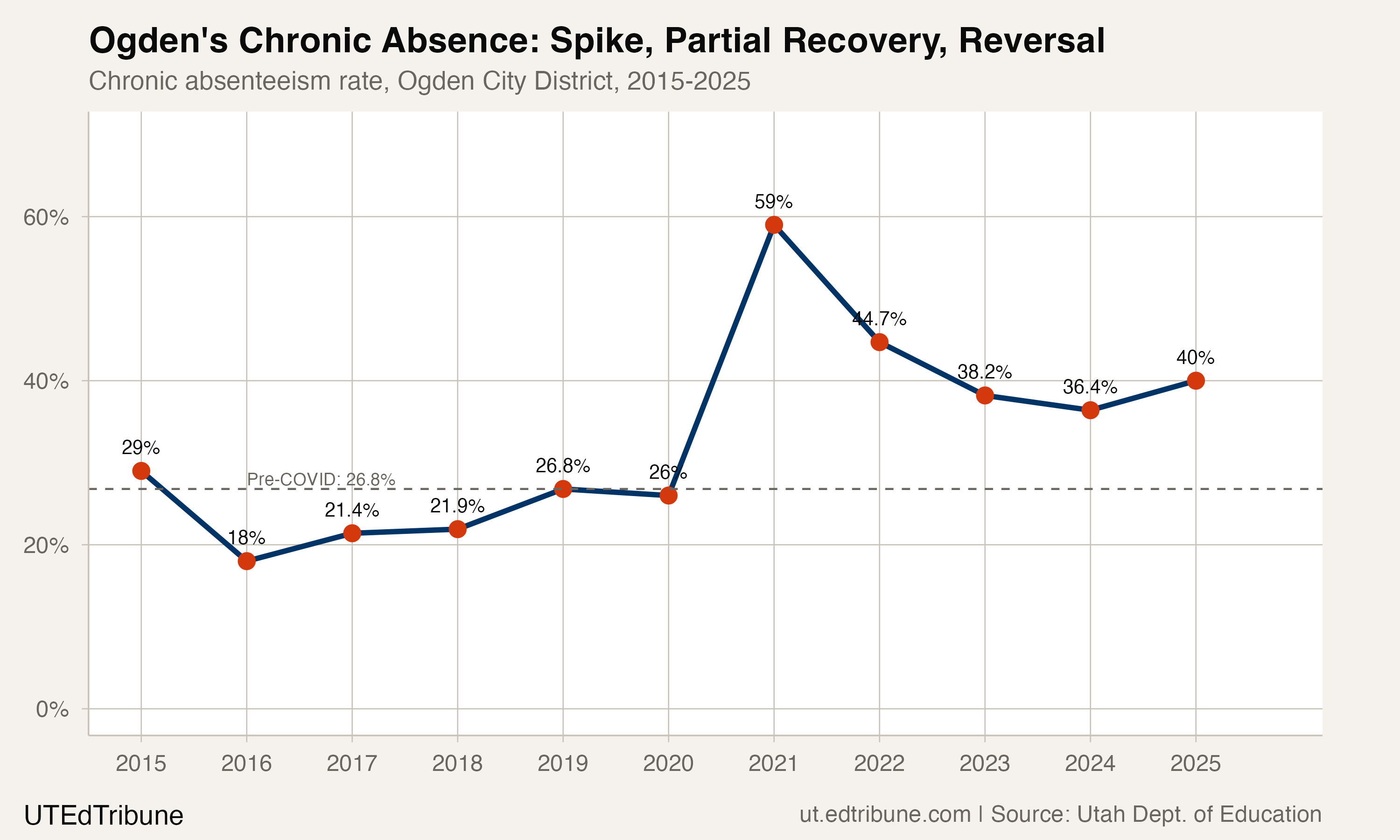
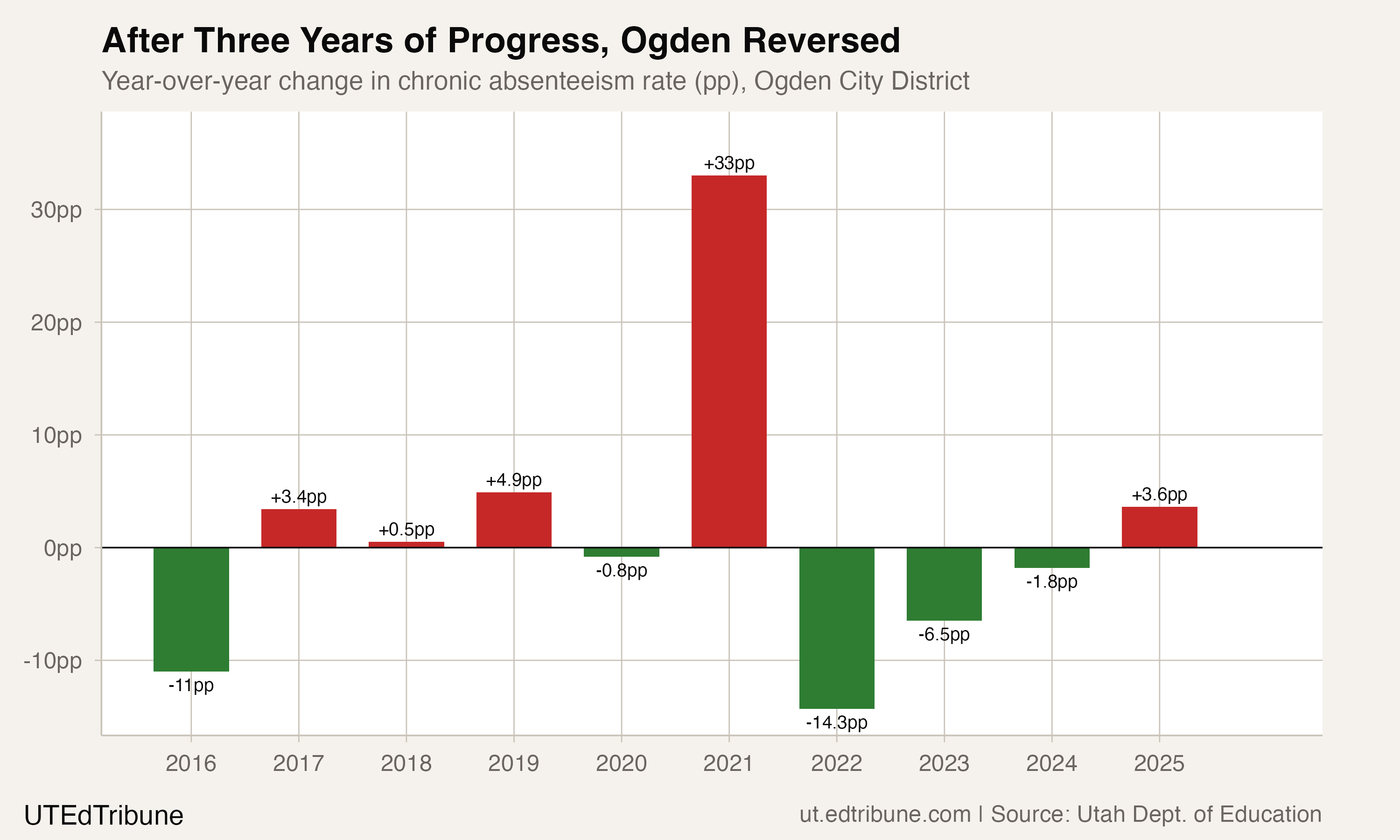
In June 2024, the Ogden City District↗ET school board voted to close Bonneville Elementary and redraw attendance boundaries for every elementary school north of 12th Street. The district was consolidating around shrinking enrollment, trying to right-size a system that has lost 1,508 students since 2019. But the students who remain are increasingly not showing up. Ogden's chronic absenteeism rate climbed to 40.0% in 2024-25, a 3.6 percentage point increase that reversed three consecutive years of improvement and left the district further from its pre-pandemic baseline than it was a year ago.
Four in ten Ogden students missed at least 10% of the school year. That rate is 10.1 points above the statewide district average of 29.9% and 13.2 points above Ogden's own 2019 rate of 26.8%. Among Utah's 41 traditional public school districts, only Uintah (50.9%) and Logan (43.7%) posted higher rates.
The spike that never fully healed
Ogden's 2021 chronic absence rate of 59.0% was among the highest in the state that year. Nearly six in ten students were chronically absent. The only districts with higher rates were small single-school entities. Among districts operating multiple schools, Ogden's spike was unmatched.
Between 2022 and 2024, Ogden clawed back 22.6 points from that peak, bringing the rate down to 36.4%. That represented 70% recovery of the 32.2-point COVID spike, a pace that would have brought the district back to baseline around 2027 or 2028. Then 2025 happened.
The 3.6-point reversal is not catastrophic in isolation. But it breaks the trajectory. At 40.0%, Ogden is now worse than it was in 2022-23 (38.2%), effectively erasing more than a full year of progress.
A district where every pressure converges
Ogden is Utah's only majority-Hispanic traditional school district, with 51.2% Hispanic enrollment. It is also one of the state's most economically disadvantaged, with 55.2% of students qualifying for free or reduced-price meals. The district's 13.7% poverty rate is about 1.5 times Weber County's 9.0%.
Those demographics place Ogden at the intersection of the risk factors most strongly associated with chronic absence nationally. Statewide USBE data for 2024-25 shows economically disadvantaged students miss school at 1.5 times the overall state rate. English learners, who overlap heavily with Ogden's Hispanic population, face a growing attendance gap that widened even as other equity gaps narrowed.
The district is also losing enrollment. Ogden has shed students every year since 2019, a 13.1% decline even as statewide enrollment grew 1.3% over the same period. That decline forced the Bonneville Elementary closure and boundary changes, which themselves can disrupt attendance patterns as families adjust to new school assignments and longer travel distances.
How Ogden compares to its urban peers
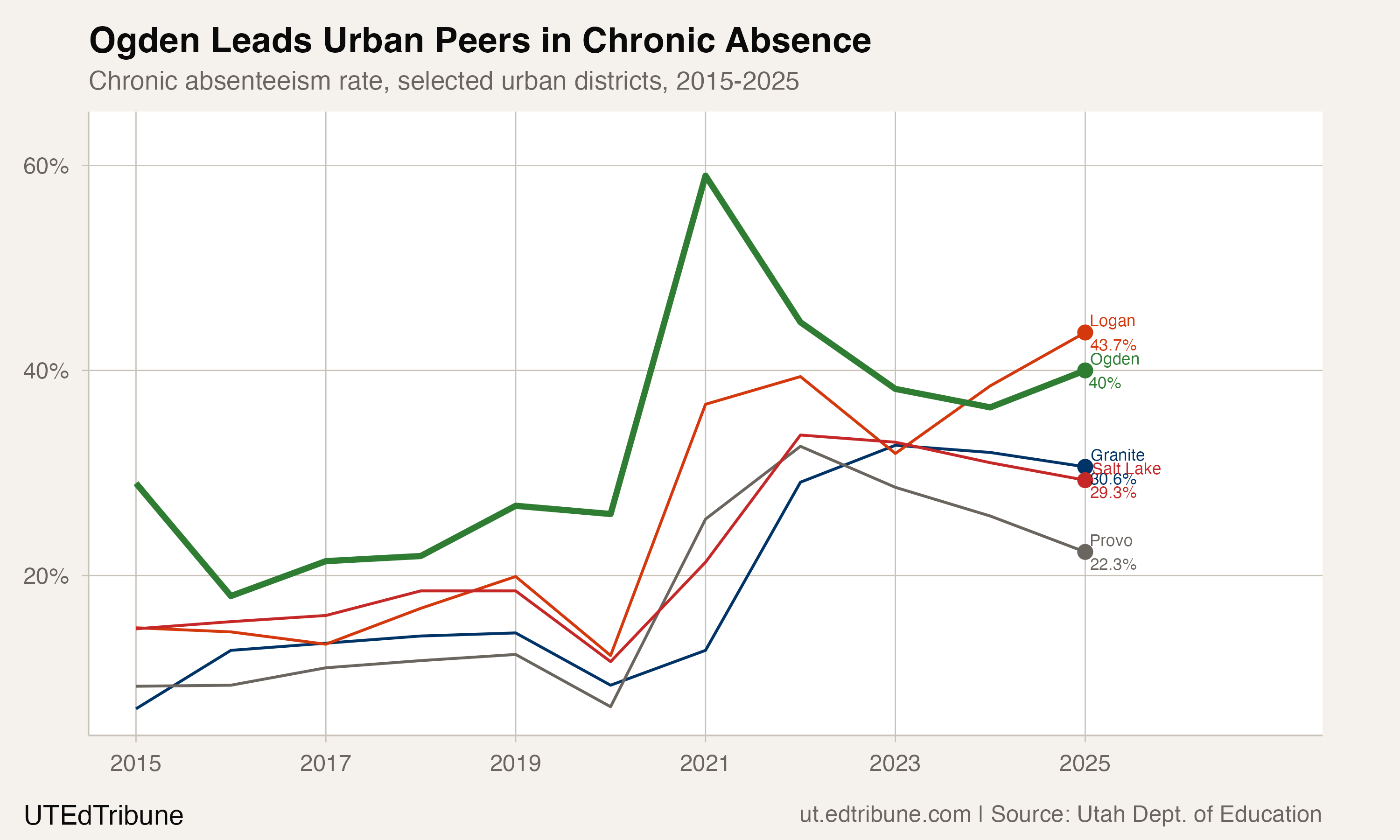
Ogden's trajectory is an outlier among Utah's urban districts. The COVID spike hit Ogden harder, and the recovery has been slower and less durable.
Provo, which spiked to 25.5% in 2021, has recovered to 22.3%, just 10.0 points above its 2019 baseline and improving. Granite District sits at 30.6%, down from its delayed peak. Salt Lake District, at 29.3%, never experienced the same acute spike Ogden did. Both have higher rates than pre-COVID but are trending in the right direction.
Logan City District is the one peer moving in the wrong direction alongside Ogden. Logan's rate climbed to 43.7% in 2025, the highest among the peer group, and it has the distinction of never recovering from COVID at all. Its 2025 rate is more than double its 2019 level of 19.9%, though the climb has not been steady.
What might explain the reversal
Ogden's 2025 setback did not happen in isolation. Fifty-three Utah districts saw their chronic absence rate worsen after at least one year of improvement. The breadth of that reversal suggests something beyond local factors.
The most direct contributor is likely the structural overlap between poverty and attendance. Utah uses Average Daily Membership for its Weighted Pupil Unit funding formula, meaning chronically absent students reduce district revenue even as the services they need grow more expensive. A district already losing enrollment and closing schools has fewer resources to deploy attendance interventions, and those interventions are competing with instructional, transportation, and facility priorities.
An alternative explanation is that the easy recoveries are over. The initial post-COVID improvements may have reflected the return of students whose absences were primarily pandemic-related: quarantines, family COVID illness, temporary disengagement. The remaining chronically absent population may be driven by deeper factors, including housing instability, family work demands, and mental health challenges, that a general "return to normal" does not resolve.
USBE launched a statewide attendance campaign in August 2025, emphasizing community partnerships to address transportation, mental health, and family-level barriers. The campaign arrived too late to affect the 2024-25 data, but it signals state-level recognition that districts like Ogden cannot solve this alone.
The revenue squeeze beneath the absence rate
In a state that funds schools through ADM, every chronically absent student represents a direct fiscal loss. Ogden's FY2026 tentative budget projects approximately $206 million in expenditures against $187 million in revenue, a structural gap of roughly $19 million that the district is bridging with fund balance drawdowns. The projected fund balance drops from $37 million at the end of FY2025 to $18.3 million at the end of FY2026.
Declining enrollment and rising absenteeism are compounding that pressure from two directions. Fewer students enrolled means fewer WPUs. Students who are enrolled but chronically absent reduce average daily membership further, shrinking the revenue base below even the headcount decline would suggest.
The district adopted the state-certified tax rate in June rather than pursuing additional local revenue through truth-in-taxation, a choice that avoids a tax increase for homeowners but does nothing to close the structural gap.
The question Ogden has not answered
The 2025 reversal puts Ogden at a decision point. Three years of organic improvement brought the rate from 59.0% to 36.4%, driven largely by the natural fade of pandemic-era disruptions. That trajectory is now broken, and the next round of improvement, if it comes, will require something the first round did not: an active intervention targeted at the population still chronically absent after the pandemic excuse evaporated.
Ogden's school board spent 2024 consolidating buildings. The question for 2025-26 is whether the district can consolidate its attendance strategy with the same urgency, in a budget environment where the fund balance is halving and every absent student makes the math worse.
Detailed code that reproduces the analysis and figures in this article is available exclusively to EdTribune subscribers.
Discussion
Sign in to join the discussion.
Loading comments...