Ogden City District↗ET holds a distinction no other traditional public school district in Utah can claim: a majority-Hispanic student body. At 51.2%, it is the only one of the state's 41 traditional districts where Hispanic students outnumber every other group. It has held that status since at least 2019.
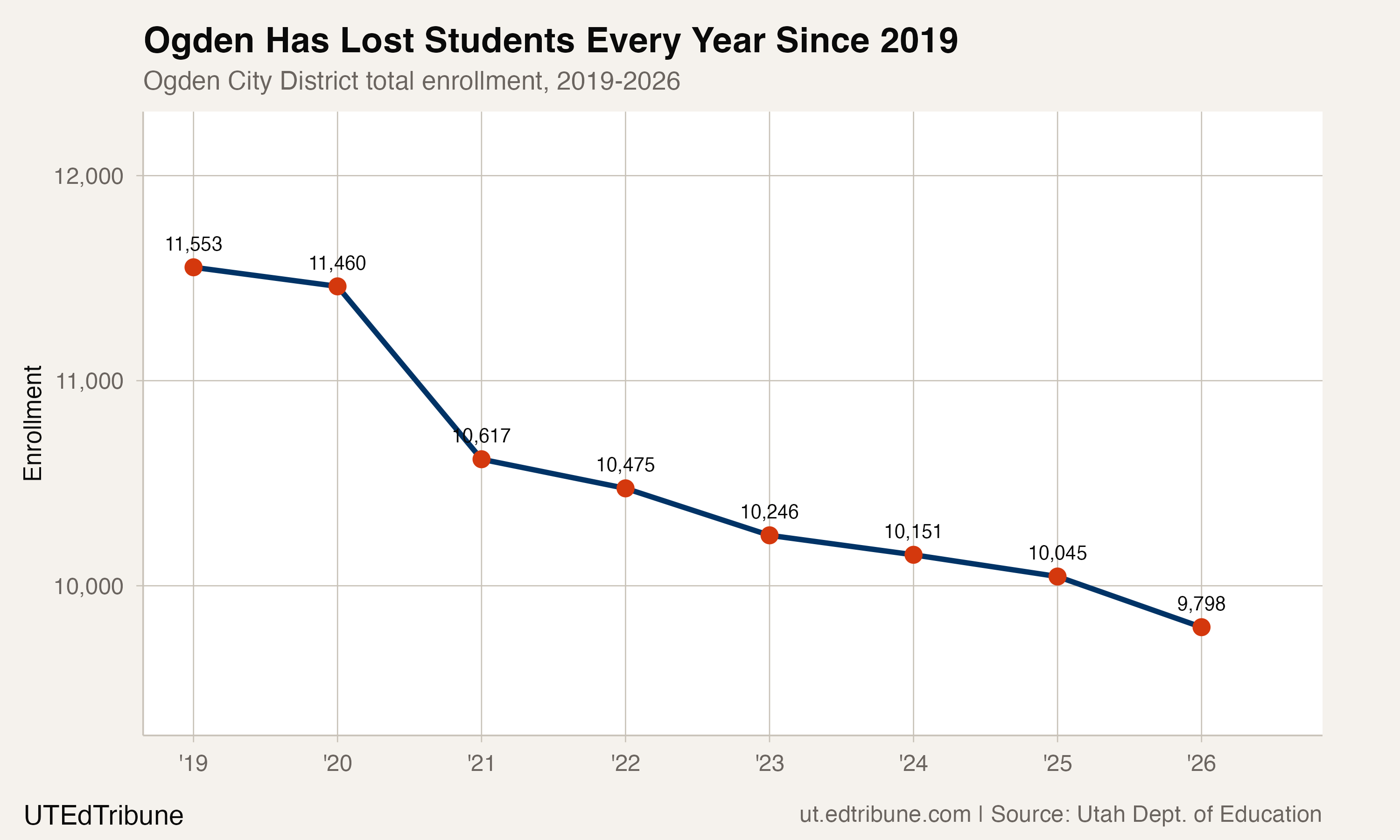
It also holds a less enviable distinction. Ogden has lost students in every single year of the data window, shedding 1,755 students, a 15.2% decline, since 2019. That rate is nearly 40 times the statewide decline of 0.4% over the same period. The 2026 loss of 247 students, a 2.5% drop, was the second-worst year outside the pandemic.
The typical story of a declining majority-minority district involves white families leaving while the minority population holds steady or grows. Ogden breaks that script. Both groups are leaving.
Seven years, no bottom
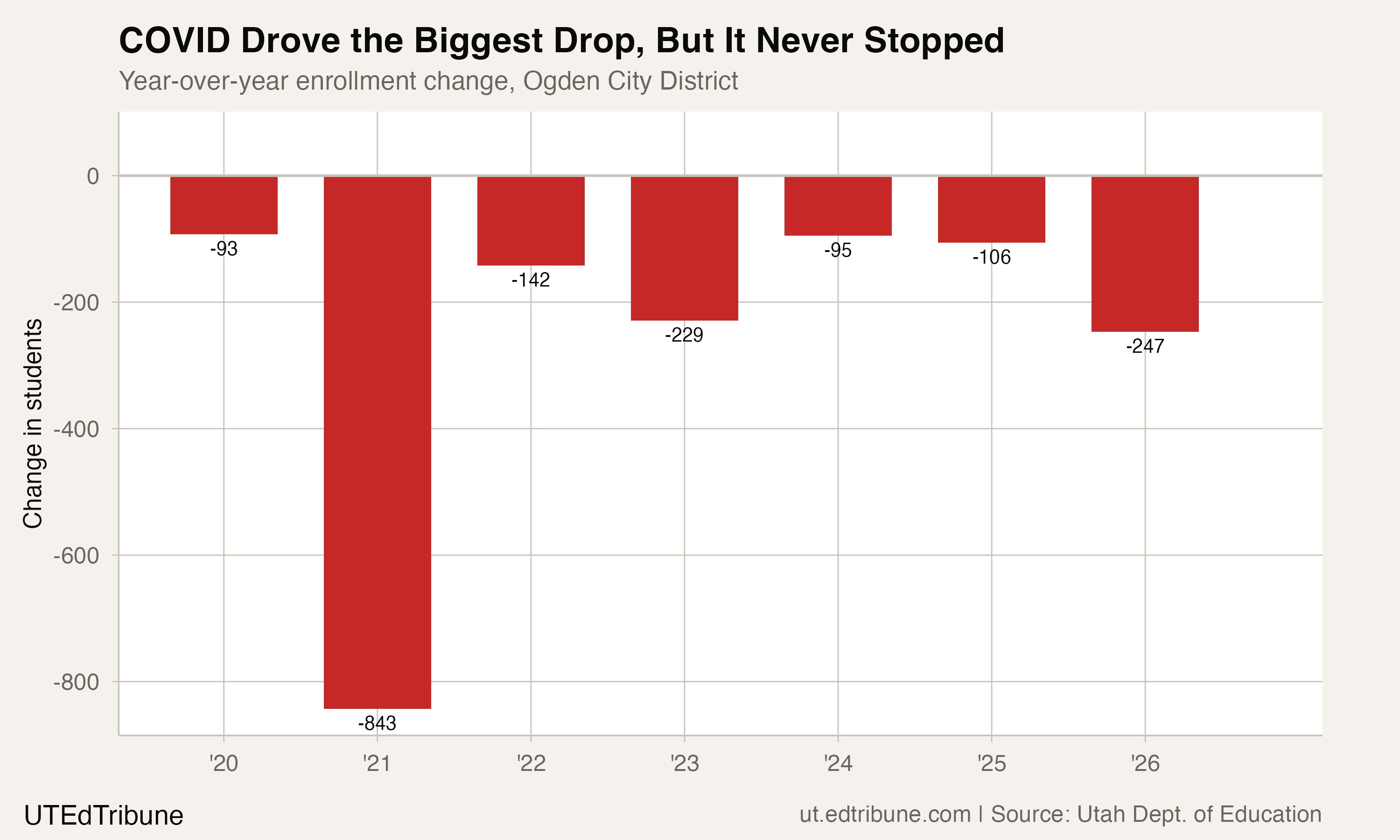
The pandemic year was catastrophic. Ogden lost 843 students in 2020-21, a 7.4% single-year drop. But four years later, the decline has not stabilized. The district shed 95 to 247 students every year after that initial hit, and the 2026 loss of 247 is the largest post-COVID annual decline yet.
Ogden shares its seven-year decline streak with three other traditional districts: Granite (-15.3%), Park City (-15.3%), and Salt Lake City (-21.2%). But Ogden's demographic profile makes its decline structurally different. Granite and Salt Lake are large, urbanizing districts where charter growth and gentrification have reshaped enrollment patterns. Park City is an affluent resort town where housing costs have pushed families out. Ogden is none of those things. It is a mid-sized, working-class district where 62.7% of students are economically disadvantaged.
A parallel exodus
The most striking feature of Ogden's enrollment loss is how evenly it is distributed across race. White enrollment dropped by 913 students (18.5%) since 2019. Hispanic enrollment dropped by 871 students (14.8%). Together, these two groups account for all but a sliver of the district's 1,755-student decline.
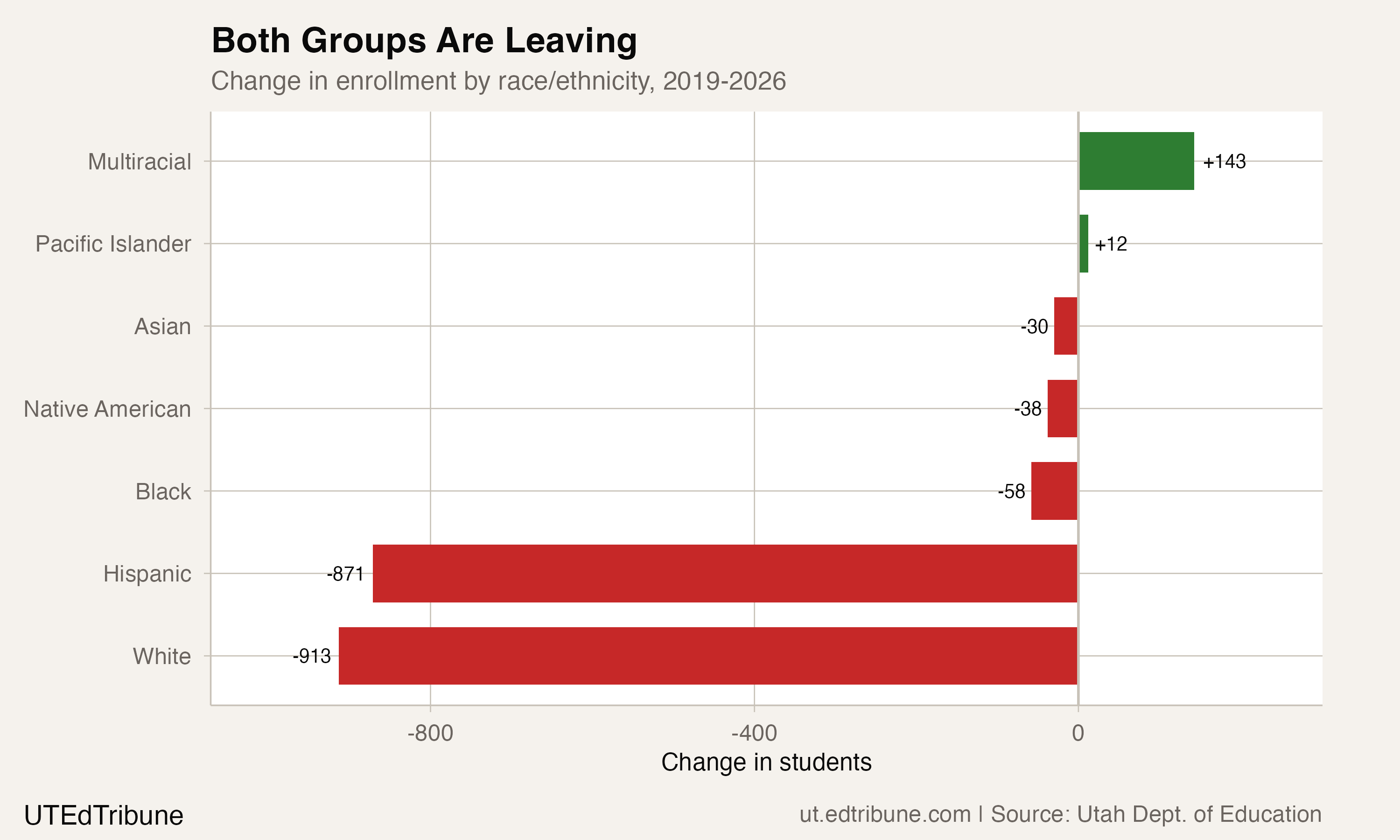
This parallel departure is unusual. In most declining districts, one demographic group drives the loss while others hold or grow. In Ogden, the only group that grew was multiracial students, up 143 (47.7%), consistent with a nationwide shift in how families report race and ethnicity rather than a net inflow.
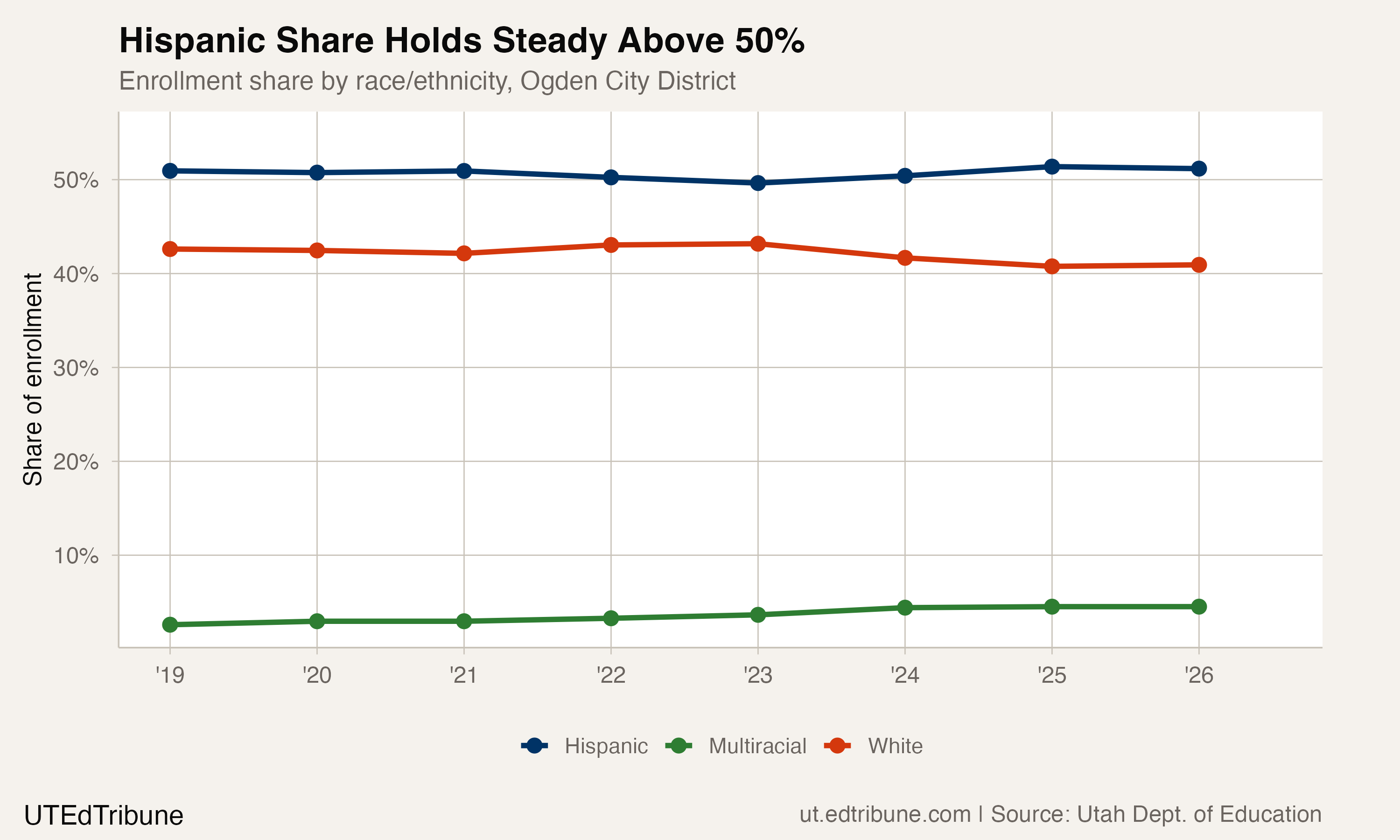
The result is a demographic composition that barely budged despite massive enrollment loss. Hispanic students were 50.9% of the district in 2019 and 51.2% in 2026. White students went from 42.6% to 40.9%. The district is losing everyone at roughly the same rate.
Fewer arriving, more graduating
The arithmetic of Ogden's decline is visible in its grade-level pipeline. In 2019, kindergarten enrollment (902) slightly exceeded grade 12 (874). By 2026, the gap had inverted: 694 kindergartners entered while 925 seniors graduated, a deficit of 231 students in a single year.
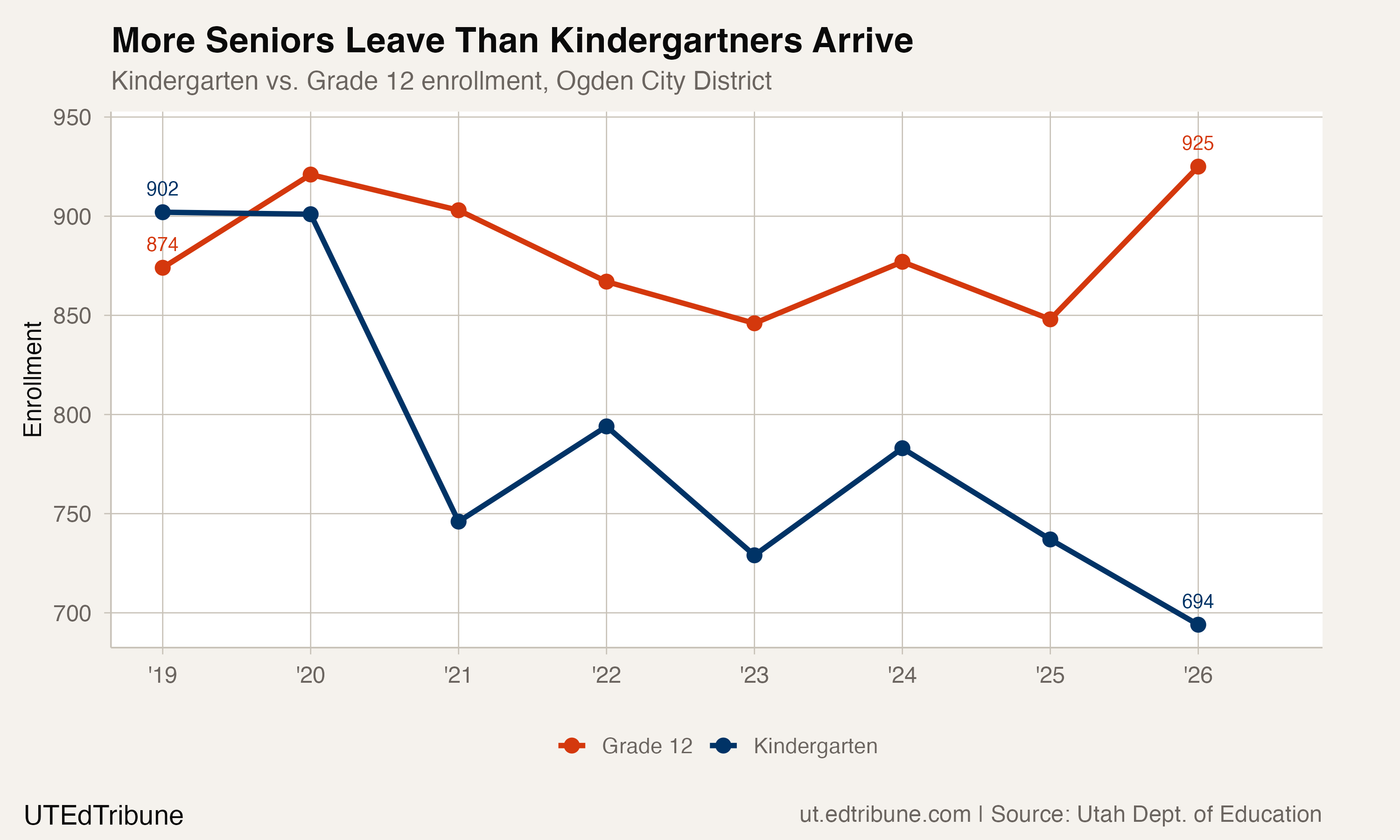
Kindergarten enrollment fell 23.1% from 2019 to 2026, tracking Utah's broader birth rate decline. The state's fertility rate dropped from among the highest in the nation to 10th by 2023, with demographer Emily Harris pointing to "economic factors such as housing and child care costs and broader social factors like postponement of marriage and childbearing." Ogden, with its higher share of lower-income families, is particularly exposed to this pipeline shrinkage.
The 2026 senior class of 925, meanwhile, was the district's largest graduating cohort in the data window. The combination guarantees continued net losses even if kindergarten stabilizes.
Housing, enforcement, and the limits of the data
Ogden's dual-group decline suggests a shared mechanism rather than one tied to any specific demographic. Rising housing costs are the most likely common driver. The Ogden-Clearfield metro area's house price index has climbed steadily, reaching 447.7 in the fourth quarter of 2025, more than quadrupling since 1995. Median sale prices in Ogden crossed $400,000 in late 2025, in a city where the median household income sits well below the state average. The city has acknowledged the pressure directly: Ogden Community Development buys, renovates, and resells homes to families earning up to 80% of area median income, a program that has operated since 1991.
For the district's Hispanic families specifically, federal immigration enforcement adds a layer of uncertainty that enrollment data cannot capture. Weber County is one of seven Utah counties that signed 287(g) agreements with ICE, including the expansive task force model that allows deputies to enforce immigration laws during routine operations. Ogden's city government has taken the opposite stance: Mayor Ben Nadolski stated the city "will not be participating in a 287(g) agreement," and Police Chief Jake Sube told the city council that the department is "not part of the 287(g) program" and "will not be a part of the 287(g) program."
"We are not part of the 287(g) program. We will not be a part of the 287(g) program." Police Chief Jake Sube, KSL, Feb. 2026
Whether this city-county split affects enrollment decisions is unknown. The data shows that Hispanic enrollment held steadier than white enrollment in the most recent year (Hispanic fell 2.9% vs. white fell 2.1% in 2026, but the longer trajectory since 2019 shows white families leaving at a slightly faster rate). The enrollment data alone cannot distinguish between families leaving because of housing costs and families leaving because of enforcement concerns.
Four schools closed, buildings rebuilt
The operational consequence of losing 1,755 students is tangible. The district has closed four elementary schools since 2019: Gramercy (2019), Taylor Canyon (2022), James Madison (2023), and Bonneville (2025). The number of elementary facilities dropped from 14 to 10.
"We've been closing older, less safe, less secure, less comfortable, smaller schools and replacing them with schools that are safer, more secure, more comfortable, more capable and also larger." Jer Bates, Ogden School District spokesman, KSL, Jan. 2025
The district used an $87 million bond approved in 2018 to rebuild Polk, Liberty, East Ridge, and Wasatch elementary schools and construct the new $52.7 million Hillcrest Elementary. The strategy is consolidation by design: fewer buildings, each serving a larger attendance zone, each newer and better equipped.
A 2021 consultant's study projects Ogden enrollment falling to 9,056 by 2031. At its current trajectory, 100 to 250 students lost per year, the district is roughly on pace.
Separately, the service burden is growing
While total enrollment declined 15.2%, special education enrollment went the other direction. The number of students receiving special education services fell from 1,452 to 1,414, a modest absolute decline, but as a share of a shrinking student body, it rose from 12.6% to 14.4%. That 1.8 percentage-point increase over seven years reflects a structural mismatch: the students whose instructional programs carry higher per-pupil costs are representing a growing share of a district with fewer students to spread fixed costs across.
English learner enrollment, which overlaps heavily with the Hispanic student population, held remarkably stable at roughly 18.7% to 19.8% of the student body throughout the window, even as Hispanic enrollment fell by 871 students in absolute terms.
What to watch
The 2026 kindergarten class of 694 is the smallest in the data window, and the pipeline gap of 231 students between entry and exit grades means Ogden will lose students in 2027 even if not a single family moves out of the district.
Around 100 to 250 Ogden High School students walked out in February 2026 to protest federal immigration enforcement, on the same day city council members drafted a resolution to formalize the city's non-cooperation with ICE. Police Chief Jake Sube stood before the council and said the department would not participate in 287(g). The enrollment numbers will eventually register what that walkout already showed: for families in Utah's only majority-Hispanic district, staying is no longer just about affording the rent.
Detailed code that reproduces the analysis and figures in this article is available exclusively to EdTribune subscribers.
Discussion
Sign in to join the discussion.
Loading comments...