Granite District↗ET is a single school system. It has one superintendent, one school board, one budget, one set of policies. It spans the Salt Lake Valley from the affluent east bench to the working-class west side, and within that geography it contains two fundamentally different realities for graduating high school.
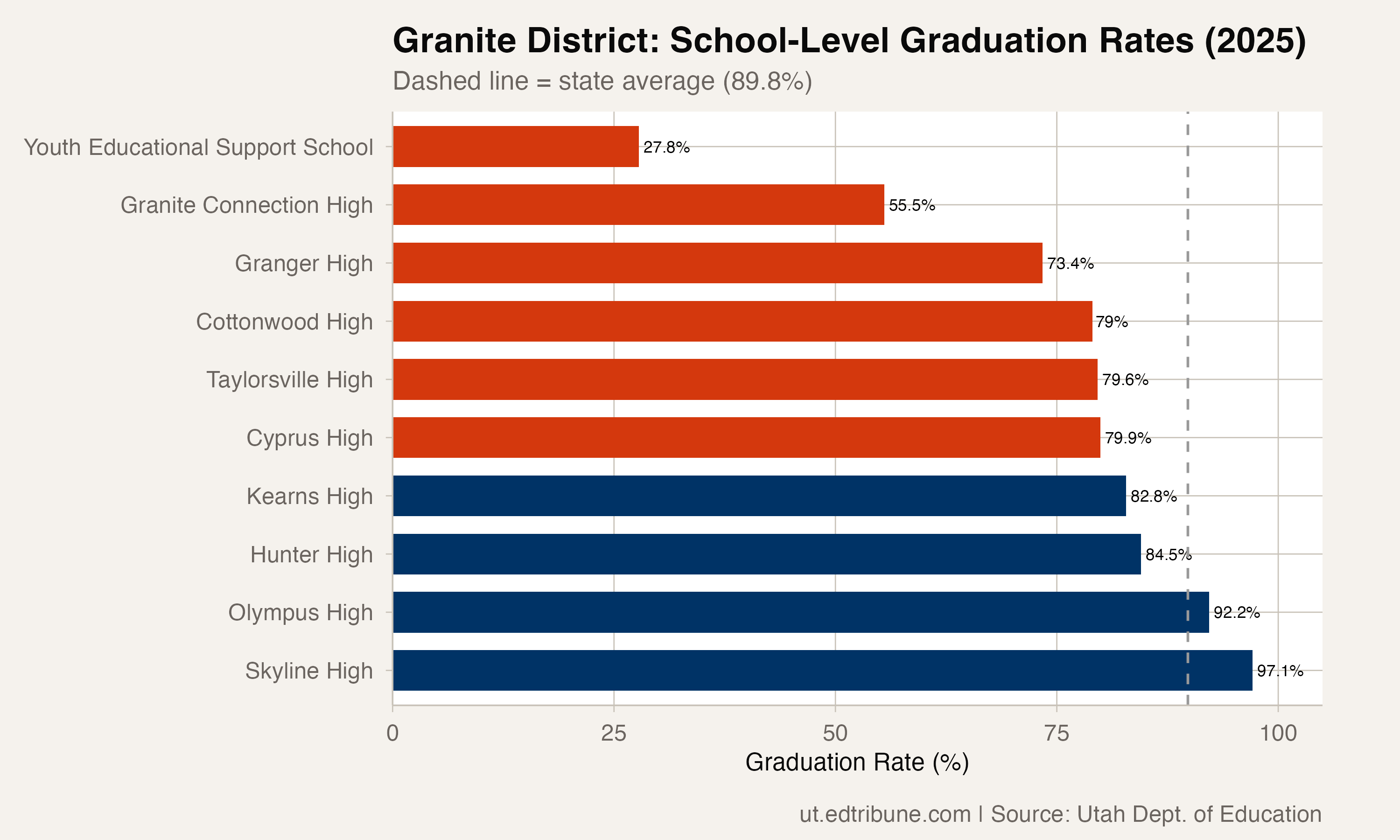
At Skyline High, on the eastern edge of Millcreek, 97.1% of the Class of 2025 graduated. Seven miles west, at Granger High in West Valley City, the rate was 73.4%. The 23.7 percentage point gap between two traditional high schools in the same district is larger than the gap between the highest- and lowest-performing states in the country.
The full spread
Including the district's alternative and non-traditional programs, the range stretches even wider. Youth Educational Support School, which serves students with significant behavioral and academic challenges, graduates 27.8%. Granite Connection High, an online and credit-recovery program, hits 55.5%.
Among the eight traditional high schools, the distribution is bimodal. On one side: Skyline (97.1%), Olympus (92.2%), Hunter (84.5%), and Kearns (82.8%). On the other: Cyprus (79.9%), Taylorsville (79.6%), Cottonwood (79%), and Granger (73.4%).
The dividing line runs roughly along the I-15 corridor. East-side schools serve communities with higher incomes, more stable housing, and greater access to private tutoring and college prep. West-side schools serve immigrant families, refugees, and communities where parents often work multiple hourly jobs.
A district improving unevenly
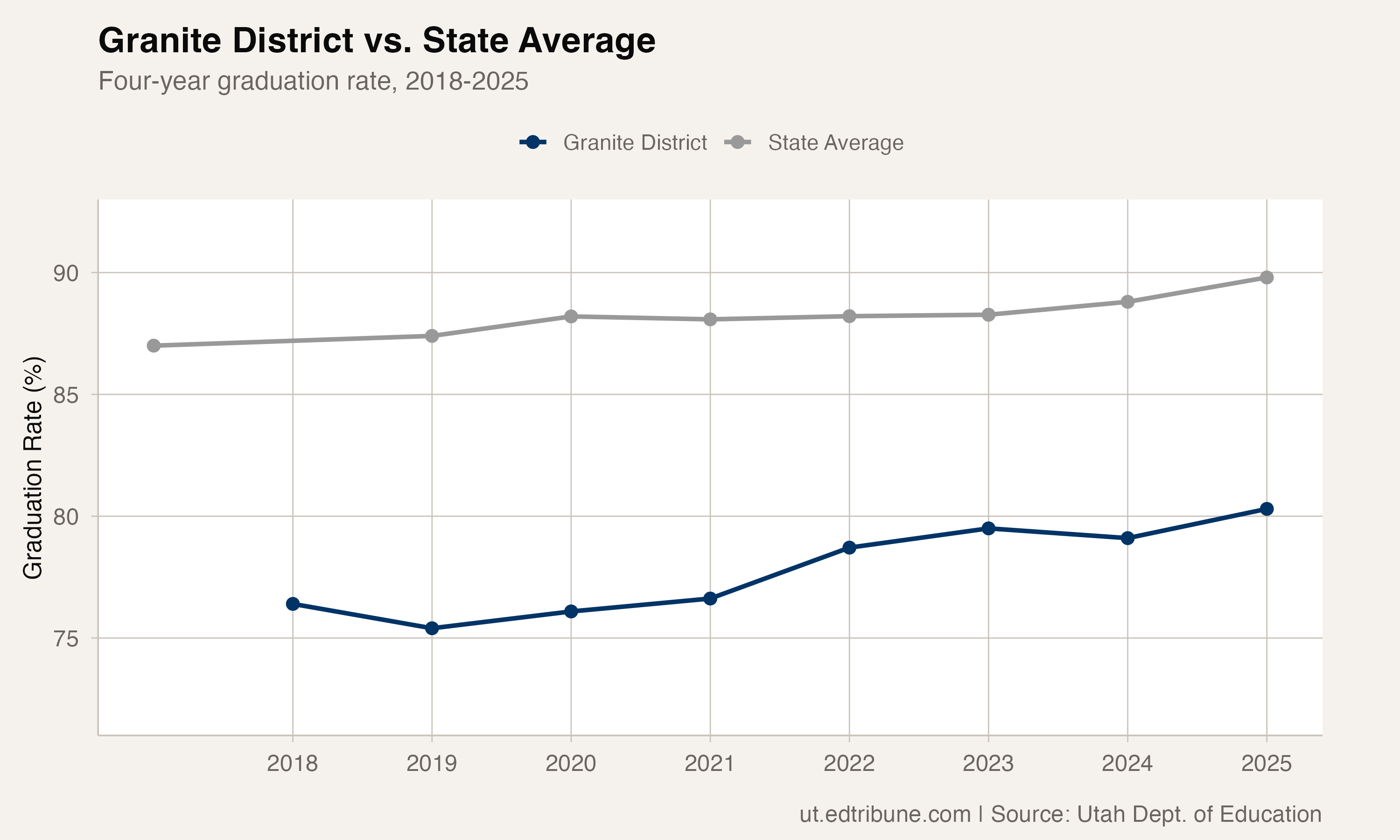
Granite as a whole has been improving. The district rate climbed from 75.4% in 2019 to 80.3% in 2025, a 4.9 point gain that pushed it above 80% for the first time.
But the improvement hasn't reached all schools equally. Skyline has been above 91% for every year in the data. Granger, by contrast, peaked at 80.8% in 2019 and has since fallen to 73.4%, a 7.4 point decline while the district around it was improving.
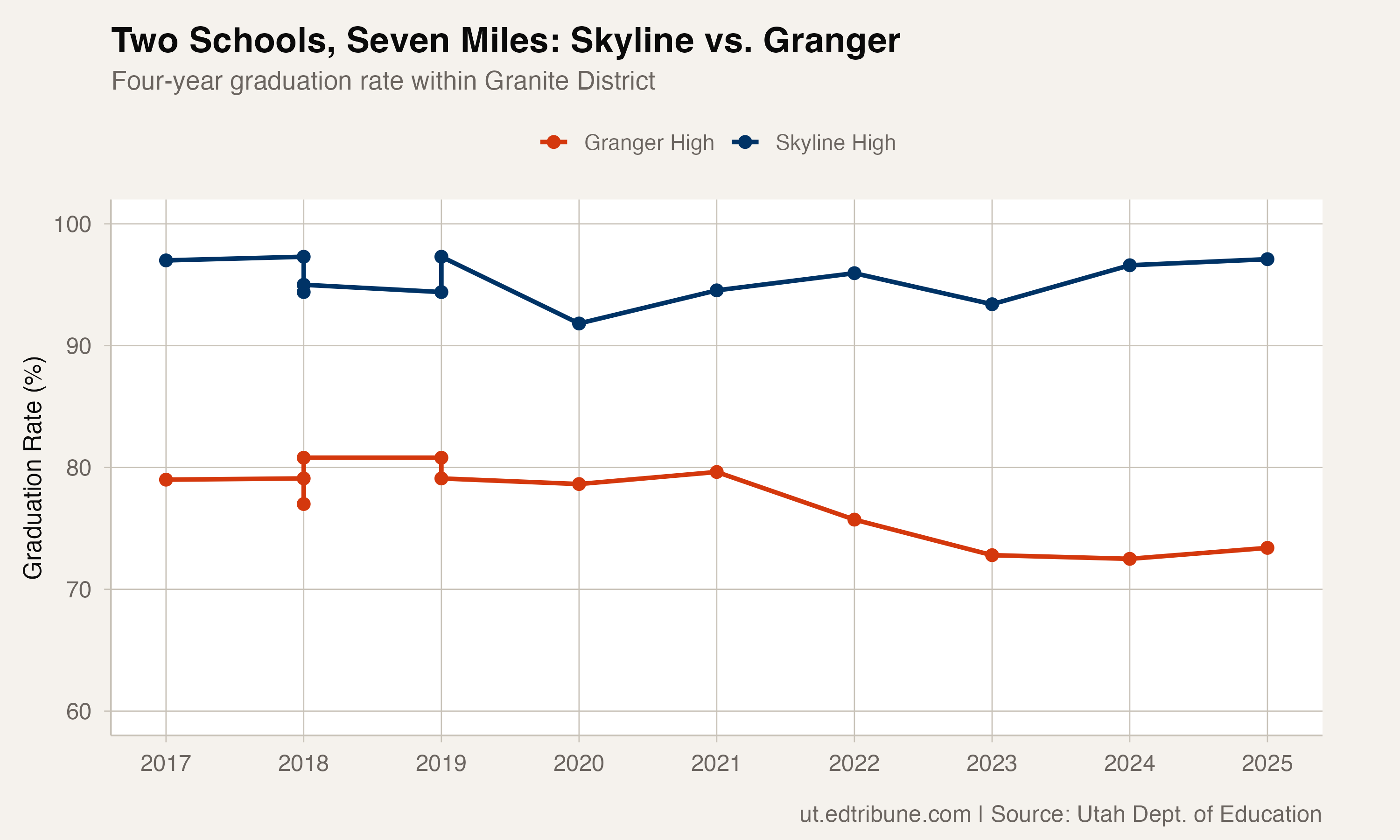
The divergence is getting worse. In 2019, the Skyline-Granger gap was 13.6 points. By 2025, it had widened to 23.7. Whatever the district is doing to push its overall rate up, the benefits are concentrated in schools that were already performing well.
What the gap reflects
Within-district graduation gaps are common across the country. They generally track poverty rates, racial demographics, and English learner concentrations. Granite is no exception.
Granger High sits in a community where more than 60% of residents speak a language other than English at home, according to Census data. The school serves large Tongan, Mexican, and Guatemalan communities. Skyline serves the Holladay and Millcreek neighborhoods where median household income is roughly double that of West Valley City.
But acknowledging that the gap reflects community demographics doesn't absolve the district of responsibility for it. The whole premise of public education is that where you live shouldn't determine your odds of graduating. In Granite District, it very clearly does.
The 80.3% average
The district's 80.3% rate sits 9.5 points below the state average of 89.8%. Only Salt Lake District↗ET (77.4%) performs worse among Utah's major districts. Davis District↗ET, up the highway in Farmington, graduates 93.6%. Alpine District↗ET in Utah County manages 92.7%.
Granite's overall number conceals as much as it reveals. For a Skyline family, the district is excellent. For a Granger family, it's struggling. The 80.3% average is an abstraction that describes neither school's reality.
The question for Granite's leadership is whether the district's improvement plan can reach beyond the schools that were already doing well. Climbing from 75% to 80% is meaningful. But if the gap between the best and worst schools continues to widen, the overall number becomes less and less meaningful as a measure of the district's actual performance.
Data from the Utah State Board of Education. Four-year adjusted cohort graduation rates, 2018-2025.
Detailed code that reproduces the analysis and figures in this article is available exclusively to EdTribune subscribers.
Discussion
Sign in to join the discussion.
Loading comments...