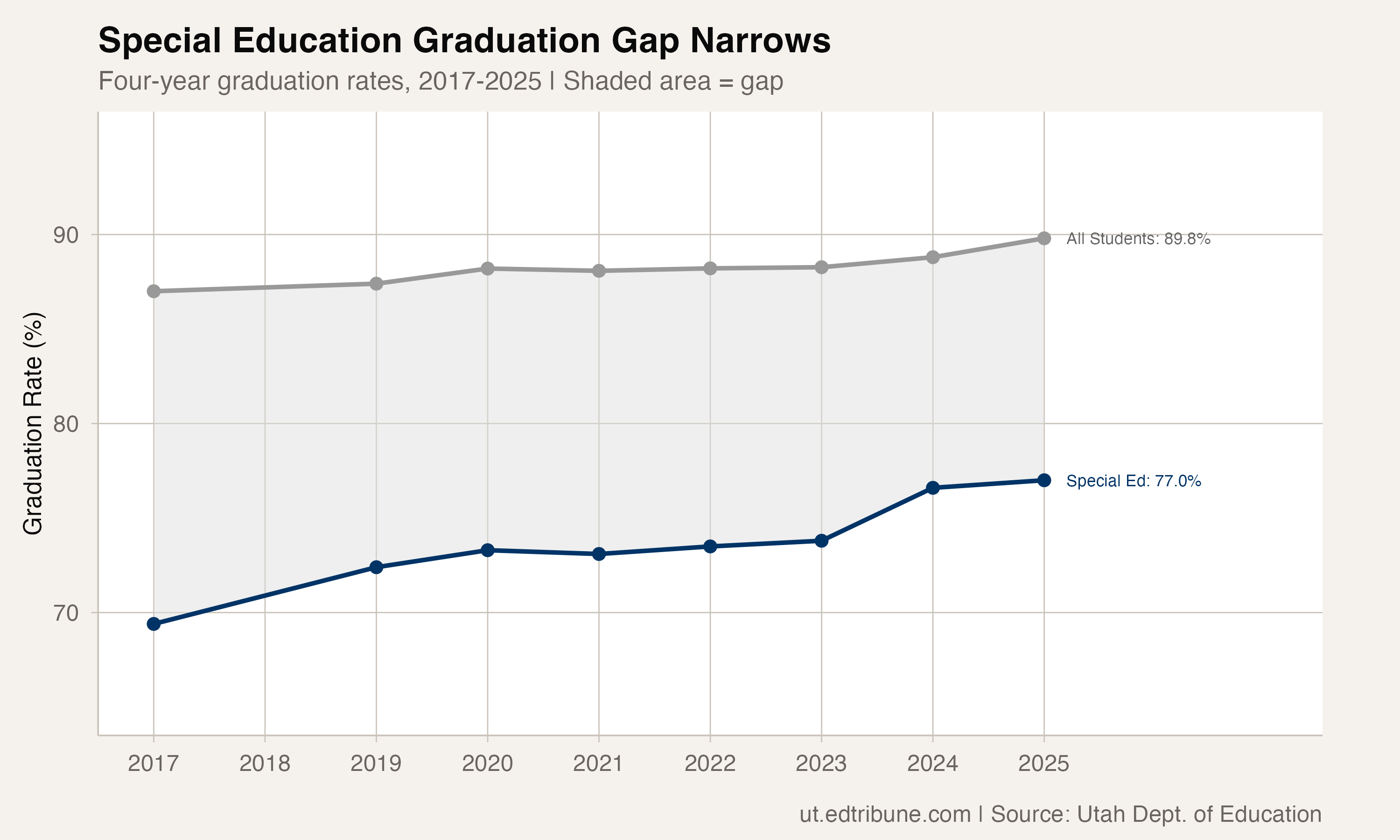
In 2017, the gap between Utah's overall graduation rate and its special education rate was 17.6 percentage points. The state graduated 87% of all students and 69.4% of those with disabilities -- a difference that meant special education students were roughly three times as likely to not graduate on time.
By 2025, that gap has narrowed to 12.8 points. Special education students now graduate at 77%, up 7.6 points over eight years. The improvement is meaningful and, at its current pace, could bring the gap below 10 points within the next few years.
But the rate also means that nearly one in four special education students still isn't earning a diploma within four years. Whether that's a failure of the system or an inherent challenge of serving students with significant disabilities depends on how you think about the purpose of a four-year timeline.
A long plateau, then a jump
The improvement wasn't steady. Special education rates barely moved from 2019 through 2023 -- hovering between 72.4% and 73.8% for five years. Then came 2024, when the rate jumped 2.8 points to 76.6%, followed by a smaller 0.4-point gain to 77% in 2025.
The five-year plateau is hard to explain. During that same period, other lagging subgroups -- Black students, English learners -- were posting annual gains. Special education rates stayed flat while the rest of the state improved, which actually widened the gap slightly before the 2024 surge closed it again.
The delayed improvement may reflect the longer lead time that systemic changes take for special education students. A new reading intervention or counseling program might show results for general education students within a year but take two or three years to work through IEP processes, staff training, and implementation at scale.
Where special education fits in the equity picture
Special education students have the largest graduation gap of any subgroup in Utah -- 12.8 points below the state average. English learners are next at 10.3 points, followed by economically disadvantaged students at 10 points.
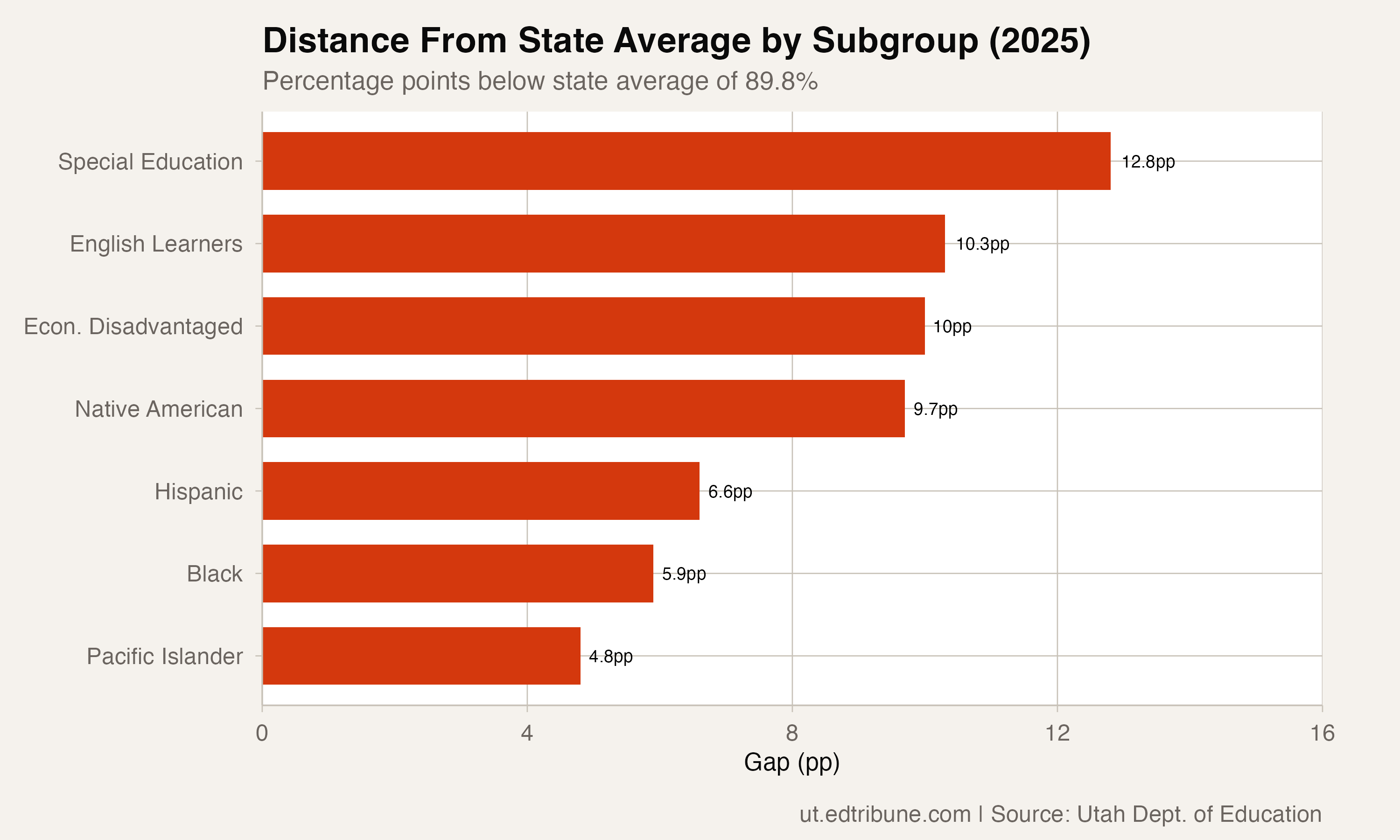
The ordering matters. Special education is the only subgroup where the gap has a structural component that can't simply be trained or funded away. Some students with significant cognitive, physical, or behavioral disabilities will not complete a standard academic program in four years regardless of how much support they receive. The question is how many of those students eventually graduate with additional time.
Utah doesn't publish a five-year extended graduation rate, which makes it impossible to know how many of the 23% who don't graduate in four years eventually do. National data suggests that roughly half of non-graduating special education students earn a diploma within five or six years. If Utah follows that pattern, the effective completion rate for special education students could be closer to 88%.
The gap trajectory
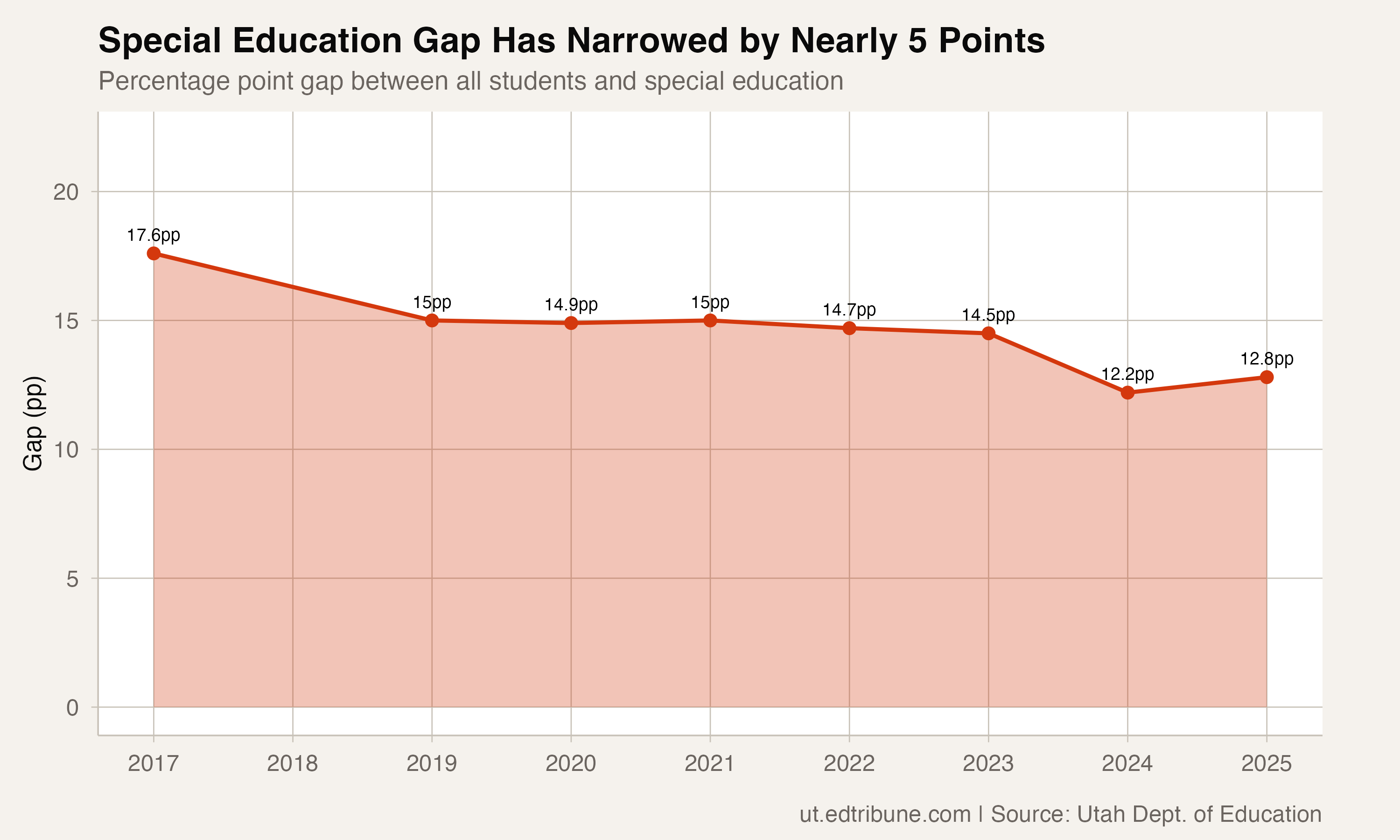
The gap peaked at 17.6 points in 2017, narrowed to about 14.5-15 points through 2023, then dropped sharply to 12.2 points in 2024 before widening slightly to 12.8 in 2025. The 2025 increase happened because the overall state rate jumped a full point while special education gained only 0.4 points -- a reminder that gap closure requires the lagging group to improve faster, not just improve.
Over the full eight-year window, the gap has narrowed by 4.8 points. That's a pace of about 0.6 points per year. At that rate, the gap would reach single digits around 2030 -- assuming both groups continue improving.
The funding question
Special education services are expensive. Every student with an IEP receives individualized instruction, often with dedicated aides, therapists, and modified curricula. Utah's special education population has been growing -- both in absolute numbers and as a share of total enrollment. More students receiving services means more resources required to maintain, let alone improve, outcomes.
The 77% graduation rate represents real progress by real educators working with students who face genuine challenges. The remaining gap to the state average is partly irreducible and partly a function of how much a state is willing to invest in the students who need the most support.
Utah's trajectory suggests the investment is paying off, if slowly. The question is whether the state can sustain the kind of concentrated improvement that produced the 2024 jump, or whether the rate settles back into the slow plateaus that characterized most of the data series.
Data from the Utah State Board of Education. Four-year adjusted cohort graduation rates, 2017-2025.
Detailed code that reproduces the analysis and figures in this article is available exclusively to EdTribune subscribers.
Discussion
Sign in to join the discussion.
Loading comments...