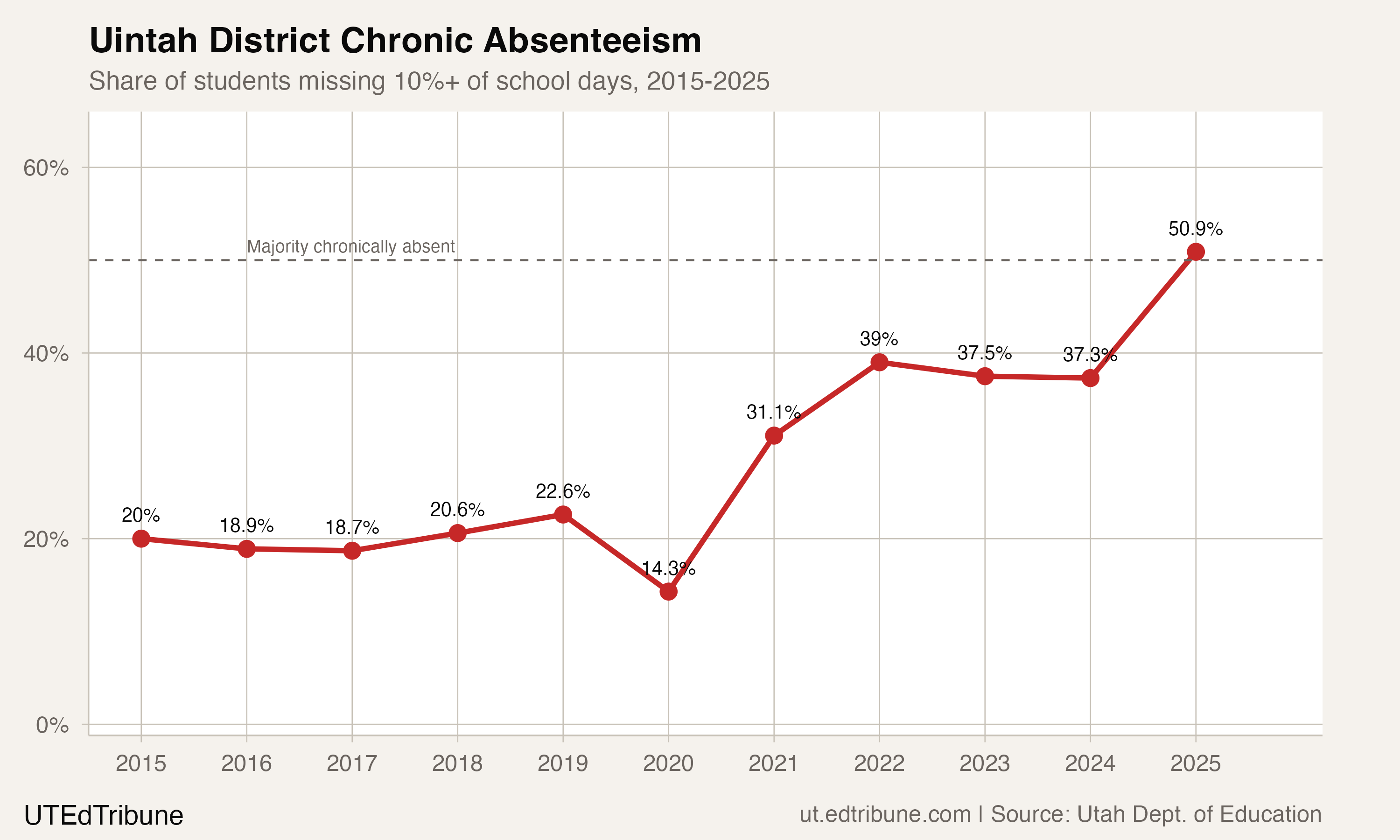
In a district of about 6,500 students spread across the high desert of northeastern Utah, more are now absent than present. Uintah District↗ET recorded a 50.9% chronic absenteeism rate in the 2024-25 school year, a 13.6 percentage point surge from 37.3% the year before. It is the only traditional public school district in Utah where a majority of students miss 10% or more of the school year.
The number is not a gradual erosion. Before the pandemic, Uintah's rate hovered around 20%. It is now 2.5 times that level, and the gap between Uintah and the typical Utah district has widened from six percentage points to 23.
The Basin and the reservation
Uintah District sits in the Uintah Basin, a remote stretch of energy country east of the Wasatch Range. The district shares geography and students with the Uintah and Ouray Reservation, the second-largest reservation in the United States. About 700 Ute students attend K-12 schools across Uintah and neighboring Duchesne District↗ET, according to Salt Lake Tribune reporting.
The attendance crisis landed hardest in Uintah, not Duchesne. Both districts tracked together through 2019, with chronic rates in the low 20s. Both dropped during Utah's largely in-person 2020 school year, then surged in 2021 when the pandemic attendance wave finally hit. But starting in 2023, their paths split. Duchesne stabilized around 31%. Uintah kept climbing.
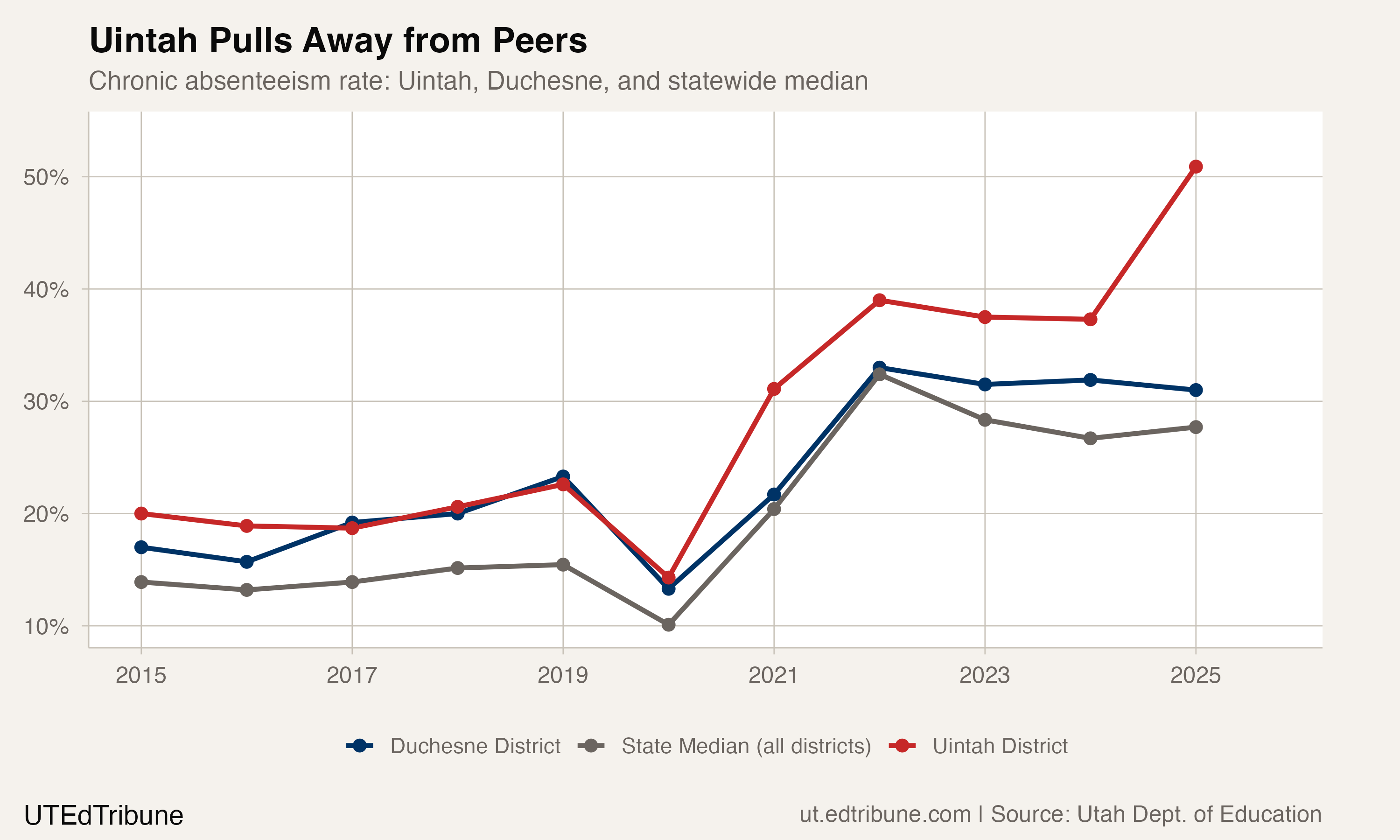
That divergence is the central puzzle. Two districts in the same basin, drawing from overlapping communities, facing the same oil-field economy and the same pandemic aftershocks. One plateaued. The other is in freefall.
A 13.6-point year
The 2025 surge was not a continuation of a trend. It was an acceleration. Uintah's chronic rate had been essentially flat from 2022 to 2024, hovering between 37% and 39%. Then it jumped 13.6 percentage points in a single year, the largest year-over-year increase in the district's 11-year data history and second only to the 16.8-point COVID spike in 2021.
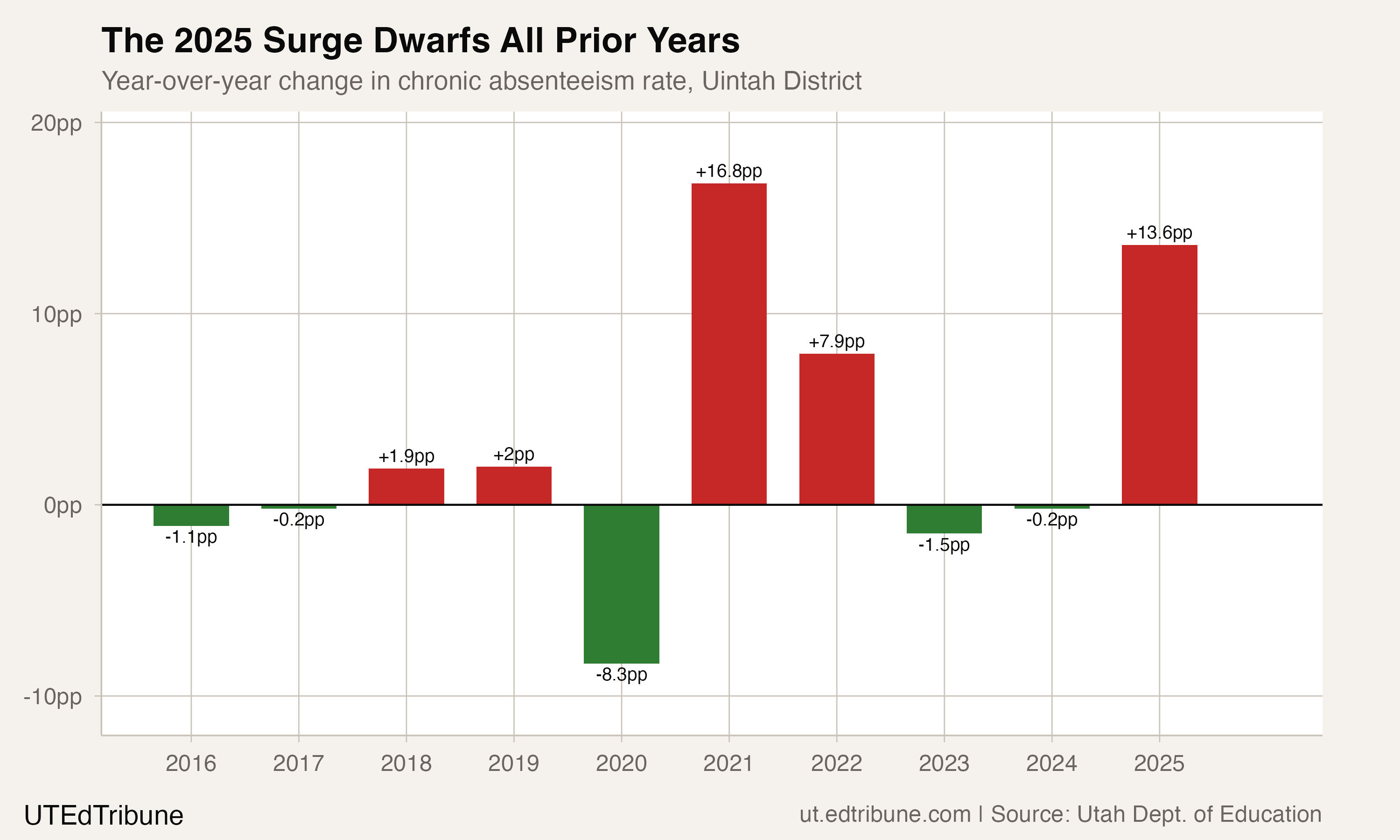
For context, Uintah's one-year surge exceeds the total chronic absenteeism rate of many suburban districts along the Wasatch Front. Wasatch District, roughly 90 miles southwest, has a rate of 14.5%.
What the statewide data shows
Utah's overall chronic absenteeism rate held steady at 23.8% in 2024-25, unchanged from the prior year. The statewide picture masks sharp differences by race and income.
Native American students face the second-highest chronic absence rate of any subgroup in Utah at 39.8%, trailing only Pacific Islander students at 45.0%. Both rates sit well above the state average. Economically disadvantaged students, English learners, and Hispanic students all exceed 33%.
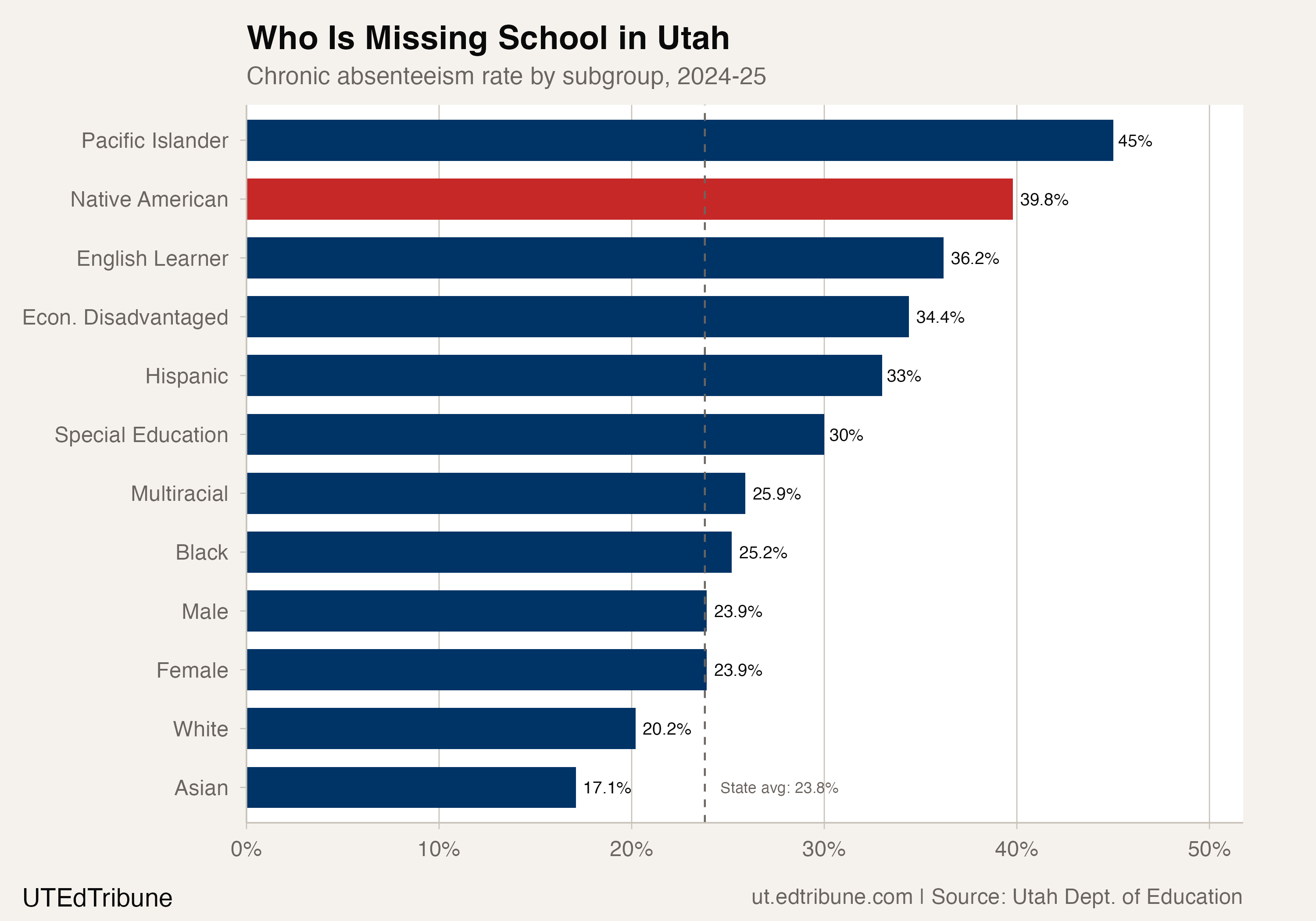
The 39.8% statewide Native American rate is itself a statewide figure. In Uintah County, where the reservation anchors the economy and culture, the county-level chronic rate is 49.4%, the highest of any county in Utah.
An education system that "will continue to fail"
The attendance data sits inside a broader pattern of educational failure for Ute students that tribal leaders have documented for years. In Uintah District, only 10% of Ute students scored proficient in reading in 2023, and fewer than 8% hit grade level in math. Graduation rates for Ute students in the district fell from 65% to below 59% between 2022 and 2023, while white students graduated at roughly 88%.
The Ute Indian Tribe built its own answer. In 1998, the tribe's Business Committee opened Uintah River High School in Fort Duchesne, a charter serving about 75 students, 83% of them Ute. The school weaves Ute language, looming, beading, and Native American studies into its curriculum.
"They were troubled kids, according to the school districts. But here, they graduate and excel." -- Former Ute tribal chair Shaun Chapoose, Salt Lake Tribune
Uintah River High's five-year graduation rate averages about 85%, with fewer than 5% of students dropping out annually, roughly half the dropout rate for Ute students in the public districts. But the school's chronic absence rate under the state's 10% metric is 79.3% in 2025. The paradox of a school that graduates most of its students while recording one of the highest absence rates in Utah suggests that the state's metric may not capture what is actually happening inside its walls, or that culturally responsive education can produce outcomes even when attendance, as measured by the state, is poor.
What is driving this
No single mechanism explains a 13.6-point one-year jump. Several forces are plausible, though none has been definitively linked to Uintah's 2025 surge.
The oil economy is the most distinctive feature of the Basin. Eighty-five percent of Utah's petroleum production occurs in Duchesne and Uintah counties, and the industry's boom-bust cycles create the kind of family instability that attendance research consistently links to chronic absence: shift work, transient employment, housing disruption. Duchesne County is among the most energy-dependent counties in the nation. But oil prices in the Basin do not explain why Uintah surged and Duchesne did not.
Mental health and school refusal are growing factors statewide. But a statewide toolkit of posters and attendance ambassadors does not obviously address the specific conditions on the reservation: geographic isolation, intergenerational trauma, and a school system that tribal leaders say fails to reflect Ute culture.
Transportation across the reservation may compound the problem. The Uintah and Ouray Reservation covers 4.5 million acres across three Utah counties. Students who live on the reservation may face hour-long bus rides to attend district schools, a barrier that grows in winter when Basin roads become treacherous.
A state that never had a plan
Utah had never had a formal strategy for supporting Native American students. That changed on paper with HB 75, sponsored by Rep. Christine Watkins (R-Price), which passed in the 2026 session and requires the Utah State Board of Education to adopt a statewide education plan for Indigenous students by January 2027.
"For decades, data has shown that Native American students are the demographic most likely to be left behind in Utah's classrooms. They are the students most likely to fail year-end tests and the least likely to read on grade level, the least likely to graduate and the most likely to drop out of high school. But despite knowing there's a problem, the state has never had a plan to intervene and help." -- Salt Lake Tribune, February 2026
Separately, HB 106 would have required USBE to collect and publish school-level chronic absenteeism data statewide, including root-cause analysis. A January 2026 committee hearing left the bill on hold for modifications.
Neither bill is specifically about Uintah District. But Uintah is the clearest case for why both are needed. The district where a majority of students are chronically absent is also the district at the center of the reservation where Native students score in single digits on proficiency tests and the state, until this year, had no plan at all.
The question facing the 2027 deadline is whether a plan will look different from a campaign. The Ute Tribe already has evidence of what works: a 75-student charter school that graduates students the public system loses. Whether the state's first-ever strategy for Native students will learn from that example, or produce another round of toolkits, may determine whether Uintah's rate is still above 50% when the next data arrives.
Detailed code that reproduces the analysis and figures in this article is available exclusively to EdTribune subscribers.
Discussion
Sign in to join the discussion.
Loading comments...