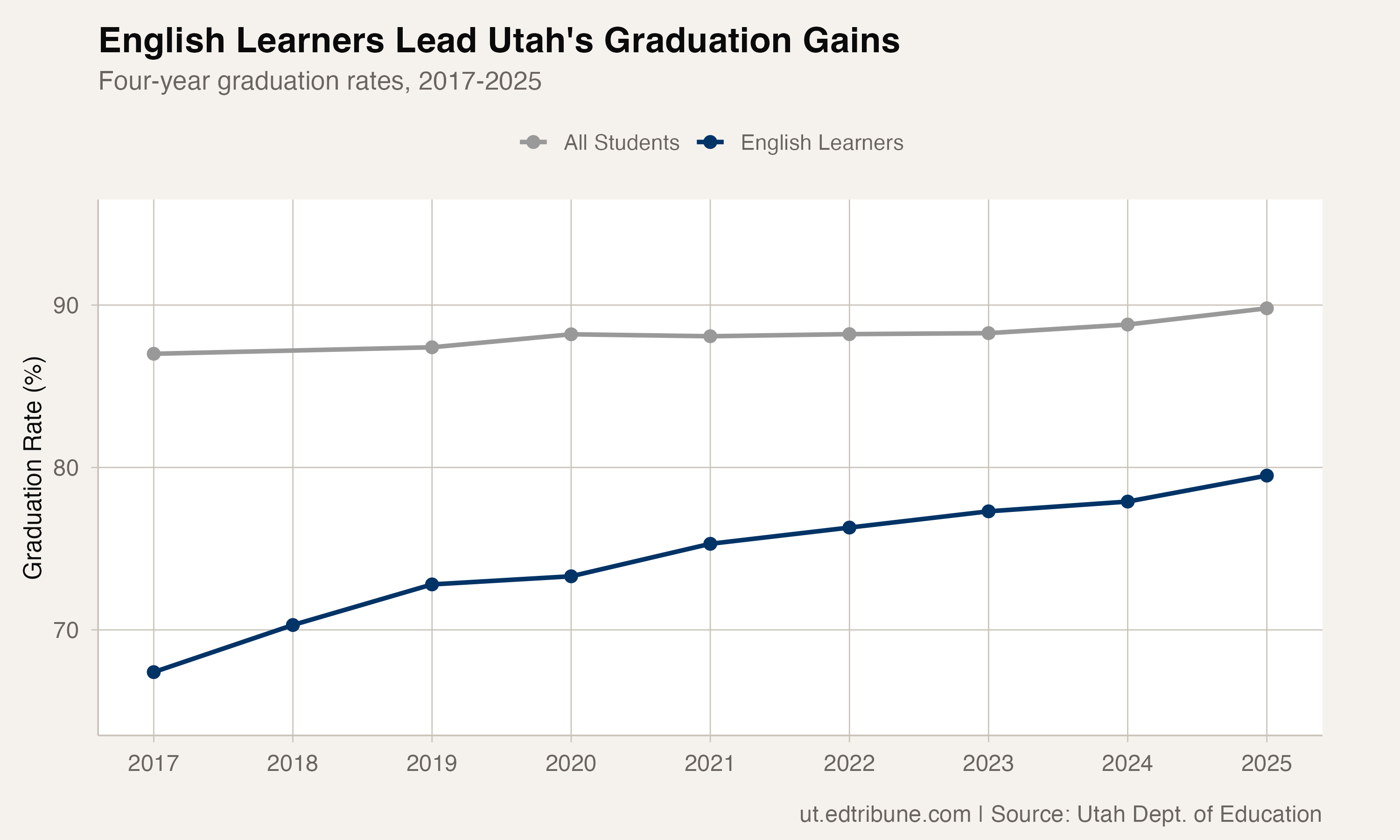
In 2017, barely two out of three students who are English learners in Utah earned a diploma within four years. Their graduation rate sat at 67.4%, a full 19.6 percentage points below the state average. It was the widest gap of any student subgroup in Utah.
Eight years later, that rate has climbed to 79.5%, a 12.1 percentage point improvement that makes students who are English learners the fastest-improving group in the state. The gap with the state average has shrunk from 19.6 points to 10.3 points, roughly halved.
Year after year
What separates the multilingual learner story from other subgroup gains is its consistency. Every year since 2017 has been an improvement: 2.9 points, 2.5, 0.5, 2.0, 1.0, 1.0, 0.6, and 1.6. Even the pandemic year of 2020, when many metrics dipped, saw a modest 0.5 point gain rather than a decline.
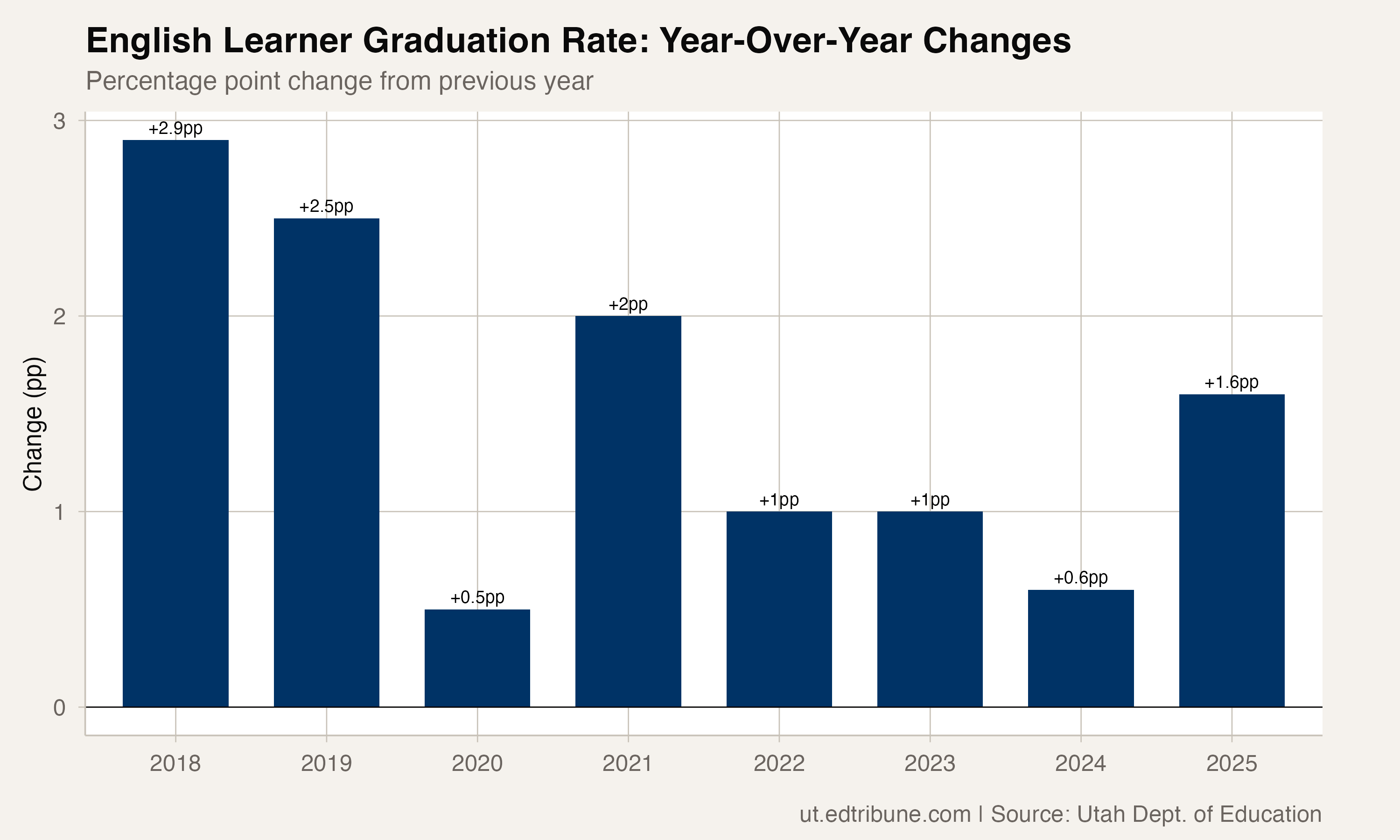
An unbroken improvement streak like this is rare in education data. It suggests sustained investment and structural changes to how schools serve students who are learning English, rather than a one-time program launch.
The Utah State Board of Education credits mentoring programs and family engagement initiatives. Whatever the specific mechanisms, the results have compounded: a 2-point gain one year becomes the new baseline for the next, and each increment stacks on top of what came before.
Still behind
The improvement is real and substantial. But at 79.5%, roughly one in five students who are English learners still doesn't graduate within four years, and the gap with the state average, while much smaller than it was, remains 10.3 percentage points.
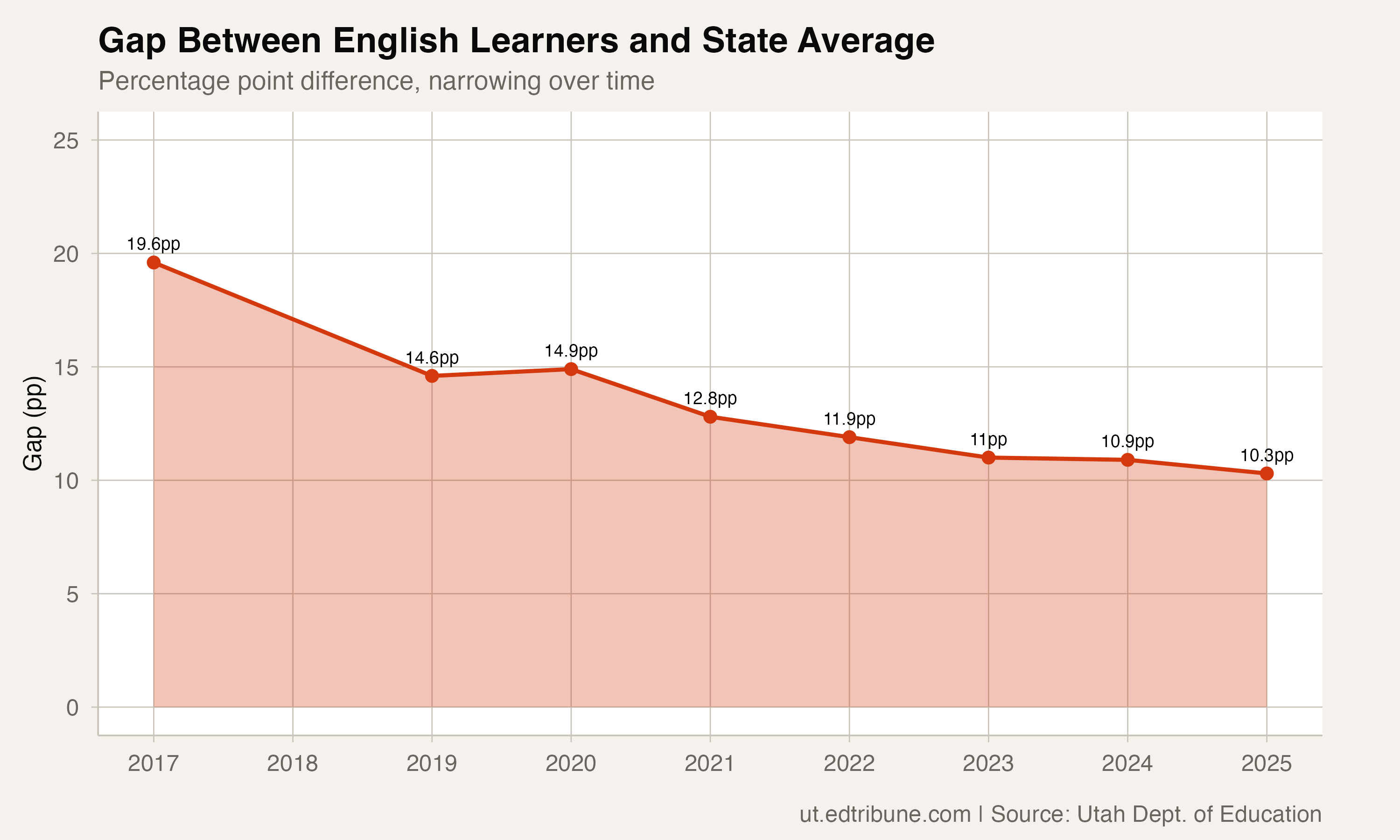
Part of this gap is structural. A four-year graduation timeline was never designed with language acquisition in mind. Students who arrive in the U.S. during high school face the dual challenge of learning English and meeting course requirements at the same time. Many need additional time, and a five-year extended graduation rate would likely show a smaller gap, but Utah's data doesn't include one.
In the company of progress
Students who are English learners aren't the only group gaining ground in Utah. Black students improved 10.8 points over the same period, students in special education gained 7.6 points, and Hispanic students added 6 points. Only Pacific Islander students saw a decline, slipping 0.6 points.
The broad-based nature of these gains matters. When every group that has been underperforming improves at once, it points to systemwide conditions, such as funding, staffing, and school culture, that support improvement rather than a single targeted program producing isolated results.
But the gain for students who are English learners stands apart in both magnitude and consistency. No other subgroup has posted eight consecutive years of gains, and no other subgroup has closed the gap by 9.3 percentage points. The trajectory suggests that whatever Utah is doing for its multilingual learners has been working for the better part of a decade.
What comes next
If the trend continues at its current pace of roughly 1.5 points per year, students who are English learners could reach 85% by the Class of 2029 and approach parity with the current state average within the decade. But the same dynamic that applies to the overall state rate applies here: the closer you get to a ceiling, the harder each additional point becomes.
The students who aren't graduating today likely face the most complex circumstances, including recent arrivals with limited prior schooling and families who are currently unhoused. Reaching them will require more than extending the strategies that lifted the rate from 67% to 79%.
Still, 12.1 points of improvement over eight years is a story worth telling, not because the work is done, but because it shows the work can succeed.
Data from the Utah State Board of Education. Four-year adjusted cohort graduation rates, 2017-2025.
Detailed code that reproduces the analysis and figures in this article is available exclusively to EdTribune subscribers.
Discussion
Sign in to join the discussion.
Loading comments...