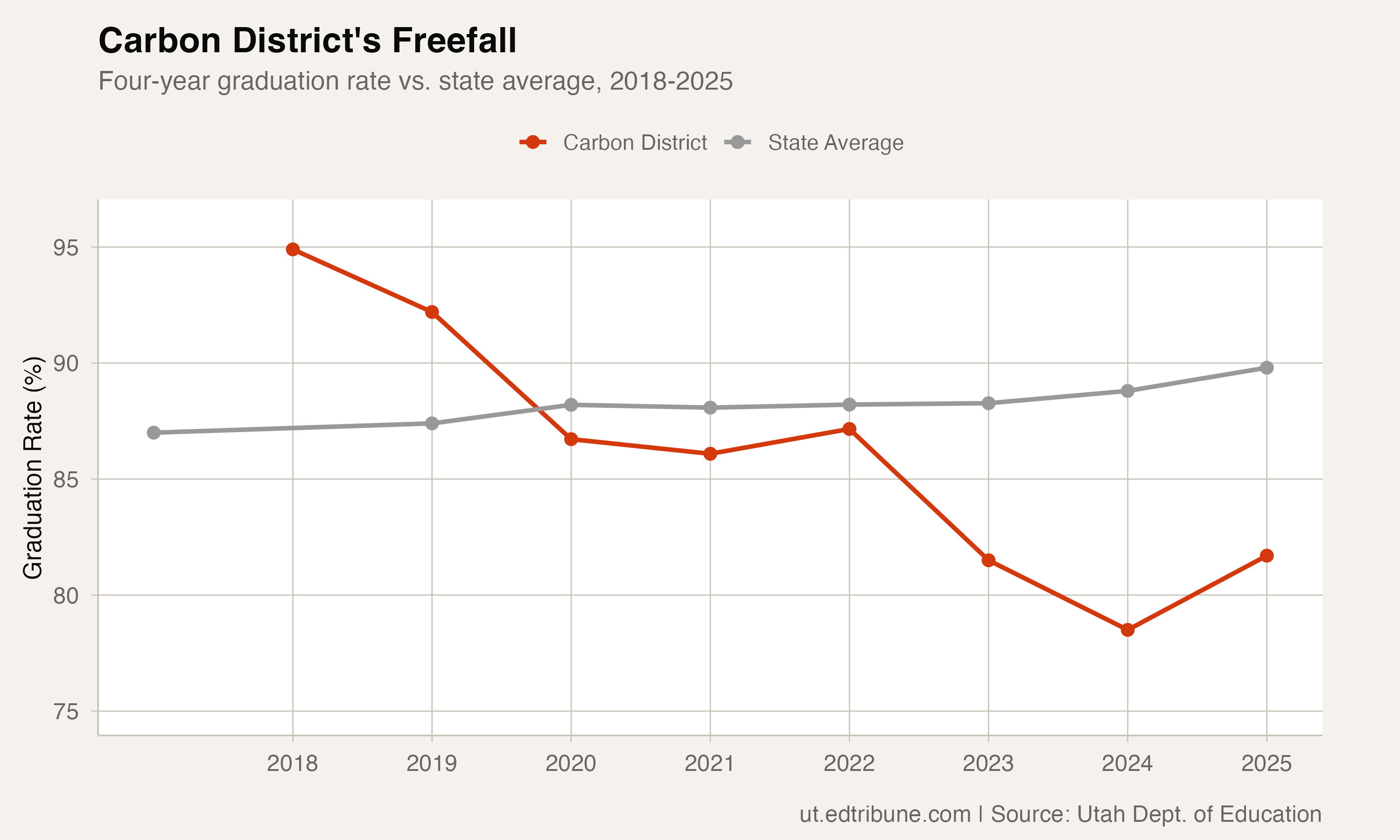
In 2018, Carbon District↗ET graduated 94.9% of its students. The small district centered on Price, a coal town of about 8,000 people in eastern Utah, was comfortably above the state average. It was the kind of graduation rate that doesn't generate headlines.
Seven years later, Carbon graduates 81.7%. The 13.2 percentage point decline is the largest of any Utah school district in the data, steeper than any other rural district's struggles and steeper than any urban district's over the same span.
Year by year, the unraveling
The decline didn't happen all at once. It came in waves, with brief pauses that might have looked like stabilization before the next drop arrived.
From 94.9% in 2018, the rate fell to 92.2% in 2019, then plunged 5.5 points to 86.7% in 2020. A brief plateau around 86-87% in 2020-2022 offered some hope. Then came 2023: another 5.7-point drop to 81.5%, followed by a further slide to 78.5% in 2024, the district's nadir.
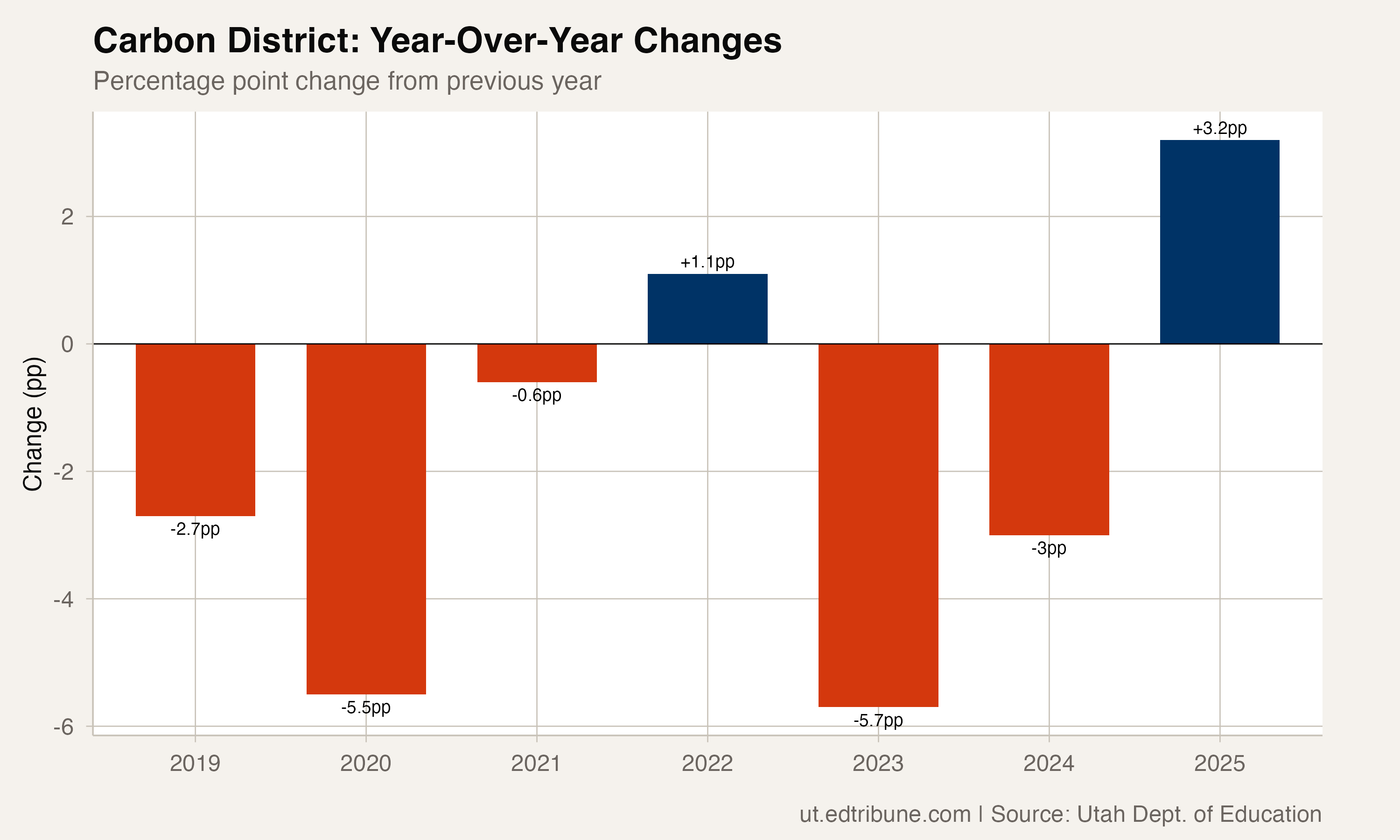
The 2025 rebound to 81.7%, a 3.2-point gain, is the first real improvement in years. But even this bounce only brings the rate back to where it was in 2023, when the number already felt alarming.
Coal country context
Carbon County's economy was built on coal, and the coal industry has been in structural decline for more than a decade. The county's population has been falling. Younger families have been leaving for jobs on the Wasatch Front, 100 miles west. The students who remain come disproportionately from families facing economic instability.
None of this makes the graduation rate decline inevitable. Other rural Utah districts facing similar pressures have maintained or improved their rates. Sevier District↗ET in central Utah climbed from 83.5% to 92.2%. Iron District↗ET in Cedar City sits at 93.3%. San Juan District↗ET, which serves the Navajo Nation, reaches 90.3%.
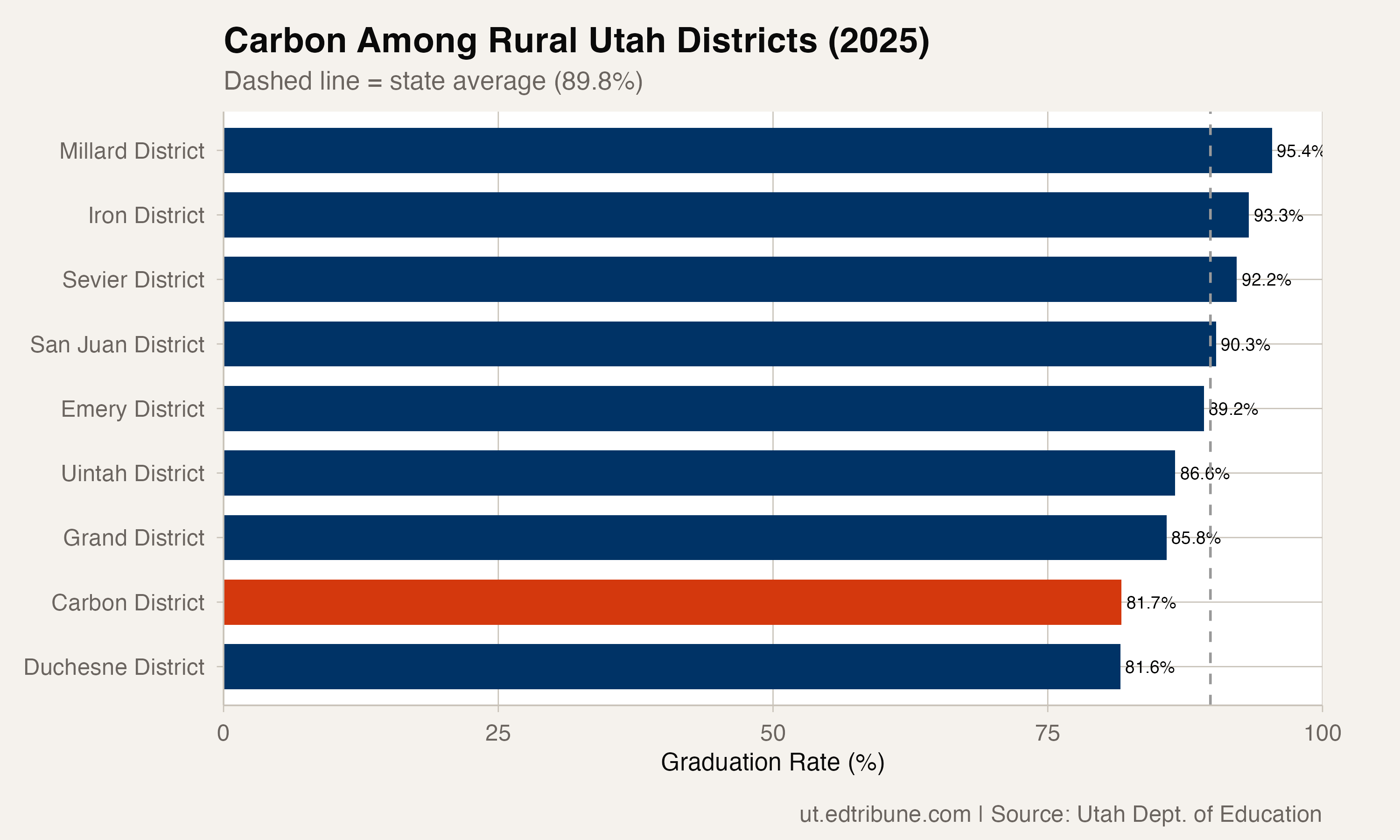
Carbon's 81.7% rate places it near the bottom of its rural peer group, trailing even Duchesne District↗ET (81.6%) in the Uinta Basin, another energy-dependent community facing similar demographic shifts.
From above average to below
Perhaps the most telling detail is Carbon's trajectory relative to the state. In 2018, the district was 7.9 points above the state average. By 2025, it trails by 8.1 points, a swing of 16 points in relative position. The state improved; Carbon collapsed.
The district went from graduating at a rate that would have been considered excellent in most states to one that leaves nearly one in five students without a diploma within four years.
A single high school district
Carbon is essentially a one-high-school district. Carbon High serves the entire area, and its 2025 rate of 82% is nearly identical to the district figure. There's no within-district variation to analyze, no east-side/west-side divide. The decline is happening to one community, in one school, with one set of students.
That simplicity is both a challenge and an opportunity. There's no complexity to hide behind. If the graduation rate is falling, everyone in Price knows it, and whatever changes are needed can be implemented without the bureaucratic layers of a larger system.
What's at stake
For a small town, graduation rates carry outsized significance. Each student who doesn't earn a diploma limits their own prospects and reduces the talent pool in a community that's already losing population. Carbon County can't afford to lose one in five of its young people to non-completion on top of the out-migration it's already experiencing.
The 2025 rebound is a reason for cautious optimism. But one good year after six bad ones doesn't constitute a recovery. Carbon District needs to string together the kind of steady, incremental improvement that the state as a whole has achieved, and it needs to do it in a community where the economic headwinds keep blowing.
Data from the Utah State Board of Education. Four-year adjusted cohort graduation rates, 2018-2025.
Detailed code that reproduces the analysis and figures in this article is available exclusively to EdTribune subscribers.
Discussion
Sign in to join the discussion.
Loading comments...