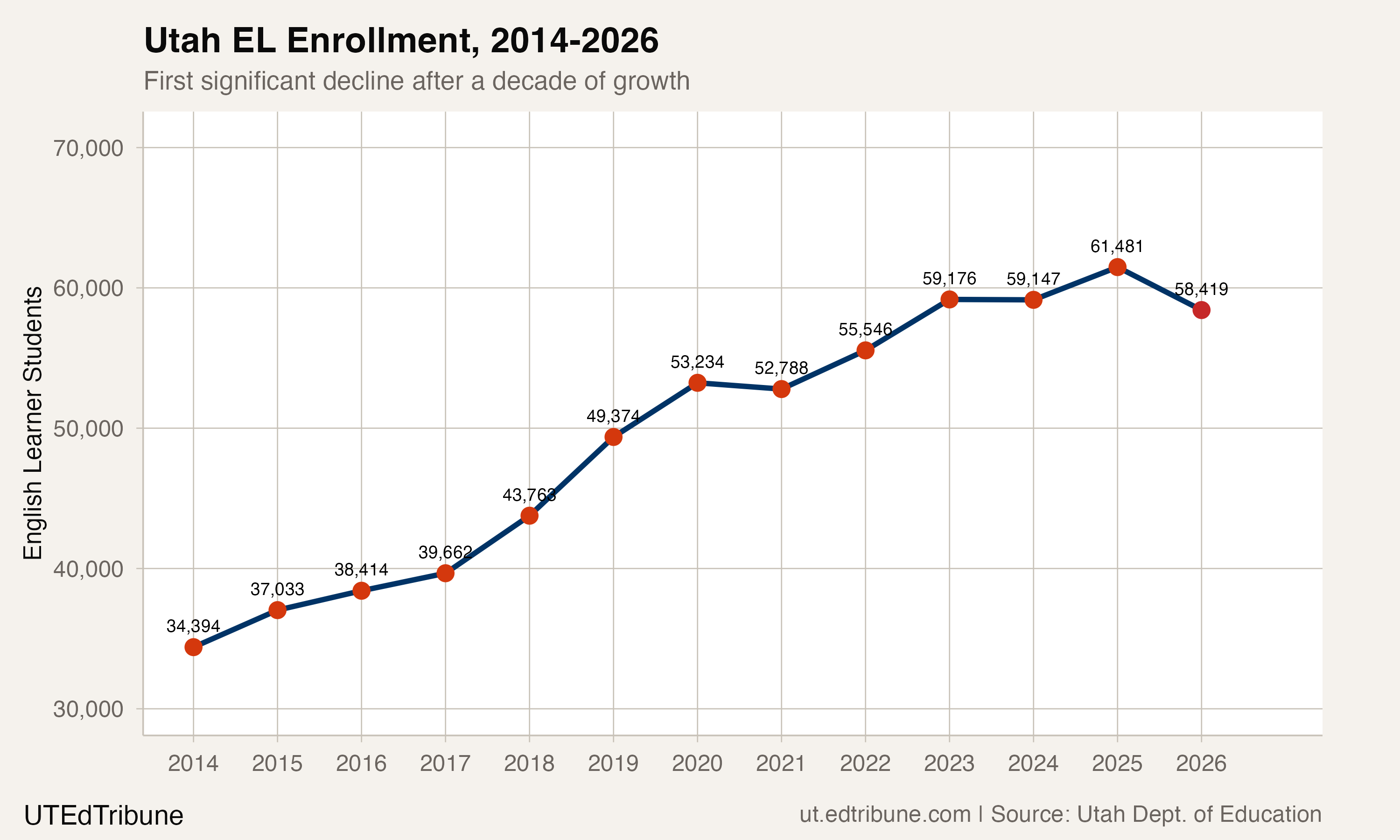
For 11 years, Utah's English learner population moved in one direction. From 34,394 students in 2014 to 61,481 in 2025, EL enrollment grew 78.8% while total enrollment grew 9.1%. The trajectory seemed durable enough that the legislature passed emergency funding legislation in early 2025 to help schools absorb the influx.
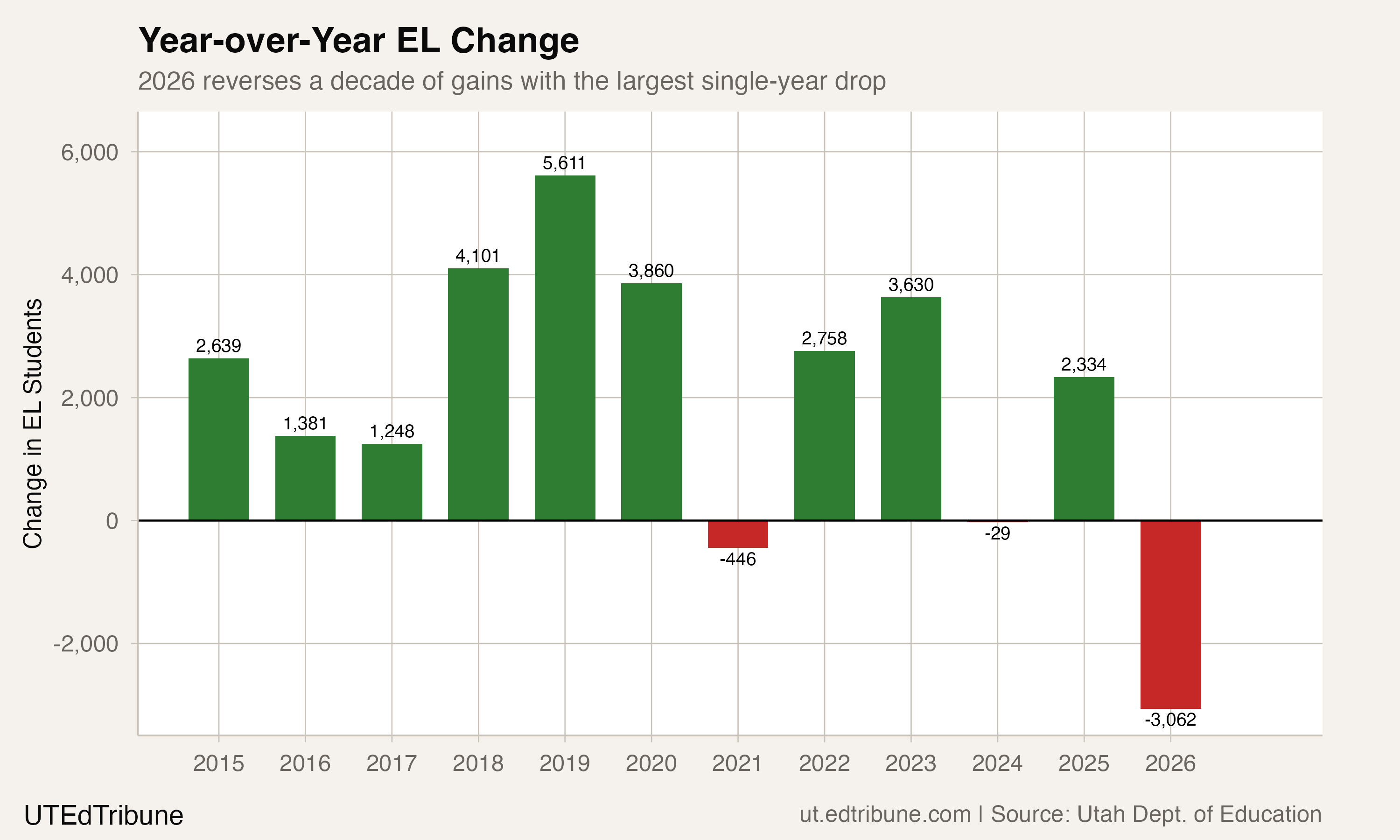
Then it reversed. In the 2025-26 school year, EL enrollment fell to 58,419, a drop of 3,062 students, or 5.0%. It is the largest single-year EL decline in the state's modern data history.
The clue in the Hispanic numbers
The instinctive explanation is that immigrant families are leaving. Roughly 3,000 immigration arrests occurred in Utah in 2025, a 170% increase over 2024, according to data from the Deportation Data Project analyzed by The Salt Lake Tribune. The Salt Lake City School District reported attendance dropping from 91% to 87% in January 2025 after the federal government reversed its policy restricting ICE enforcement in schools.
But the enrollment data complicates that narrative. Hispanic enrollment, the demographic most closely associated with EL identification in Utah, was essentially flat in 2026: 142,284 students, up 17 from the prior year. If thousands of immigrant families had left the state, Hispanic enrollment would show it. It does not.
The more revealing metric is the ratio of EL students to Hispanic students. In 2020, 45.3% of Utah's Hispanic students were classified as English learners. By 2025, that share had fallen to 43.2%. In 2026, it dropped to 41.1%, the lowest level since before the identification surge began.
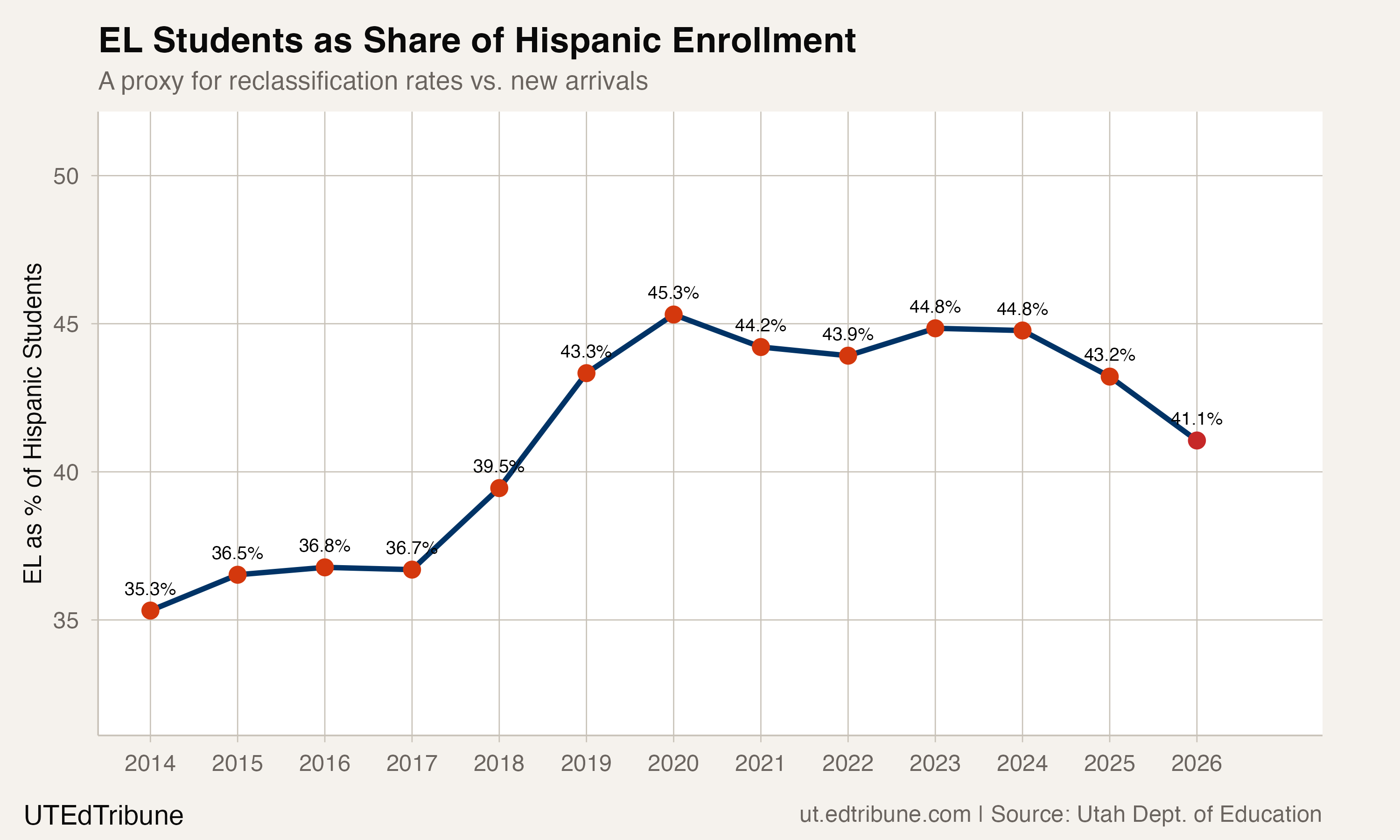
A falling EL-to-Hispanic ratio, combined with stable Hispanic enrollment, points toward reclassification as the primary driver. More English learners are testing out of EL status than new students are entering it.
A lowered bar with a delayed effect
Utah changed its WIDA ACCESS exit threshold in 2022-23, reducing the required composite score from 5.0 to 4.2. That lower bar meant students who had been close to proficiency for years could reclassify sooner. The timing fits: the 2022-23 change would have taken two to three testing cycles to work through the pipeline, producing its largest reclassification cohort in 2025-26.
This mechanism would also explain why the decline is concentrated in traditional districts with large, established EL populations rather than in charter schools or rural areas. Districts that had been accumulating near-proficient EL students for years would see the steepest exits once the threshold dropped.
Salt Lake County bore the brunt
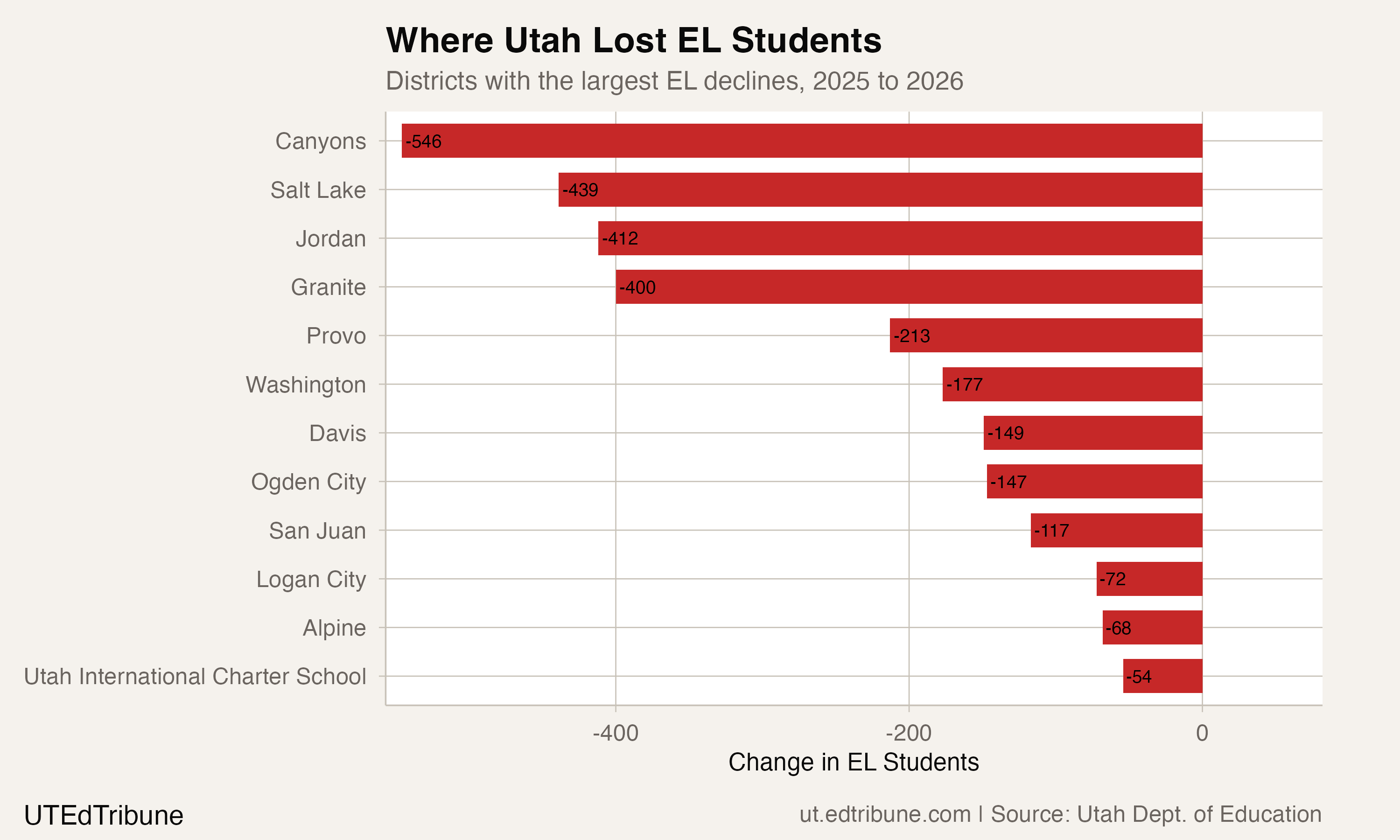
Thirty-one of 48 districts with EL students lost ground in 2026. The losses were concentrated in Salt Lake County's urban core, where four districts account for 59% of the statewide decline.
Canyons District↗ET lost 546 EL students, a 15.2% drop. Salt Lake District↗ET lost 439 (10.5%). Jordan District↗ET lost 412 (7.5%). Granite District↗ET, which enrolls more EL students than any district in the state at 14,136, lost 400 (2.8%).
Granite's situation is instructive. The district's EL population dipped in 2024 to 13,759 before rebounding to 14,536 in 2025, only to fall again to 14,136 in 2026. Despite a district that has lost nearly 10,000 students overall since 2019, EL students now represent 26.0% of Granite's enrollment, up from 22.6% seven years ago. The EL population is shrinking, but it is shrinking slower than everything else.
Across SLC metro districts, the combined EL loss was 2,242 students, accounting for 77.6% of the statewide district-level decline. The remaining 648 students of loss were scattered across 23 other districts.
The ICE effect is real but secondary
Immigration enforcement intensified in Utah throughout 2025. State Sen. Luz Escamilla told The Salt Lake Tribune about the impact on school attendance:
"The kids are not coming. Simple as that."
The reversal of the federal policy restricting ICE and Customs and Border Protection from enforcement in schools, churches, and hospitals sent a measurable chill through Salt Lake County classrooms. Middle and high schools in Salt Lake City saw 1,056 fewer students attending the week the policy change was announced compared to the prior week.
Yet the enrollment data suggests enforcement is a contributing factor, not the primary one. If families were leaving in large numbers, Hispanic enrollment would have declined proportionally. Instead, it held steady at 142,284. The 5.0% EL decline against a flat Hispanic population is the signature of a classification system processing students out faster than new ones enter, not of families disappearing.
Some portion of the decline likely reflects both mechanisms: families avoiding enrollment (especially recent arrivals who might have been identified as EL) while simultaneously, established EL students reclassify at higher rates under the relaxed exit threshold. The data cannot separate these effects.
The funding paradox
The legislature's 2025 response to the EL surge illustrates how fast the ground shifted. HB 42 allocated $500,000 for emergency funding to schools where beginner EL enrollment exceeded the three-year average by 75% or more. No school in the state qualified. The surge the bill was designed to address had already crested.
That irony is less about legislative failure than about the speed of demographic change. The Alpine School District, whose 139% EL increase was cited as justification for the bill, saw its EL population drop by 68 students in 2026.
Districts are now in an awkward position. They hired bilingual aides, expanded sheltered instruction programs, and reorganized classrooms around a student population that may be reclassifying out faster than anticipated. The per-pupil cost of EL instruction does not scale down linearly. A district that loses 400 EL students may not be able to cut a single teaching position if the remaining 14,000 EL students are spread across dozens of schools.
What the 2027 count will clarify
The most important unknown is whether this is a one-year correction or the start of a new trend. If the WIDA threshold change created a backlog of reclassification-ready students, the 2026 decline may represent that backlog clearing. In that case, EL enrollment could stabilize or resume modest growth in 2027 as new arrivals refill the pipeline.
If, on the other hand, immigration enforcement continues to suppress new EL enrollments while the lower reclassification bar continues to process students out, the decline could deepen. Utah's immigration court caseload increased more than sixfold from 2021 to 2023, reaching nearly 20,000 cases. That wave of arrivals is now working its way through the school system. Once it passes, the inflow side of the equation may look very different.
The legislature passed emergency EL funding that no school qualified for. Districts hired bilingual staff for a surge that may already be over. And in January 2025, when Salt Lake City attendance dropped from 91% to 87% in a single week after the ICE enforcement policy change, no reclassification formula can explain what happened in those classrooms. Something is shifting, and the enrollment data is only catching part of it.
Detailed code that reproduces the analysis and figures in this article is available exclusively to EdTribune subscribers.
Discussion
Sign in to join the discussion.
Loading comments...