At Pacific Heritage Academy, a charter school on Salt Lake City's west side built around Polynesian and Latin American cultural traditions, more than half of students are chronically absent. The rate, 56.3% in the 2024-25 school year, is not an anomaly. It reflects something broader: across Utah, Pacific Islander students miss school at the highest rate of any demographic group, a disparity so large it dwarfs every other equity gap in the state's attendance data.
The number is 45.0%. Nearly one in two Pacific Islander students in Utah missed 10% or more of the school year in 2024-25. The rate is more than double that of white students (20.2%), 12 percentage points above Hispanic students (33.0%), and 21.2 points above the state average (23.8%). No other racial or ethnic group comes close.
A gap that attendance campaigns haven't reached
Utah's chronic absenteeism crisis is well-documented. The statewide rate nearly doubled over a decade, climbing from 12.2% in 2014 to 23.8% in 2024. USBE launched a statewide attendance campaign in August 2025 built around community partnerships and parent outreach. The campaign does not mention Pacific Islander students. Its materials address absenteeism as a universal challenge across "all grade levels, regions, and demographic groups." For a community where nearly half of students are chronically absent, that universality is part of the problem.
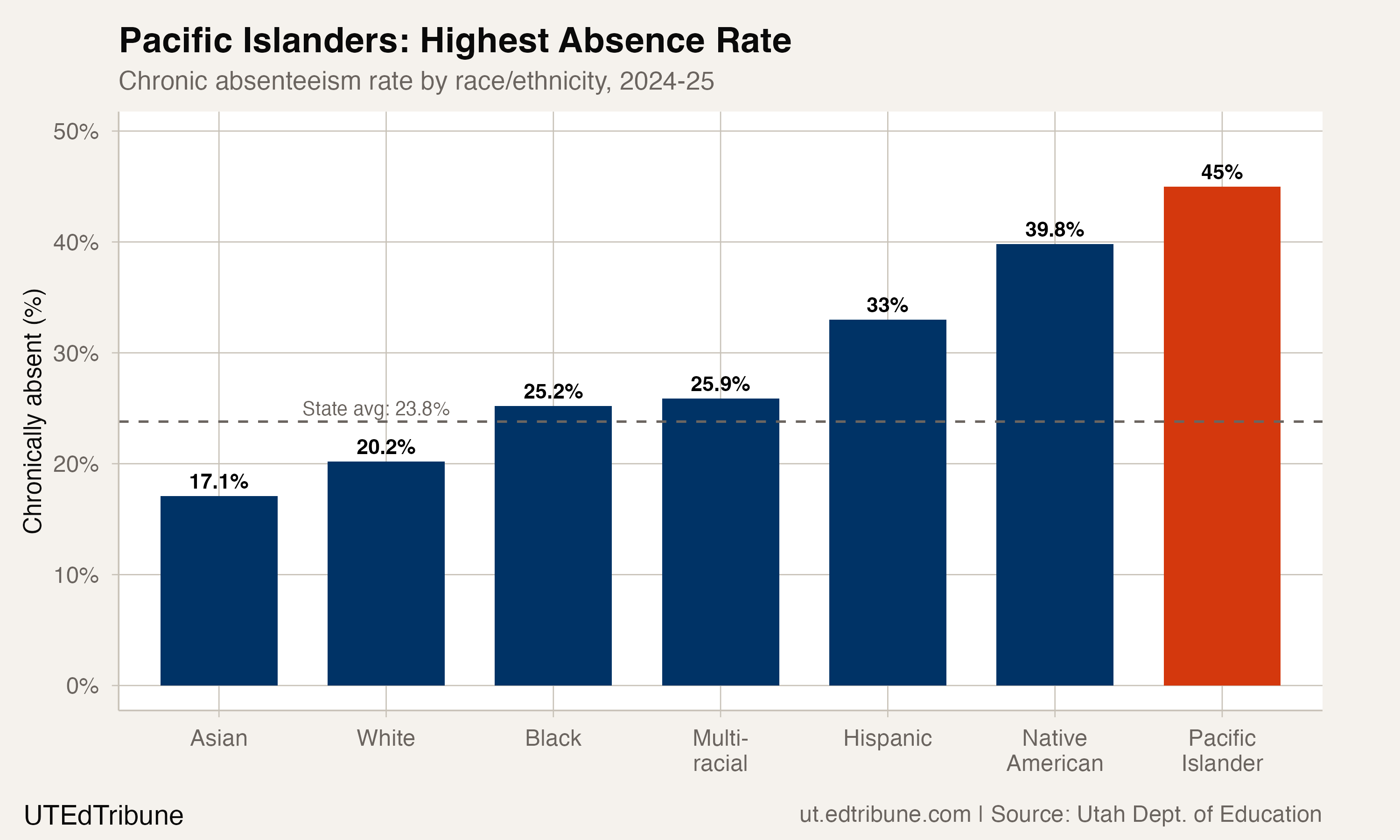
Pacific Islander students constitute roughly 1.5% of Utah's public school enrollment, a population small enough that their rate rarely surfaces in statewide discussions. But the scale of the disparity is striking. Their 45.0% chronic absence rate exceeds even the rates for economically disadvantaged students (34.4%) and English learners (36.2%), two far larger groups where attendance barriers are expected and extensively studied. It exceeds the rate for students with disabilities (30.0%). Among racial and ethnic groups, Native American students rank second at 39.8%, more than five percentage points behind.
Improvement everywhere, but barely here
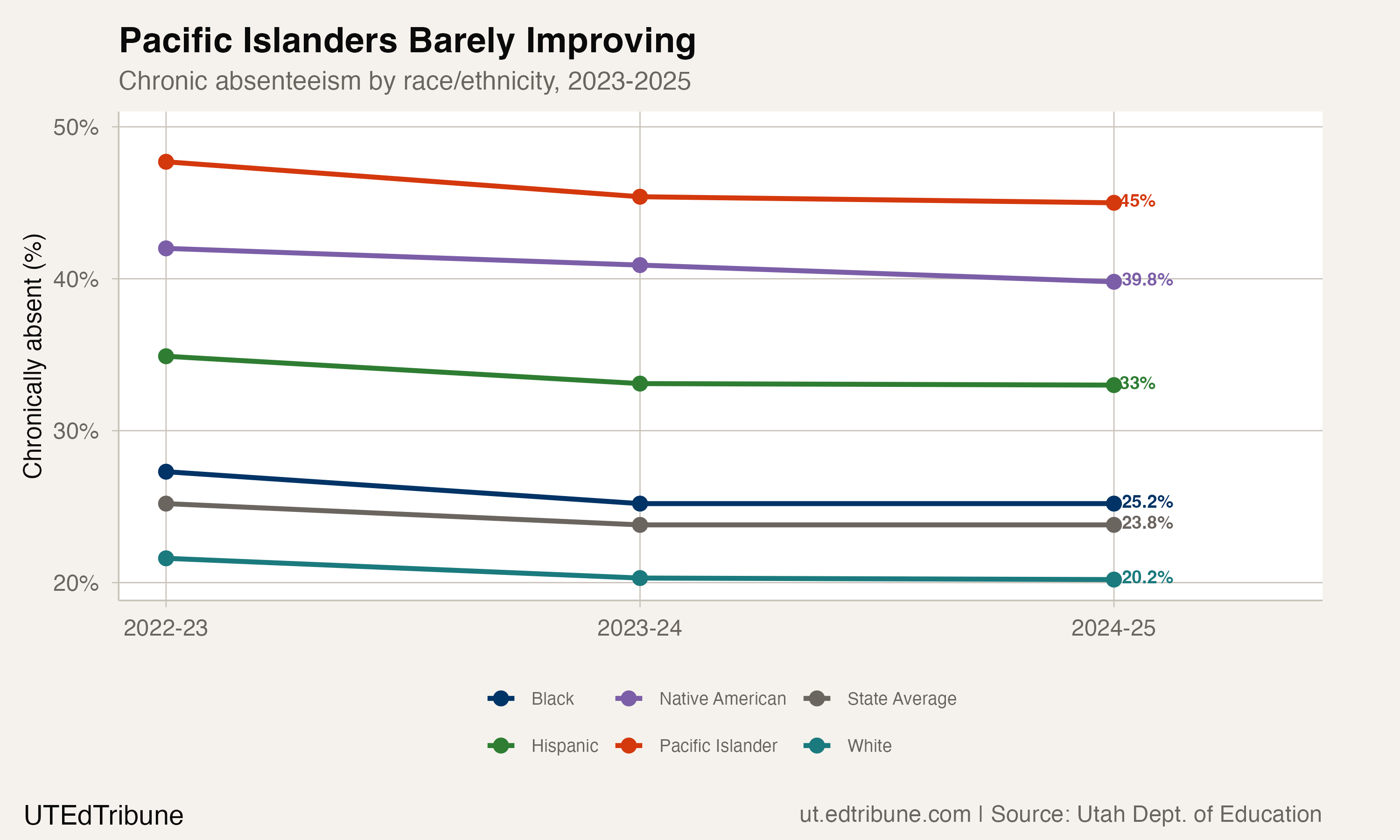
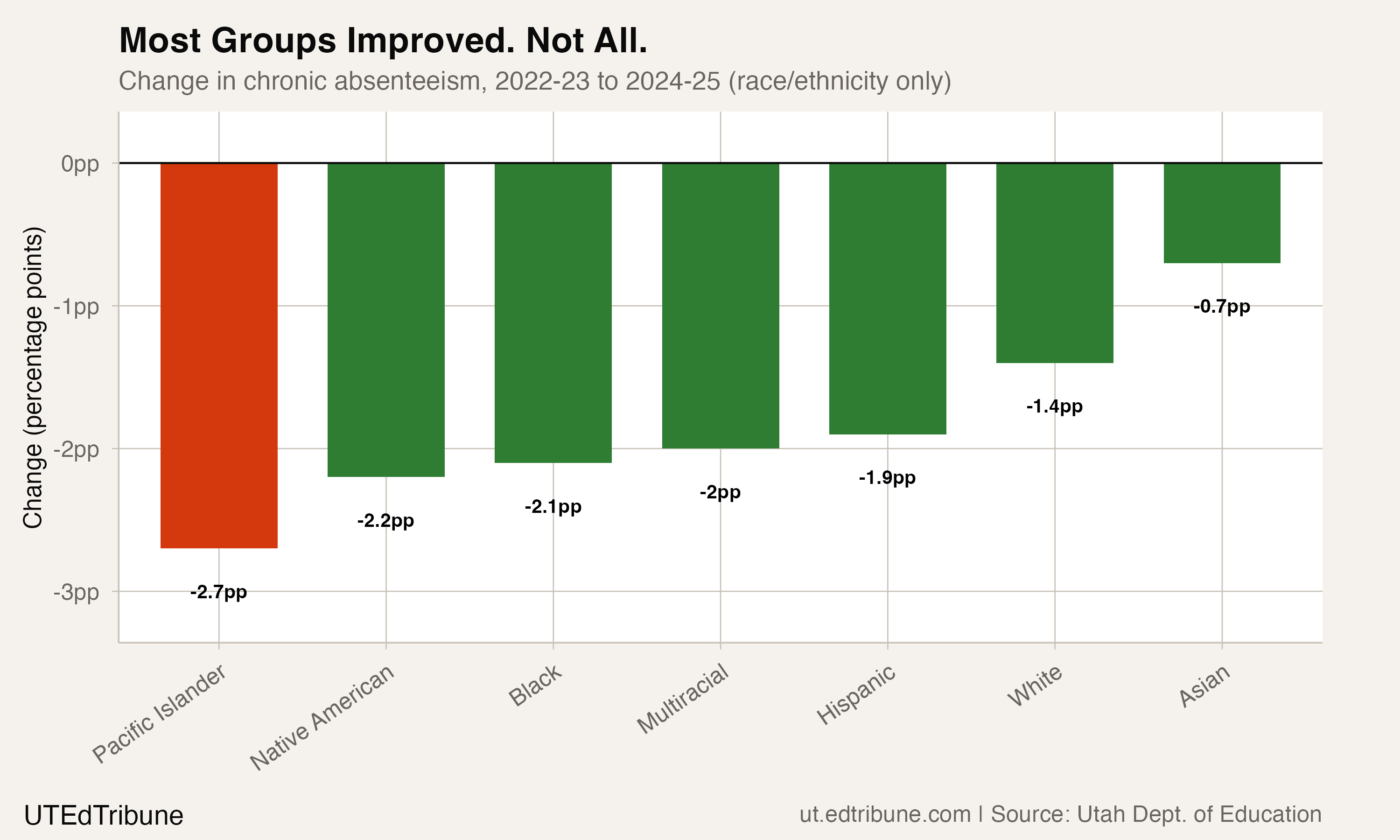
Since Utah began reporting demographic breakdowns in 2022-23, most groups have seen meaningful improvement. Black students dropped from 27.3% to 25.2% chronically absent, a 2.1-point decline. Multiracial students fell by 2.0 points. Hispanic students improved by 1.9 points.
Pacific Islander students improved too, on paper: 47.7% to 45.0%, a decline of 2.7 percentage points. But the trajectory tells a different story. Most of that improvement came in the first year, from 47.7% to 45.4%. Between 2023-24 and 2024-25, the rate barely moved, dropping just 0.4 points while the statewide rate held flat at 23.8%.
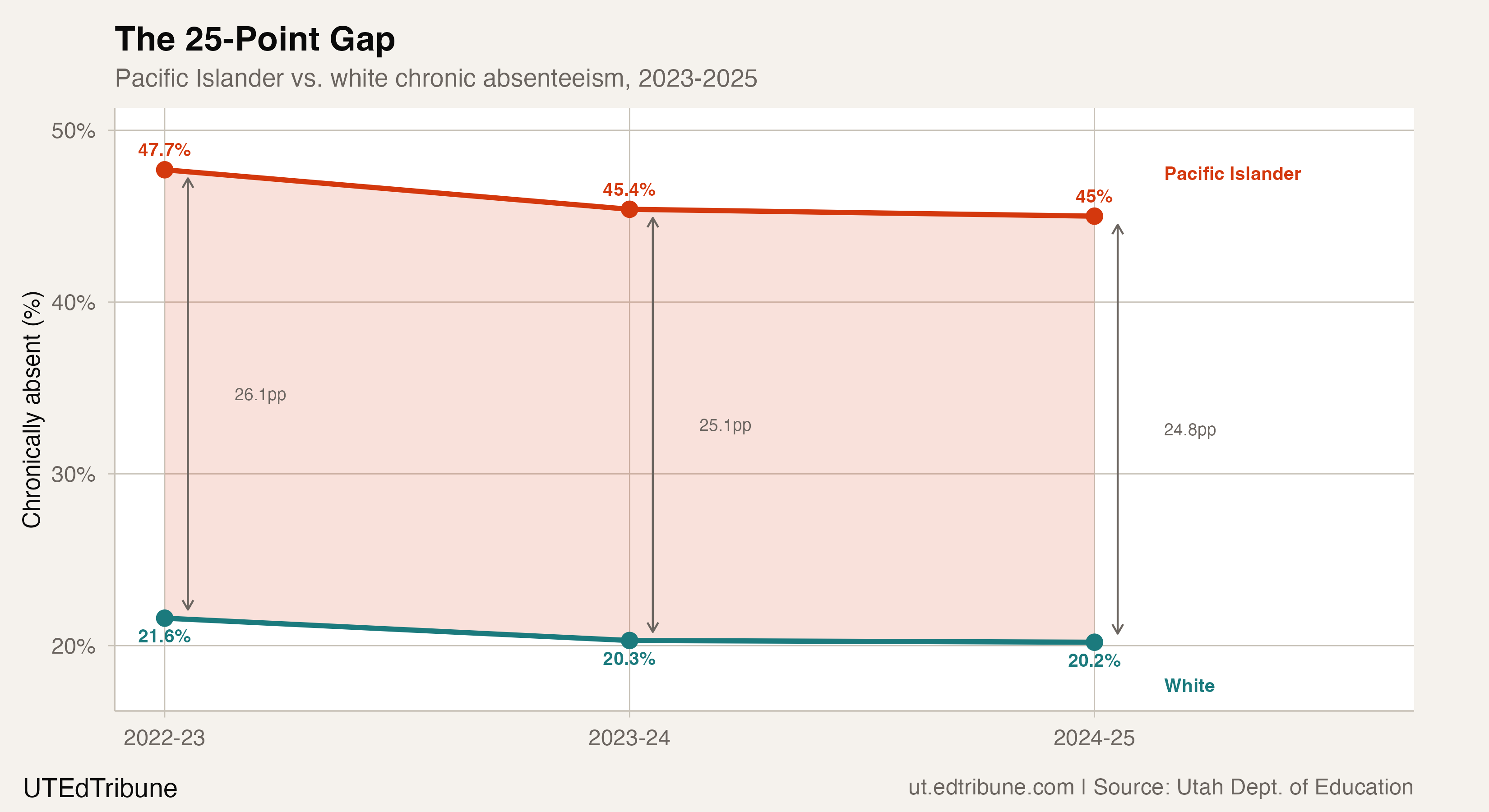
The gap between Pacific Islander and white students has narrowed, but only from 26.1 percentage points to 24.8, a closing rate of about 0.65 points per year. If sustained, that pace would require nearly four decades to eliminate the gap entirely.
The community behind the numbers
Utah's Pacific Islander population is among the oldest and most established in the continental United States. Native Hawaiians first arrived in Salt Lake City in the 1870s; Samoans settled in Castle Dale and Heber Valley in the 1880s. Today, over 60,000 Pacific Islanders live in Utah, giving the state the third-highest Pacific Islander share of any state behind Hawaii and Alaska. Tongans make up 39% of Utah's Pacific Islander population, Samoans 30%, concentrated heavily along the Wasatch Front in cities like West Valley City, where Tongans and Samoans each constitute more than 2% of the total population.
The barriers to school attendance in this community are structural. Multigenerational households are common: one West Valley City family profiled by the Deseret News included 15 people living in a single home at one point. Research on Native Hawaiian and Pacific Islander families has found that older children frequently take on caregiving responsibilities for younger siblings and elders, a cultural expectation that can conflict with daily school attendance. Language barriers and working parents limit engagement with school systems, and as community advocate Bev Uipi told the Salt Lake Tribune: "They don't go to parent-teacher conferences."
The community's relationship with public education has long been characterized by what former Pacific Heritage Academy assistant principal Hema Katoa called a kind of isolation:
"We're kind of off on our own little island, kind of stuck there." Source: Salt Lake Tribune, 2015
That phrasing predates the current absenteeism crisis by a decade, but it describes a dynamic the data still reflects: Pacific Islander students fall into a gap between groups large enough to command policy attention and those small enough to be overlooked entirely.
Two charter schools, two approaches
Two Utah charter schools were founded specifically to serve Pacific Islander students. Their attendance records tell starkly different stories.
Pacific Heritage Academy, which opened in 2012 as the first school in the nation to incorporate Pacific Islander culture into an expeditionary learning framework, had a chronic absenteeism rate of 56.3% in 2024-25. The school hovered around 30% pre-COVID, then nearly doubled. In 2023-24 the rate hit 60.5%.
Mana Academy Charter School in West Valley City, which offers instruction in Tongan, Samoan, and Spanish and focuses on closing the achievement gap among minority students, followed the opposite arc. Its chronic absenteeism rate dropped from 40.2% in 2014-15 to 13.7% in 2018-19, a five-year decline of 26.5 percentage points. COVID disrupted that trajectory, pushing the rate to 20.3% by 2022-23, but Mana recovered: the school sits at 14.6% in 2024-25, below the state average and within range of its pre-COVID low.
One school serving Pacific Islander students has a chronic absence rate nearly four times the other's. What Mana Academy demonstrates, and what the statewide 45% rate obscures, is that the problem is not intractable. Something at Mana works. Identifying what, and scaling it, is the question Utah has not yet asked.
What the data cannot explain
Three years of demographic data is not enough to establish whether the Pacific Islander rate is improving, worsening, or simply oscillating around a stubbornly high level. Utah did not report chronic absenteeism by race before 2022-23, so there is no pre-COVID baseline for comparison.
The data also cannot distinguish between the barriers. A 45% rate likely reflects multiple overlapping factors: economic hardship (Pacific Islanders are overrepresented among Utah's low-income households), health disparities, caregiving obligations, and school environments that may not be reaching families effectively. Without school-level demographic breakdowns, it is impossible to determine whether the problem is concentrated in a handful of schools or spread evenly across the Wasatch Front.
HB 106, introduced by Rep. Andrew Stoddard during the 2026 legislative session, was filed but did not advance. It would have required USBE to publish school-level absenteeism data and analyze root causes, representing a step toward the granular data that would make targeted interventions possible.
The question the state has not asked
The Granite School District, which encompasses West Valley City and serves a large share of Utah's Pacific Islander students, reported a 30.6% chronic absenteeism rate in 2024-25, nearly seven percentage points above the state average. Within that district average, the Pacific Islander rate is almost certainly far higher. But because Utah does not publish district-level demographic breakdowns for attendance, no one outside the district can quantify the disparity or track whether it is improving.
Utah's attendance crisis is not one problem. It is a collection of problems, each with different roots and requiring different solutions. For Pacific Islander students, whose chronic absence rate is nearly double the state average and more than double the rate of white peers, the universal strategies embedded in Every Day Counts may need a complement: targeted outreach through the community organizations that already reach these families, in the languages they speak, addressing the specific barriers they face.
The National Tongan American Society, the Utah Pacific Islander Health Coalition, and PIK2AR (Pacific Island Knowledge to Action Resources) are already working in this space. Whether the state's attendance infrastructure connects to them may determine whether 45% is a floor or a ceiling.
Detailed code that reproduces the analysis and figures in this article is available exclusively to EdTribune subscribers.
Discussion
Sign in to join the discussion.
Loading comments...