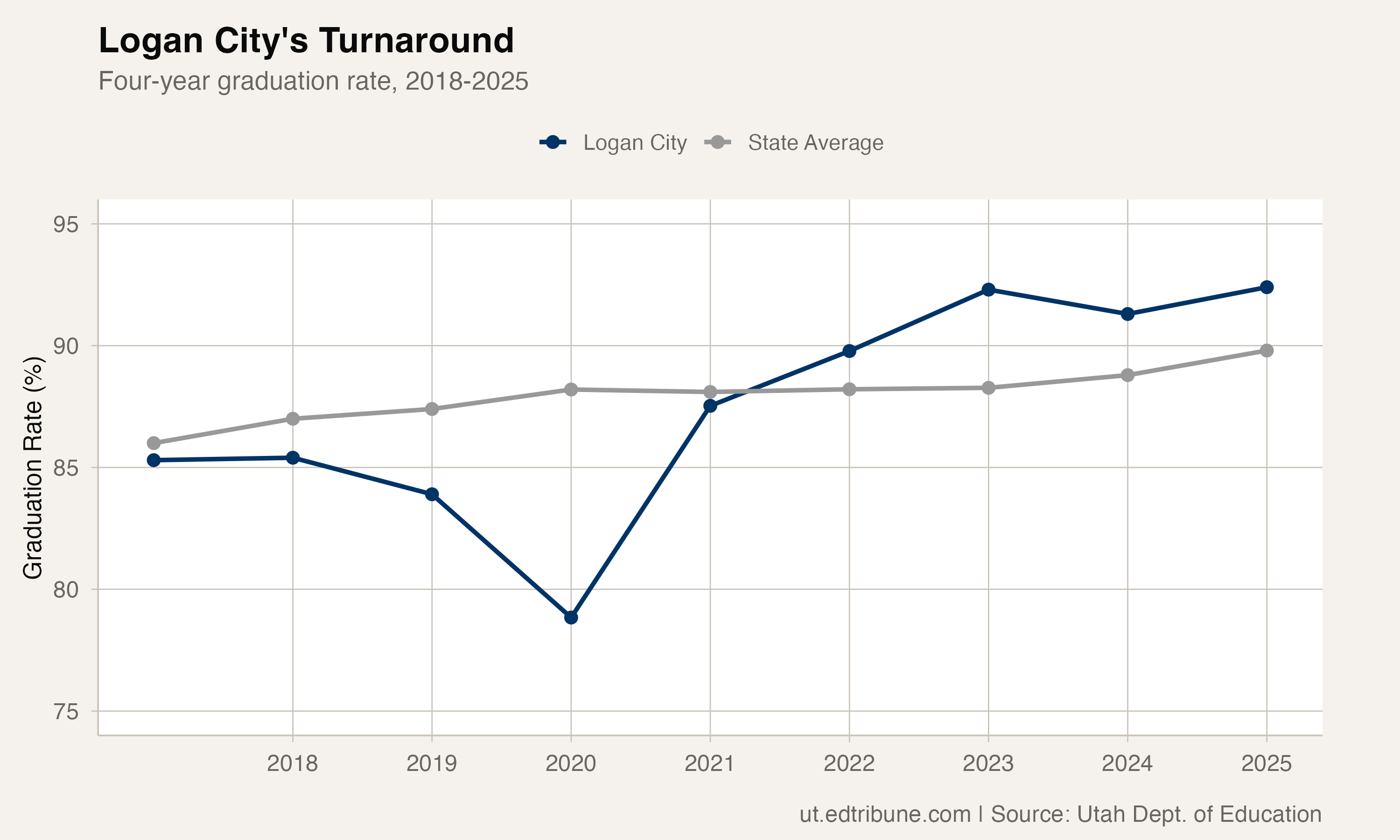
The bottom arrived in 2020. Logan City District↗ET, the small system that serves Utah State University's college town in Cache Valley, graduated just 78.8% of the Class of 2020. It was the worst rate in the district's data and came during the very year when pandemic-era grading flexibility was inflating rates elsewhere.
Five years later, Logan graduates 92.4% of its students, 2.6 percentage points above the state average and well ahead of several larger urban districts along the Wasatch Front. The 13.6-point climb from trough to current rate is the most dramatic turnaround story in Utah's graduation data.
The dip and the surge
Logan's trajectory has two distinct chapters. The first runs from 2018 to 2020: a steady decline from 85.4% to 83.9% to the 78.8% low. That 6.6-point drop over two years happened while the state held steady above 87%.
Then came the surge. In 2021, Logan jumped 8.7 percentage points in a single year, the kind of gain that typically raises questions about data quality or methodology changes. But the rate didn't fall back. It climbed to 89.8% in 2022, 92.3% in 2023, dipped slightly to 91.3% in 2024, and recovered to 92.4% in 2025.
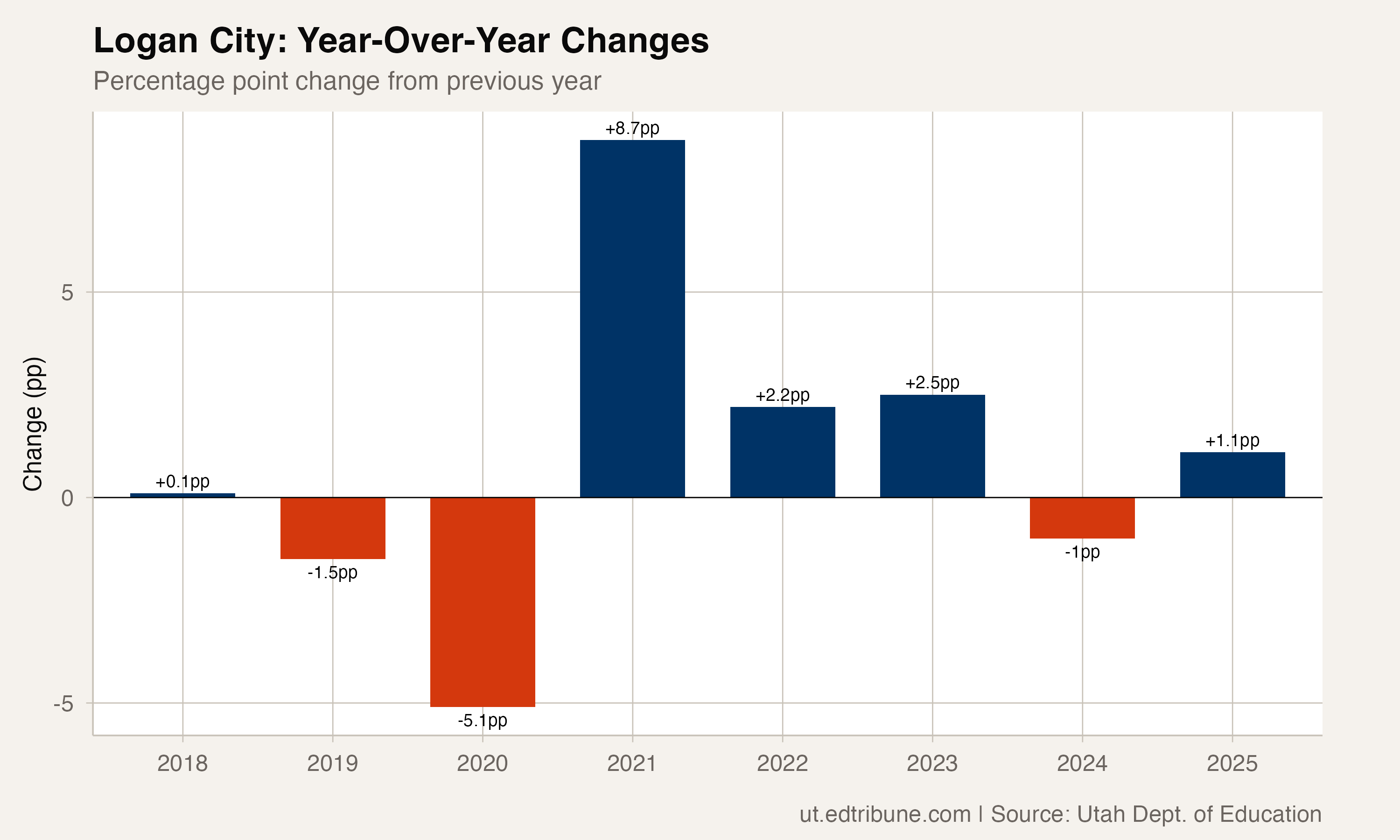
Four consecutive years above 87% suggests the improvement is structural rather than a one-time bounce. Whatever drove Logan below 79% in 2020 was addressed, and whatever replaced it has been sustained.
A diverse district in a rural valley
Logan's turnaround is notable partly because of whom the district serves. Cache Valley hosts significant refugee and immigrant populations, drawn by meat processing and agricultural jobs. Logan High School, the district's only high school, serves students from Bhutanese, Somali, Latin American, and Marshallese communities alongside multigenerational Cache Valley families.
This demographic mix is typically associated with lower graduation rates. Statewide, English learners graduate at 79.5%. Economically disadvantaged students hit 79.8%. Logan manages 92.4% with a student body that includes substantial numbers from both groups.
Where Logan ranks now
Among mid-size Utah districts, systems comparable in scope if not always in demographics, Logan sits near the top.
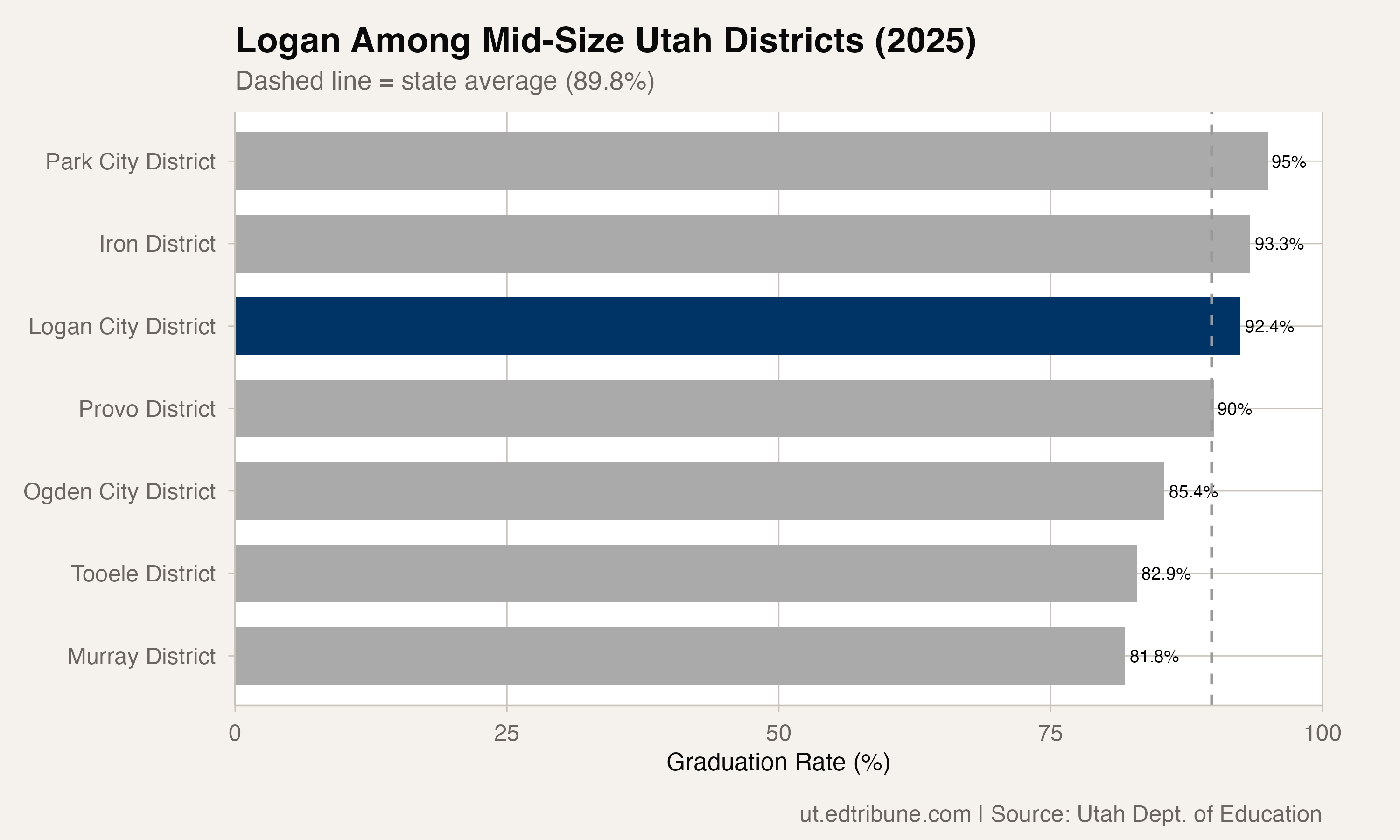
Park City District↗ET leads at 95%, and Iron District↗ET in Cedar City hits 93.3%. Logan's 92.4% puts it comfortably ahead of Provo District↗ET (90%), Ogden City District↗ET (85.4%), Tooele District↗ET (82.9%), and Murray District↗ET (81.8%).
The Ogden comparison is particularly relevant. Both are mid-size urban districts serving diverse populations. Ogden's rate has been volatile, surging to 89% before falling back to 85.4%. Logan surged and held. The difference may come down to sustainability: Logan's improvement has been maintained for four years, while Ogden's keeps giving back its gains.
The single-school factor
Logan City District is a one-high-school district. Everything flows through Logan High. This means the district-level rate and the school-level rate are essentially the same number (92.4% for both), and changes reflect what's happening in one building with one leadership team.
For turnaround purposes, this is an advantage. Policy changes, staffing decisions, and cultural shifts can be implemented directly without the coordination challenges that multi-high-school districts face. Shana Longhurst, the district's director of communications and public relations, described the same dynamic from inside the building: "Having a single high school allows employees to focus resources of time, personnel, and tools on that one school. The focused attention allows us to quickly recognize challenges and include a variety of stakeholders in developing a response."
The flip side is that bad years hit hard. There's no averaging across schools to smooth out a single cohort's challenges. The 2020 dip to 78.8% was Logan High's problem alone to fix.
What the turnaround shows
Logan's recovery demonstrates that steep graduation rate declines are recoverable, even in diverse, resource-constrained districts. The 13.6-point swing from 2020 to 2025 required more than just returning to baseline; it meant surpassing the district's pre-decline peak by 7 points.
Asked what drove the climb, the district points to volume rather than a single lever. Longhurst said the counseling team reorganized so each at-risk student has one dedicated point of contact, and the district added an after-school tutoring center, Saturday sessions, and summer school, alongside multiple ways to earn graduation credit, including hybrid and competency-based pathways. Logan High also created a newcomers class to help new immigrant and refugee students adjust to American schools and the English language, and district leaders began reviewing student data more closely to decide where to concentrate the response. "We aren't confident that one strategy has resulted in the rate increase," Longhurst said. "We just knew that our students needed additional support during these four years of high school so various strategies were used to provide that."
The question that matters for the rest of Utah is whether that mix translates to larger, more complex systems. Districts like Salt Lake↗ET (77.4%) and Granite↗ET (80.3%) face similar demographic challenges at much larger scale. Longhurst was cautious on that point. "There has been a lot of trial and error," she said. "Not every approach will work with all students, that is why it is so important to build relationships and understand individual needs which again is a bit easier to do when all efforts are concentrated on one high school." Logan's success suggests improvement is possible. Whether it's replicable elsewhere is a different question.
Graduation figures come from the Utah State Board of Education public record of four-year adjusted cohort graduation rates, covering 2018 through 2025.
Detailed code that reproduces the analysis and figures in this article is available exclusively to EdTribune subscribers.
Discussion
Sign in to join the discussion.
Loading comments...