For six straight years, from 2014 to 2020, Utah added an average of 9,128 students annually to its public schools. The state's population was booming, its birth rate led the nation, and districts along the Wasatch Front were building schools as fast as they could fill them.
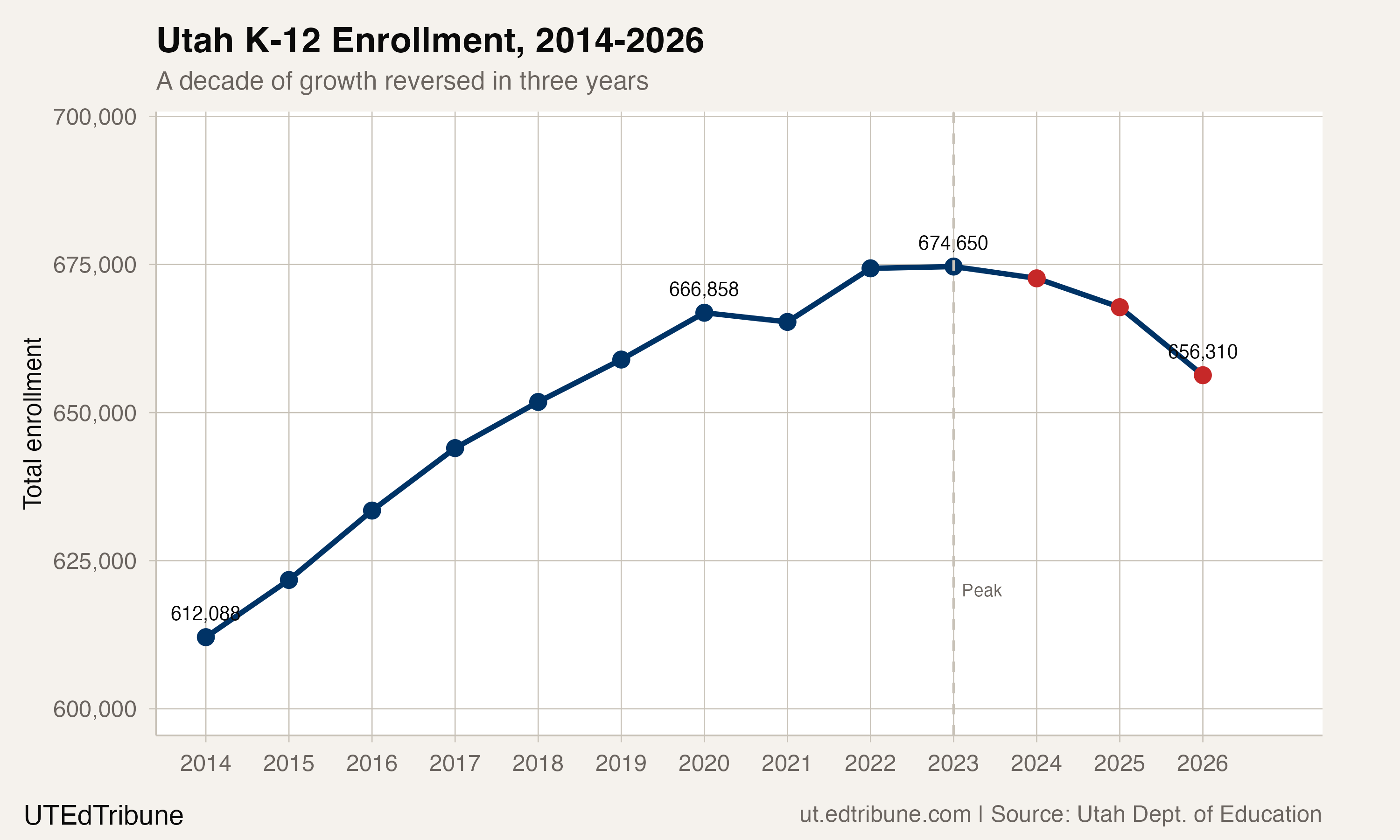
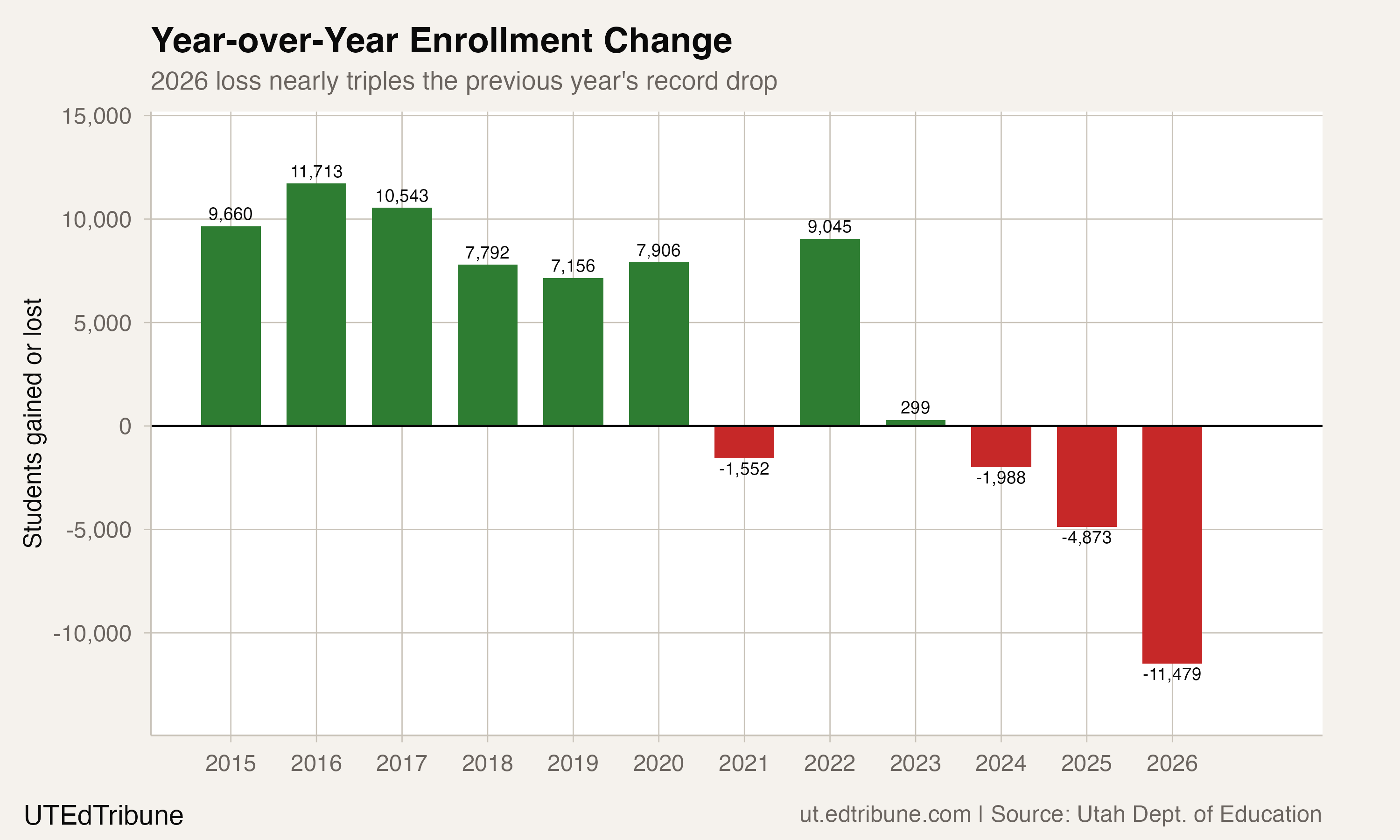
That era is over. Utah's K-12 public enrollment has fallen for three consecutive years, losing 18,340 students since its 2023 peak of 674,650. The 2025-26 decline alone, 11,479 students (1.7%), is the largest single-year drop in at least 25 years, nearly tripling the previous year's then-record loss.
The acceleration
The speed of the reversal is the story, not just the magnitude. In 2023, enrollment was essentially flat: up 299 students, a 0.04% gain. One year later, it slipped by 1,988. The year after that, 4,873. Then 11,479.
Each year's decline has roughly doubled or tripled the one before it. State Superintendent Molly Hart has attributed the trend to "smaller birth cohorts, slowing in-migration and increased school choice," but the compound effect of those forces hit harder than any individual year's data suggested it would.
At 656,310 students, Utah's public schools are back to roughly where they stood in 2018. Six years of growth, erased.
Fewer children walking in the door
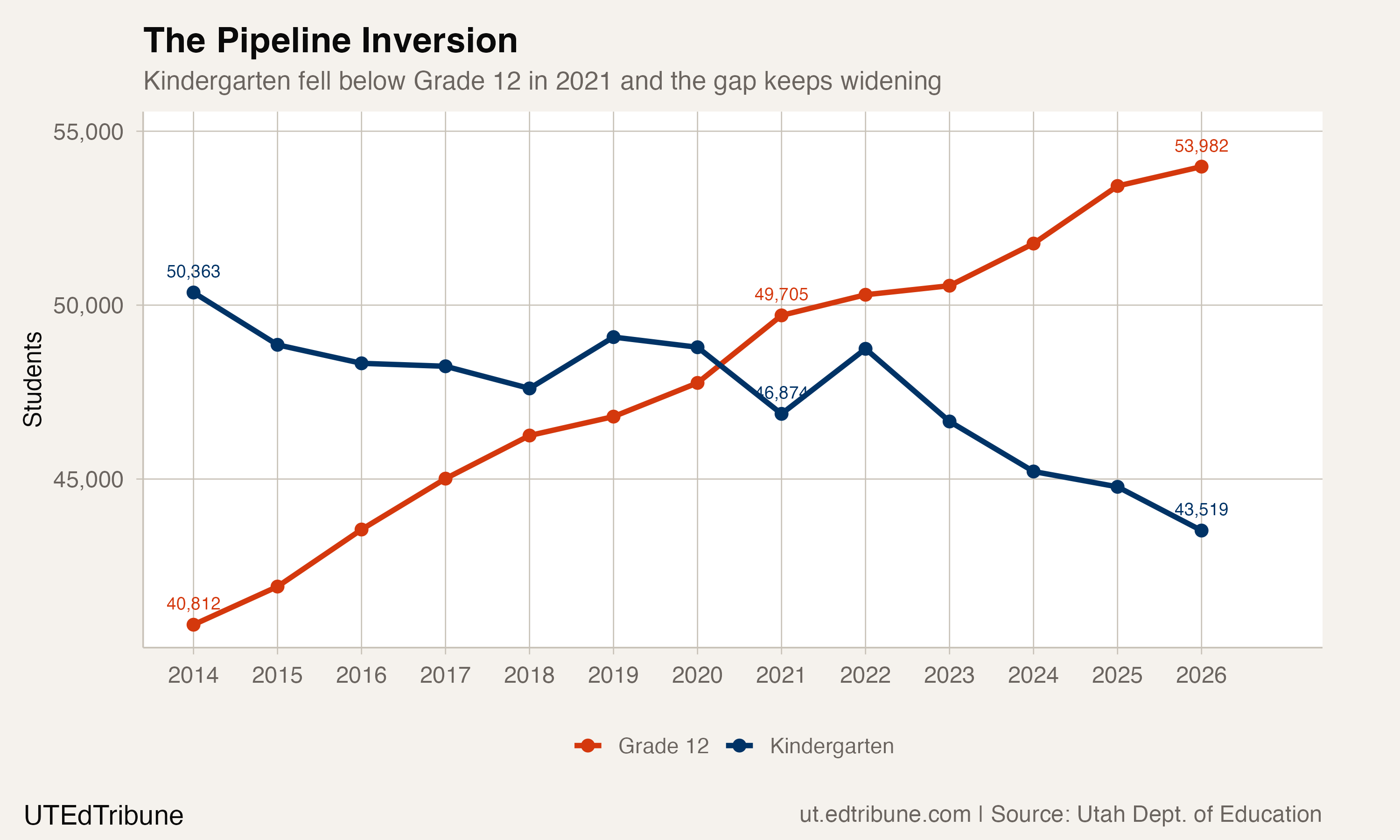
The clearest structural driver is visible in the grade-level pipeline. In 2014, Utah enrolled 50,363 kindergartners and graduated 40,812 seniors: for every student leaving the system, 1.23 were entering it. By 2021, that ratio inverted. Kindergarten dropped below Grade 12 for the first time, and the gap has widened every year since.
In 2026, Utah enrolled 43,519 kindergartners and 53,982 seniors. The ratio has fallen to 0.81. Each graduating class is now roughly 10,000 students larger than the kindergarten cohort replacing it.
The birth rate explains most of this. Utah's total fertility rate dropped from roughly 2.65 in 2008 to 1.80 in 2023, falling below the 2.1 replacement rate and sliding from fourth-highest nationally to 10th. The Utah Foundation found that Utah's fertility decline was the steepest of any state when comparing 2023 to the 2011-2020 average: a roughly 21% drop, far outpacing comparable states like North Dakota (16%) and South Dakota (13%).
Aaron Brough, director of data and statistics for the Utah State Board of Education, told the Deseret News that the shift is straightforward:
"There is a natural decline that we're tracking. Because of that decrease, the expected number of kids coming into kindergarten, first grade and such is not increasing like we've seen in the past where we've had really high birth rates."
The cultural expectation of large families, long reinforced by Utah's LDS-majority population, is weakening. Meanwhile, Utah continues attracting migrants, but in-migration is dominated by young adults aged 20-24, not families with school-age children. Population growth and enrollment growth have decoupled.
White enrollment drove nearly all the loss
The three-year decline is not spread evenly across demographic groups. White enrollment fell by 30,036 students between 2023 and 2026, a loss that exceeds the total statewide decline of 18,340. Hispanic enrollment grew by 10,330 over the same period, and multiracial enrollment added 2,263. Every other racial group was roughly flat or slightly down.
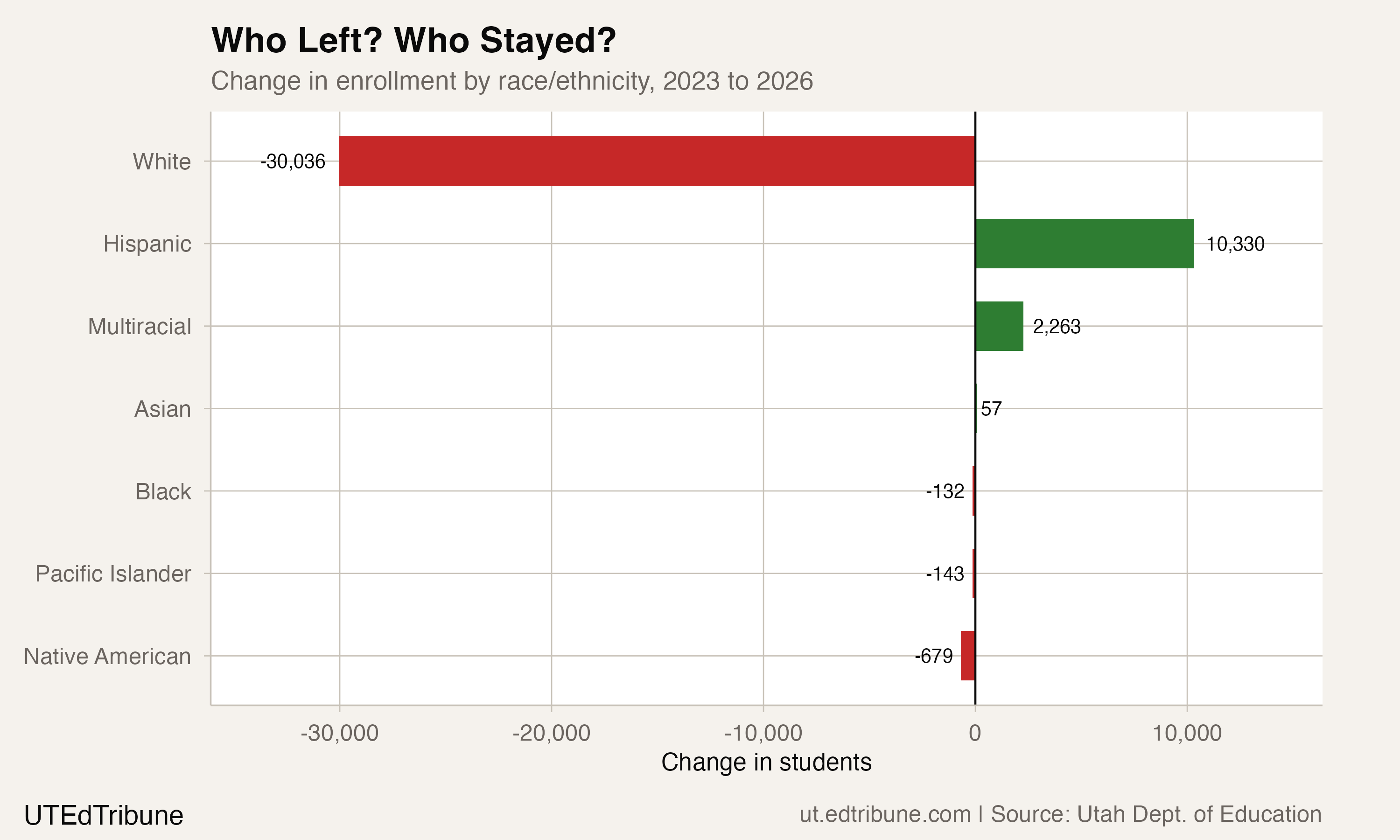
White students still make up 68.8% of Utah's public school population, down from 76.5% in 2014. The share has fallen every year for 12 consecutive years. Hispanic students now represent 21.7% of enrollment, up from 15.9% in 2014.
This pattern is consistent with the birth rate story. Utah's fertility decline has been most pronounced among white families, while Hispanic enrollment growth reflects both higher birth rates within that population and continued migration to Utah's construction, agriculture, and service sectors.
37 of 41 traditional districts are shrinking
The losses are nearly universal among traditional districts. Only four of 41 grew between 2023 and 2026 when virtual school transfers are excluded. Granite District, the state's third-largest, lost 4,654 students (7.9%). Davis lost 4,098 (5.7%). Washington lost 2,227 (6.1%).
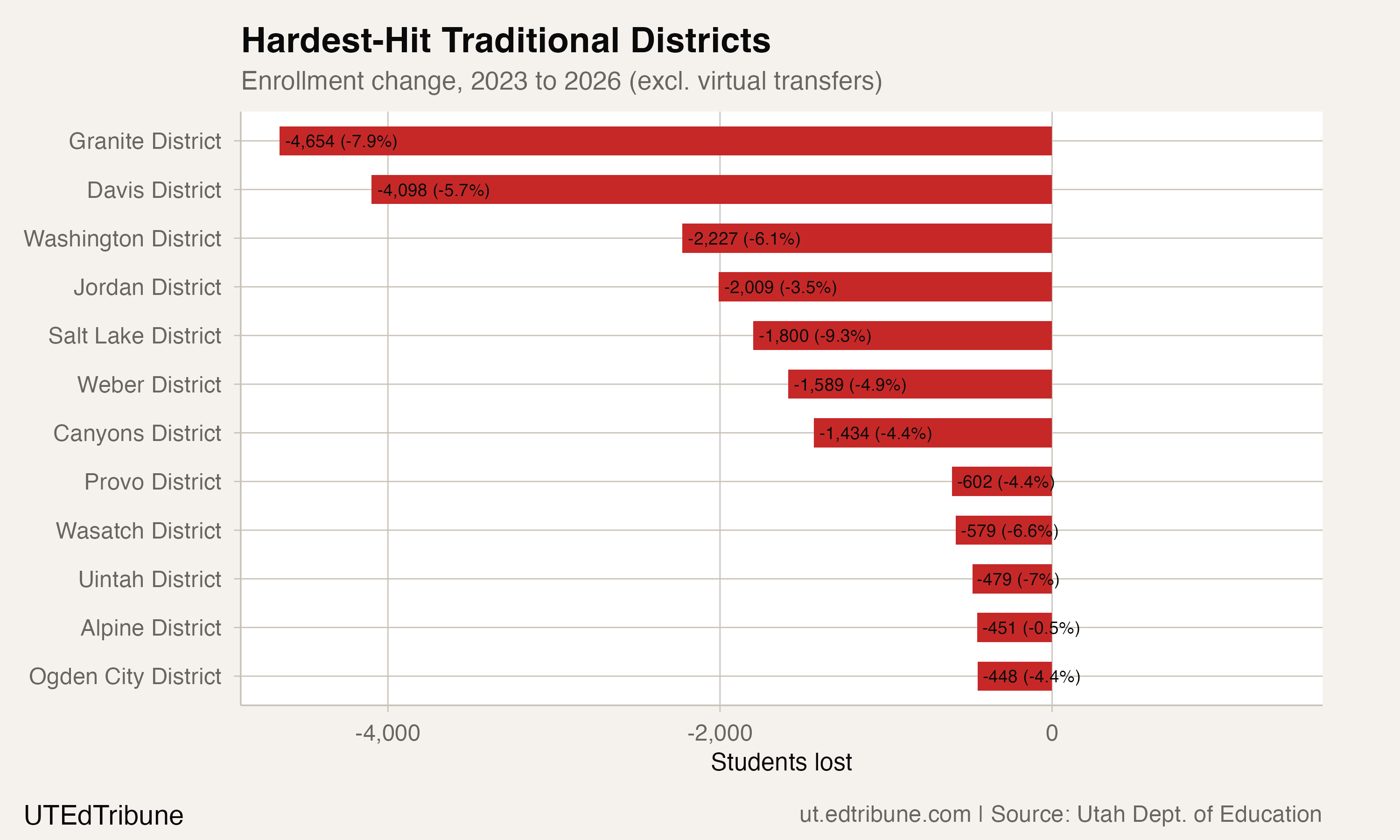
Salt Lake District's 9.3% decline is the steepest rate among the large districts. It enrolled 17,649 students in 2026, down from 22,401 in 2019: a loss of 4,752 students, or 21.2%, in seven years. Gentrification, housing costs, and school choice have all been cited as factors.
Granite's superintendent, Ben Horsley, told KSL that the district faces forces beyond its control: "That's going to impact our schools and that's totally outside our ability to control." The district has closed 10 schools in seven years and was studying additional closures before suspending the process in late 2025 amid community pushback.
Charter schools grew while the rest shrank
Charter enrollment rose from 78,761 to 85,268 between 2023 and 2026, a gain of 6,507 students (8.3%). Charter schools now enroll 13.0% of Utah's public school students, up from 11.7% three years ago.
Traditional district enrollment fell by 24,892 over the same period. The charter sector's gain accounts for roughly a quarter of the traditional sector's loss: charter expansion is a contributing factor, but it is not the primary driver.
The Utah Fits All voucher program adds a newer dimension. More than 14,000 students received scholarships for 2025-26, up from approximately 10,000 in its first year. About half of recipients are homeschooled, with the other half attending private schools. The program's $100 million budget is operating pending a state Supreme Court review after a district court ruled it unconstitutional.
How many voucher recipients would otherwise be in public schools is unknown. The program's first year drew roughly 80% homeschoolers, many of whom were never enrolled in a public school. But the shift toward private school recipients in year two suggests the program is increasingly drawing from the public system.
What the funding formula confronts
Utah funds schools through the Weighted Pupil Unit system, where each student generates a base allocation of $4,674 in FY2026. Enrollment decline translates directly into lost revenue: roughly $54 million statewide for the 11,479 students who disappeared in 2025-26 alone.
The legislature has partially cushioned the blow. HB 394, the "Hold Harmless for Public Education Enrollment Decline" bill passed in 2023, redirects projected savings from enrollment decline back into per-pupil spending for at least five years. But that mechanism delays the fiscal pressure rather than eliminating it.
Separately, the instructional programs that serve students with disabilities and English learners carry higher per-pupil costs. Special education enrollment has grown from 66,884 to 89,893 since 2014, a 34.4% increase even as total enrollment rose only 7.2% over the same period. Students receiving special education services now represent 13.7% of total enrollment.
The structural mismatch, declining base enrollment alongside growing demand for specialized instruction, means districts face budget pressure even with per-pupil holds.
What comes next
The state's own budget framework projects enrollment will decline by roughly 62,000 students (9%) through 2032. If that projection holds, Utah would fall below 600,000 public school students, a level it last saw before 2014.
The kindergarten pipeline offers no relief. The children entering kindergarten in 2032 are already born: they are the 2026-27 birth cohort, arriving after Utah's fertility rate has spent more than a decade falling. Granite District has closed 10 schools in seven years and is studying more. Salt Lake District shuttered four elementaries in January 2024 and its superintendent has told the community to expect another round. The hold-harmless provision buys five years. The demographic math runs longer than that.
Detailed code that reproduces the analysis and figures in this article is available exclusively to EdTribune subscribers.
Discussion
Sign in to join the discussion.
Loading comments...