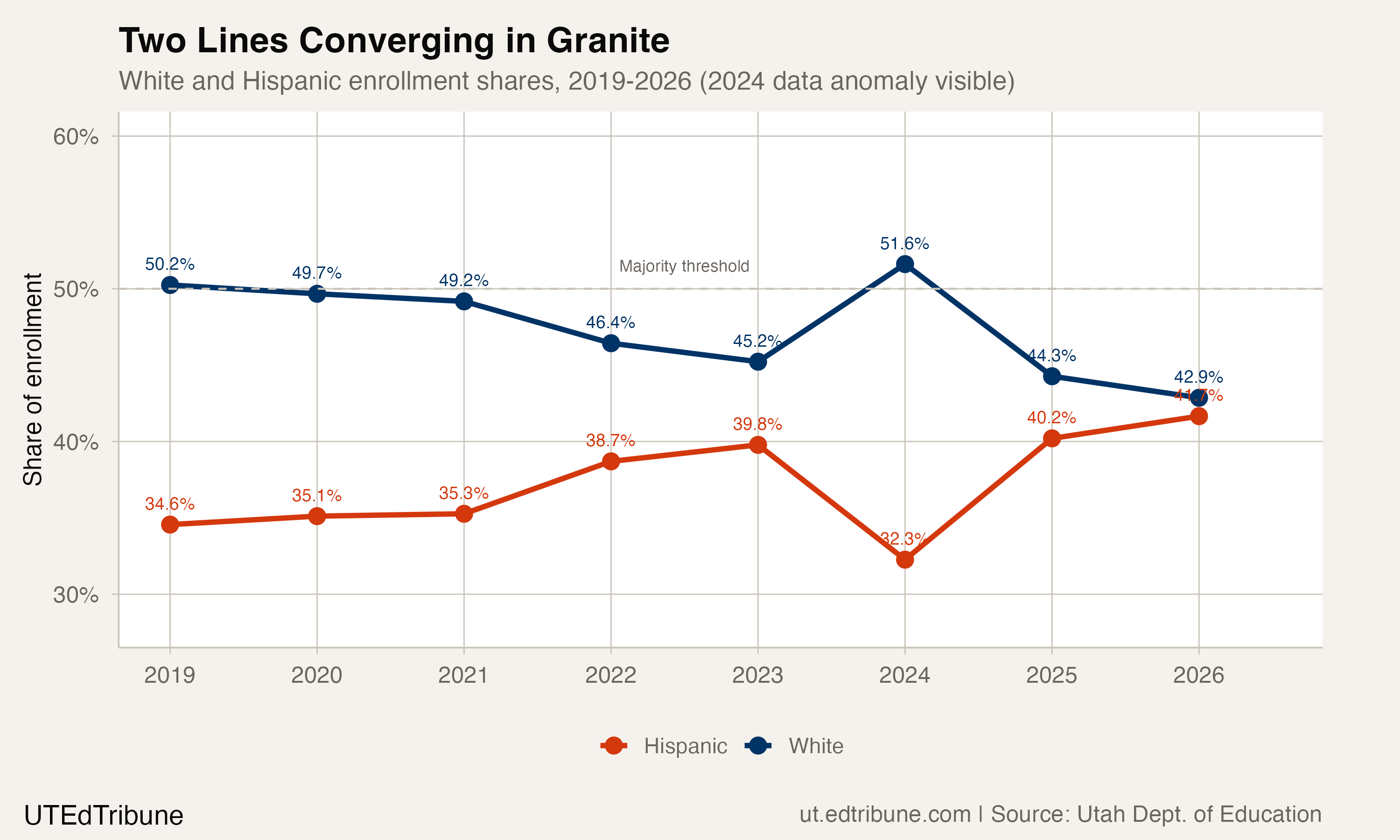
In 2019, white students held a bare majority in Granite District↗ET: 50.2% of enrollment, 15.7 percentage points ahead of Hispanic students. By fall 2025, that gap was 1.2 points. White students made up 42.9% of Granite's enrollment. Hispanic students made up 41.7%.
No one held a press conference. There was no board resolution or community meeting about the crossing. It happened the way most demographic milestones happen in American schools: gradually, then all at once, noticed mainly in the data long after the hallways already reflected it.
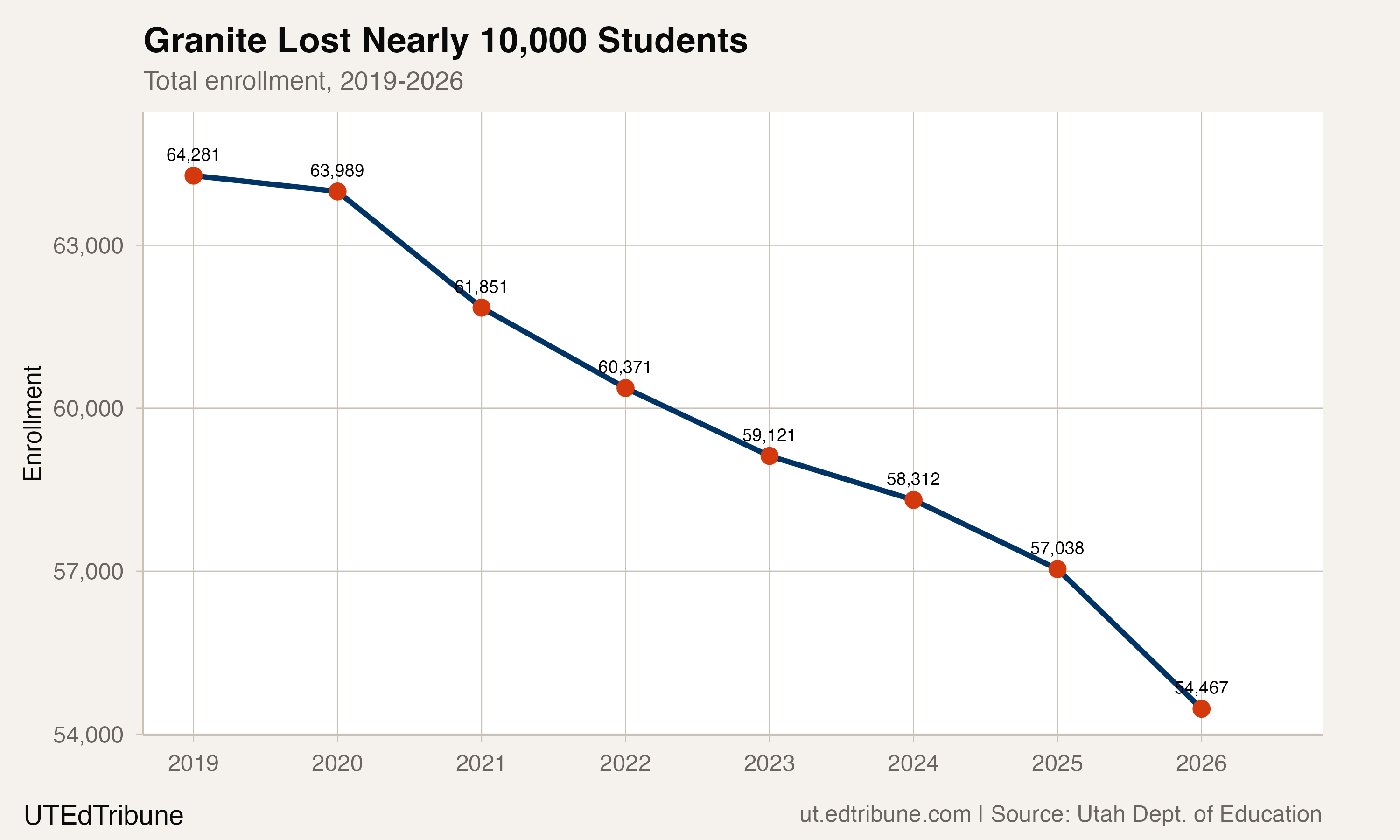
Granite is Utah's fourth-largest district, enrolling 54,467 students across a swath of the Salt Lake Valley that runs from the wealthy east side to the immigrant-rich west side. The majority-minority crossing is just one layer of a deeper transformation. The district has also lost 9,814 students since 2019, a 15.3% decline. It is simultaneously shrinking and diversifying, and the two trends are reinforcing each other.
The arithmetic of asymmetric departure
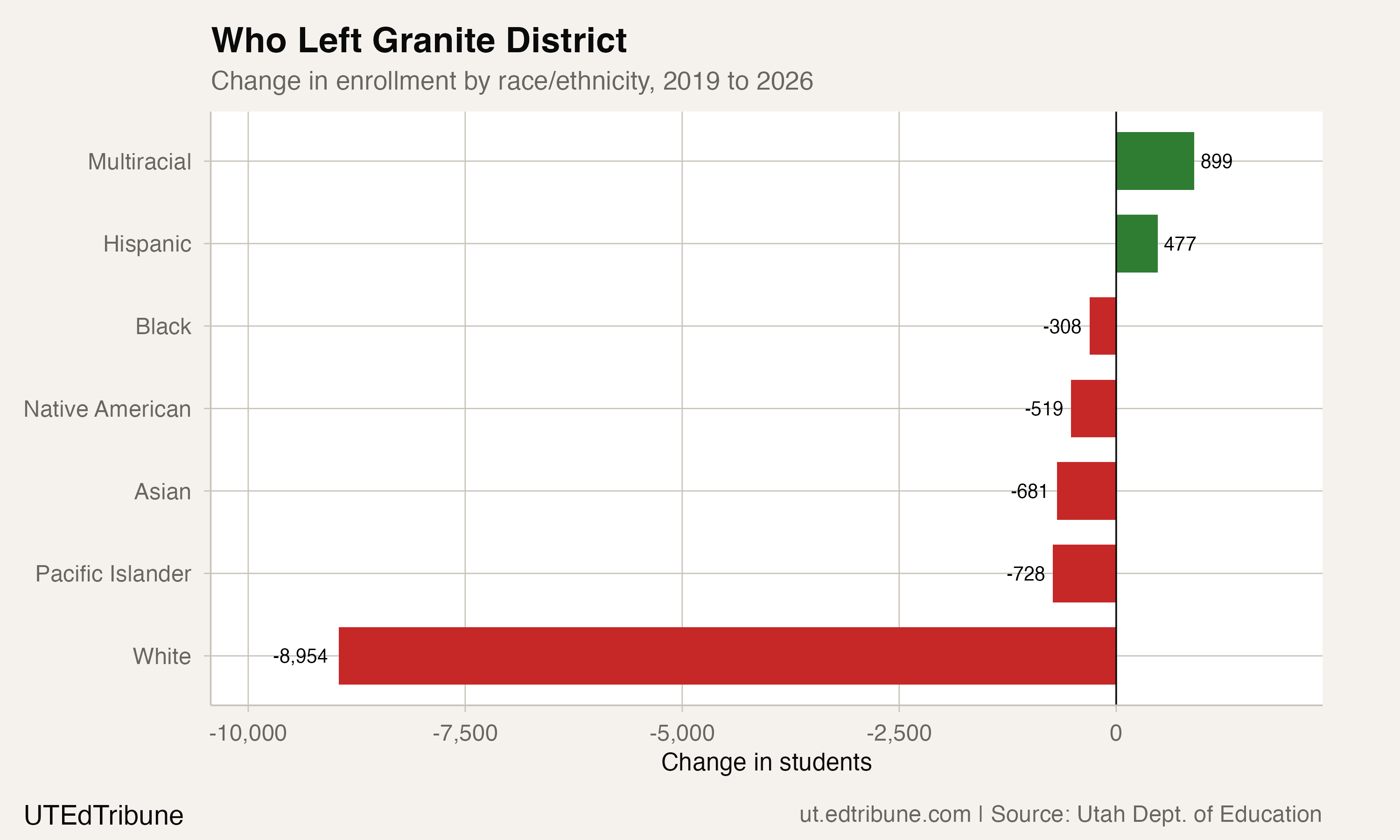
The demographic shift in Granite is not a story about Hispanic enrollment surging. Hispanic enrollment barely budged: 22,213 students in 2019, 22,690 in 2026, a gain of 477. The shift is almost entirely about who left.
White enrollment dropped from 32,300 to 23,346, a loss of 8,954 students, or 27.7%. That single group accounts for 91.2% of the district's net enrollment decline. Every other racial and ethnic group except Hispanic and multiracial students also shrank: Pacific Islander enrollment fell 25.3%, Asian enrollment fell 23.5%, Black enrollment fell 12.8%, and Native American enrollment fell 62.9%.
The pattern is consistent with selective out-migration rather than broad demographic decline. The groups most likely to have the means and mobility to choose charter schools, move to newer suburbs, or opt for private education appear to have done so. Families with roots in Granite's west-side communities, many of them first- or second-generation immigrants, stayed. The district's English learner share rose from 22.6% to 26.0% over the same period, even as total enrollment fell. One in four Granite students now receives English language services.
A district that does not look like its state
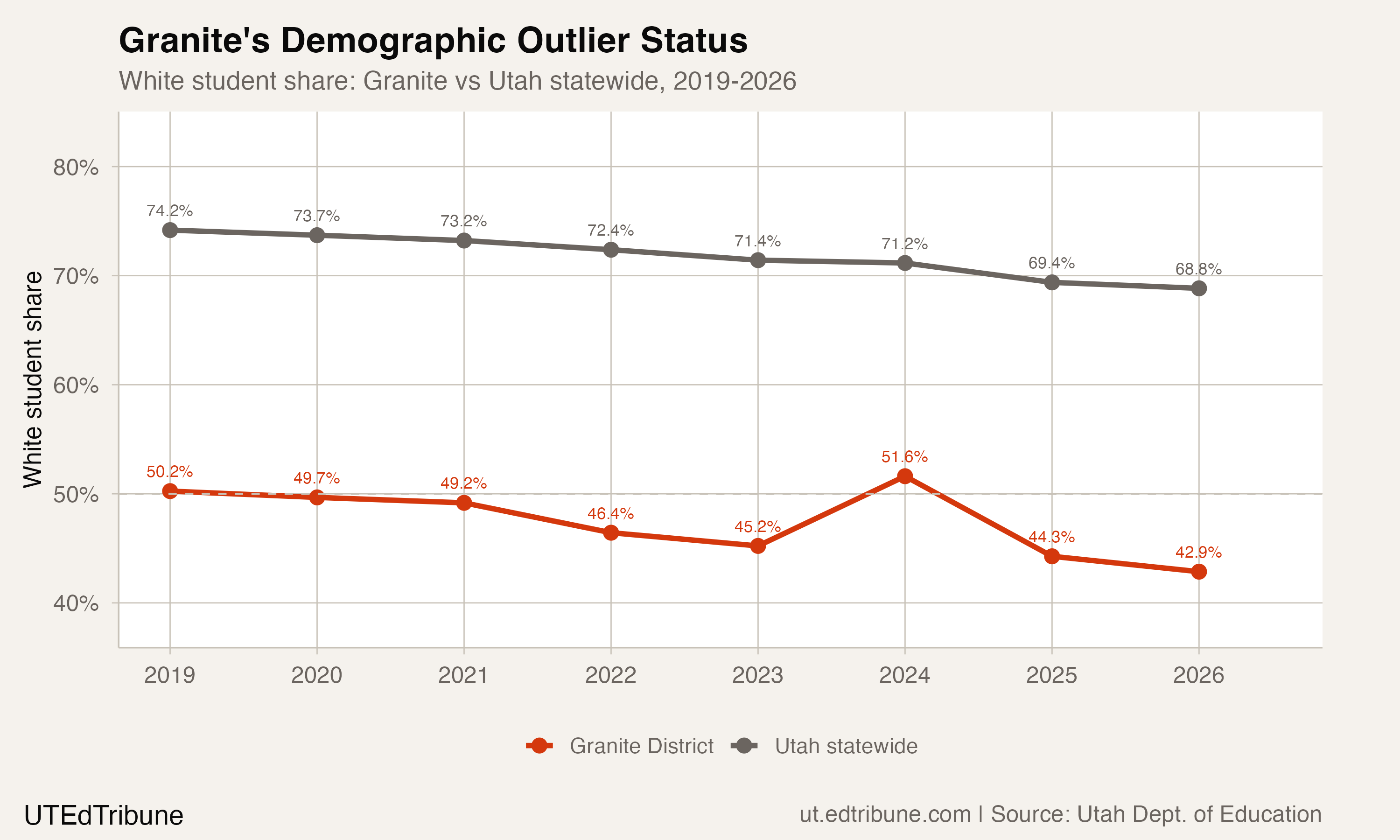
Utah remains one of the whitest states in the country by student enrollment: 68.8% white in 2026. Granite sits 25.9 percentage points below that statewide average. Among Utah's 10 largest districts, only Salt Lake District (40.1% white) is more diverse. The next-closest large district, Jordan, is 68.1% white.
Granite now has 58 minority-majority schools, more than any other district in Utah. Thirty-one of those schools have Hispanic majorities. The district's west-side schools, concentrated in West Valley City and parts of Taylorsville, serve a population that bears little demographic resemblance to the suburban districts ringing the Wasatch Front.
Where the families went
Three forces are operating on Granite simultaneously, and the enrollment data alone cannot rank them.
The most visible is school choice. Charter schools statewide now enroll 13% of Utah's public school students, up 3.6% in the most recent year alone. Granite's east-side schools face particularly intense competition. One analysis found that competitor schools within a 14-minute drive of the Skyline High network enroll 8,760 students, 69% more than all Skyline network schools combined. An estimated 35% of Skyline-area students do not attend their local public elementary school. The enrollment data cannot reveal whether charter exits skew white, but the geographic pattern (east-side losses outpacing west-side losses) is suggestive.
The second force is housing. The Wasatch Front's affordability crisis has rearranged who lives where. Natalie Gochnour, director of the Kem C. Gardner Policy Institute, told the Salt Lake Tribune that housing affordability is "moderating our growth" for both in-migration and retention. Granite's territory includes aging neighborhoods where new construction trends toward apartments and condos attracting young professionals, not the single-family homes that generate school enrollment.
The third is biological. Utah's total fertility rate dropped to 1.801 in 2023, falling from fourth-highest in the nation to tenth. The decline has been steepest among 25- to 34-year-old women. Granite's kindergarten enrollment dropped from 4,612 in 2019 to 3,389 in 2026, a 26.5% decline that signals the pipeline is not refilling.
Shrinking faster
The losses are not stabilizing. Granite lost 292 students in 2020, then 2,138 during the pandemic drop in 2021. The annual losses slowed to roughly 800 to 1,300 between 2022 and 2024. Then 2026 hit: 2,571 students gone in a single year, a 4.5% drop that matched Granite's worst pandemic-year loss and was the largest single-year decline in the dataset.
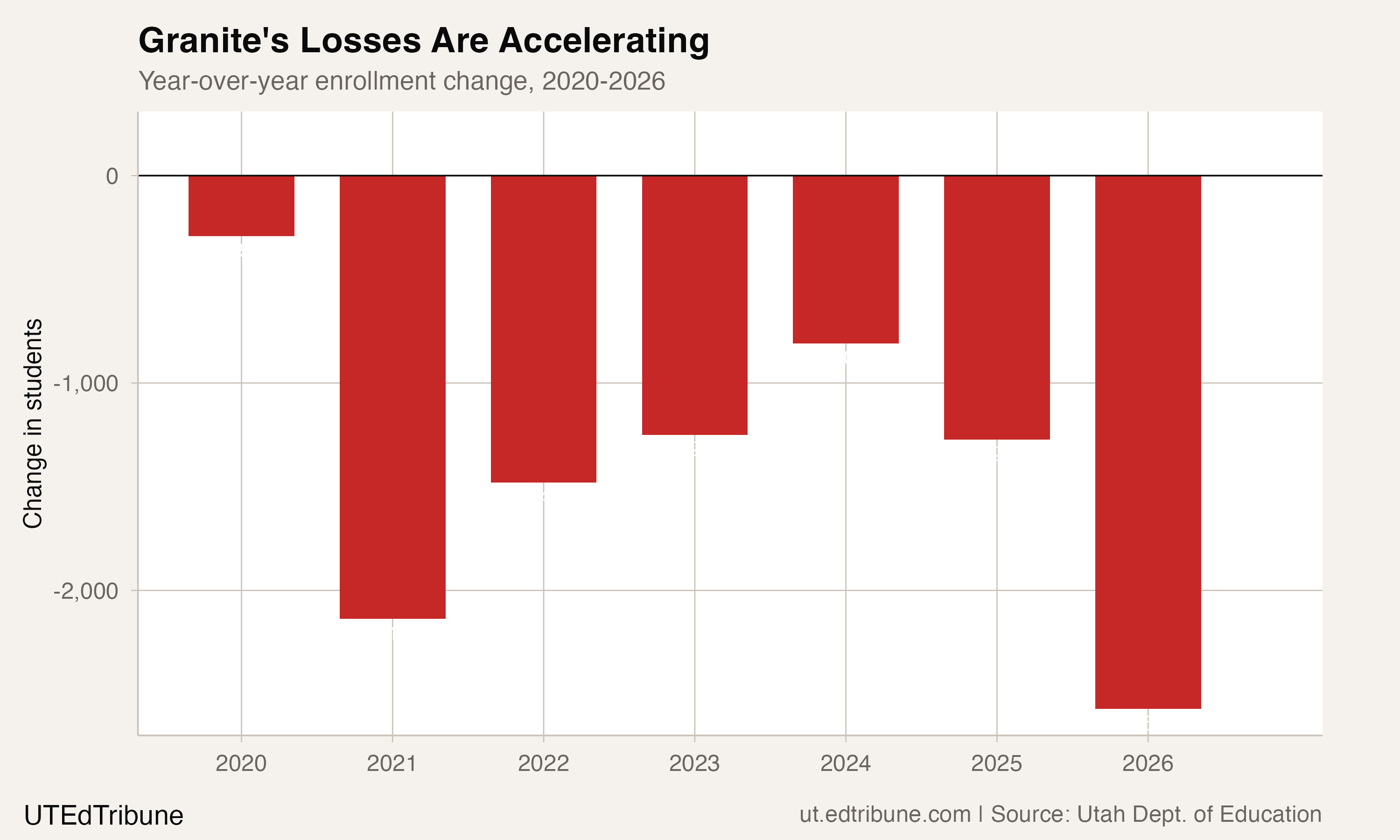
The 2026 acceleration mirrors the statewide pattern. Utah lost 11,478 students between fall 2024 and fall 2025, the largest single-year decline in at least 25 years. State Superintendent Molly Hart attributed it to "smaller birth cohorts, slowing in-migration and increased school choice."
"We seem to be exiting from the constant growth or the constant struggle to deal with the pressures of growth to ... this decline that we're seeing here." Aaron Brough, Utah Board of Education, KSL, January 2026
10 schools closed, more under study
Granite has already closed 10 schools in seven years. In late 2025, the board was studying the closure of two more east-side elementary schools, Eastwood Elementary in Millcreek and Morningside Elementary in Holladay. The board voted in November 2025 to suspend the closure study after community pushback and calls for an independent review.
"Those are very difficult decisions. There's a lot of memories packed into the bricks of every one of those schools." Ben Horsley, Granite School District Superintendent, KSL, January 2026
The closure debate reveals the geographic fault line within Granite. The east side, historically whiter and wealthier, is where enrollment is dropping fastest and where charter competition is fiercest. The west side, where Hispanic and Pacific Islander families are concentrated, has more stable enrollment but also higher concentrations of students whose instructional programs carry higher per-pupil costs: 26.0% English learners district-wide, 13.7% receiving special education services.
A note on the 2024 data
Granite's 2024 demographic data contains an anomaly. White share spiked to 51.6% that year, up from 45.2% in 2023 and before dropping back to 44.3% in 2025. Hispanic share simultaneously dropped to 32.3%. The 2024 numbers are inconsistent with the multi-year trajectory and with the absolute student counts (white enrollment in 2024 was reported as 30,098, higher than in 2020 despite overall enrollment falling by 5,677 students over that period). The most likely explanation is a data reporting issue in one year. The broader trend, visible in every other year of the dataset, is unambiguous.
What comes next
Granite District leadership has predicted an additional 10% enrollment drop in the next two years. If the white-Hispanic convergence continues at its current pace, Hispanic students will become the plurality group in Granite by 2027 or 2028. At that point, the district will have a student body that is majority-minority, plurality-Hispanic, and roughly 25% English learner, serving a metropolitan area where 68.8% of all public school students statewide are white.
Closing east-side schools frees some budget capacity. But the west-side schools where enrollment is more stable are the ones that need bilingual teachers, expanded EL programming, and specialized services that cost more per student than general instruction. The savings from consolidation on one side of the district may not reach the needs on the other. Granite's superintendent has predicted a further 10% enrollment drop. The district that quietly became majority-minority may find that its next milestone arrives just as quietly: the day it can no longer staff the bilingual classrooms its west side requires.
Detailed code that reproduces the analysis and figures in this article is available exclusively to EdTribune subscribers.
Discussion
Sign in to join the discussion.
Loading comments...