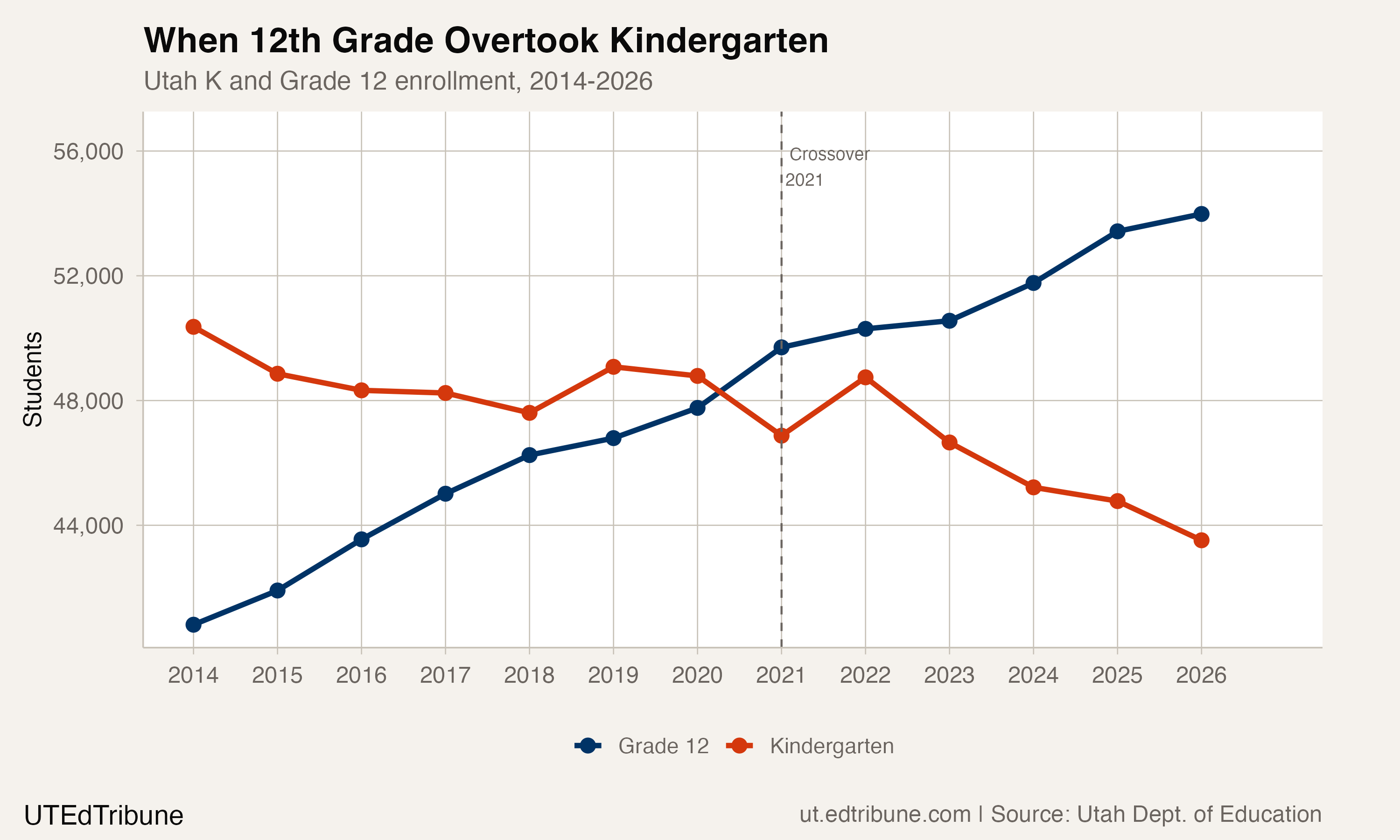
Twelve years ago, Utah enrolled 9,551 more kindergartners than 12th graders. By 2025-26, that relationship had flipped: grade 12 had 10,463 more students than kindergarten, a total swing of 20,014 students. The inversion first appeared in 2021, narrowed briefly in 2022, then widened sharply in each of the last four years. It reveals something more consequential than a single year's enrollment dip. A demographic wave is moving through Utah's school system, and the grade-by-grade data shows exactly where it has been, where it is now, and where it is headed.
Utah's kindergarten class has shrunk from 50,363 in 2014 to 43,519 in 2026, a loss of 6,844 students, or 13.6%. Over the same period, 12th grade grew from 40,812 to 53,982, a gain of 13,170 students, or 32.3%. The two lines crossed in 2021, when grade 12 hit 49,705 and kindergarten dropped to 46,874.
A wave with a timestamp on every grade
The data tells the story of a single demographic bulge moving upward through the system, one grade per year, like a bolus through a pipe. Every grade has a peak enrollment year, and those peaks form a near-perfect staircase: kindergarten peaked in 2014, first grade in 2015, second grade in 2016, third grade in 2017, and so on through grade 12, which hit its all-time high of 53,982 in 2026.
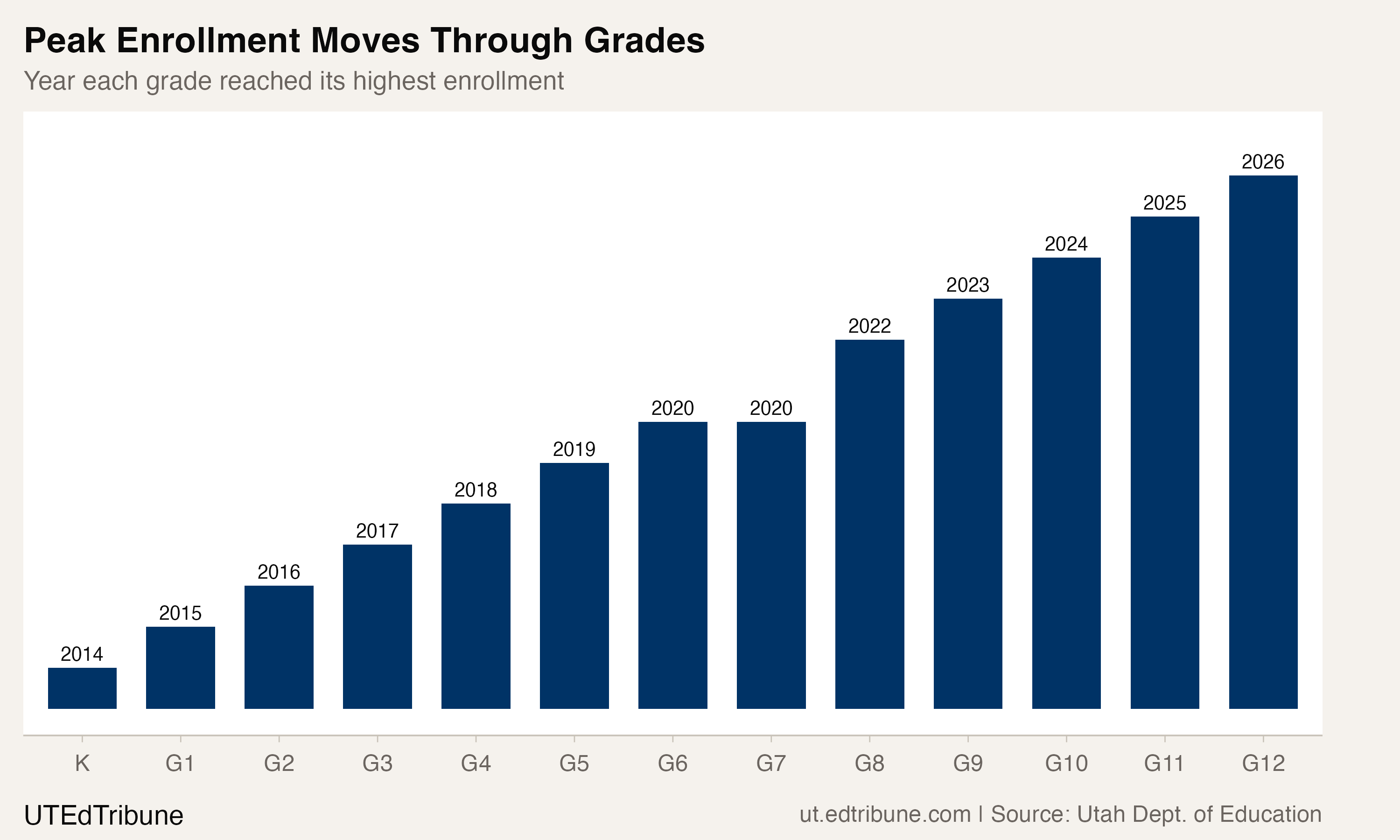
The pattern is mechanical. The large kindergarten classes of the early 2010s, themselves the children of Utah's high-fertility era, have been aging through the system. Behind them, smaller cohorts have filled in. The result is a system that now has 32.3% more seniors than it did 12 years ago but 13.6% fewer kindergartners.
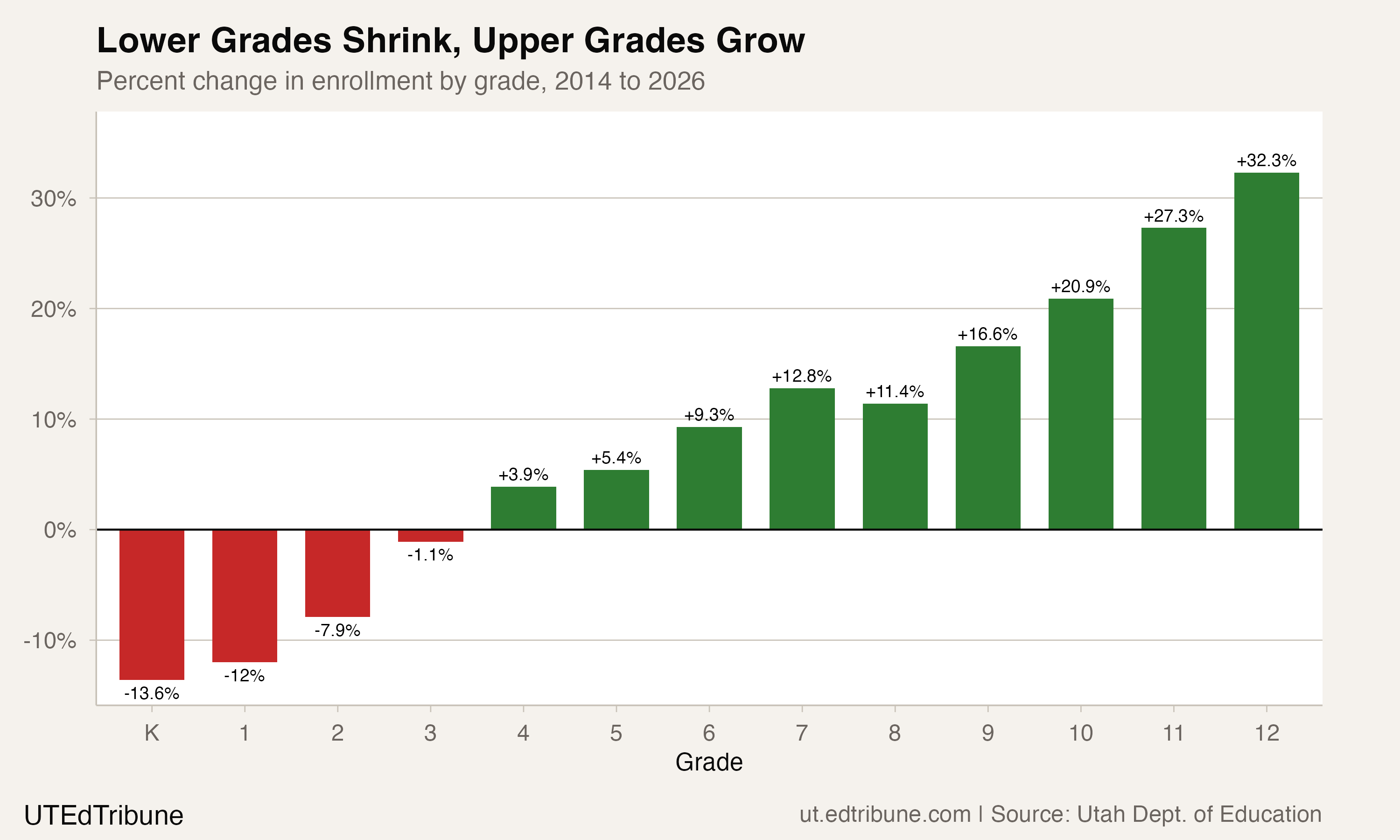
The grade-by-grade breakdown makes the gradient unmistakable. From 2014 to 2026, K through second grade lost students (K: -13.6%, grade 1: -12.0%, grade 2: -7.9%). Third grade is nearly flat at -1.1%. Fourth grade and above are all positive, with the gains accelerating monotonically through the upper grades: grade 9 is up 16.6%, grade 10 up 20.9%, grade 11 up 27.3%, grade 12 up 32.3%.
The fertility shift behind the numbers
The most likely driver of shrinking kindergarten classes is Utah's falling birth rate, though school choice programs, including the Utah Fits All voucher program launched in recent years, may also be redirecting some families away from public schools. Utah held the nation's highest fertility rate until 2016. By 2023, the state had dropped to 10th nationally, with a total fertility rate of 1.8 children per woman, well below the 2.1 replacement threshold. The Kem C. Gardner Policy Institute projects the rate will decline further, to roughly 1.6 by 2065, converging with the national average.
BYU demographer Spencer James has pointed to two forces driving the decline. The cultural and religious norms that historically sustained Utah's large families are weakening among younger cohorts.
"Today's generation that is in its prime childbearing years -- the 25 to 40 range -- is arguably the least religious of any generation in Utah history. And so that is certainly going to affect the fertility rate." -- KUER, May 2025
Housing costs and childcare affordability compound the trend. The children being born in the mid-2020s are the kindergartners of 2031 and 2032. If the fertility decline continues at its current pace, those classes will be smaller still.
What this means at the building level
Aggregated to school level, the wave's path becomes a fiscal timeline. Elementary schools (K-5) peaked at 306,140 students in 2017 and have since lost 20,556, a 6.7% decline. Middle schools (6-8) peaked in 2020 at 161,796 and have shed 5,671 students. High schools (9-12) peaked just last year at 216,526, and in 2026 they fell for the first time, losing 1,925 students.
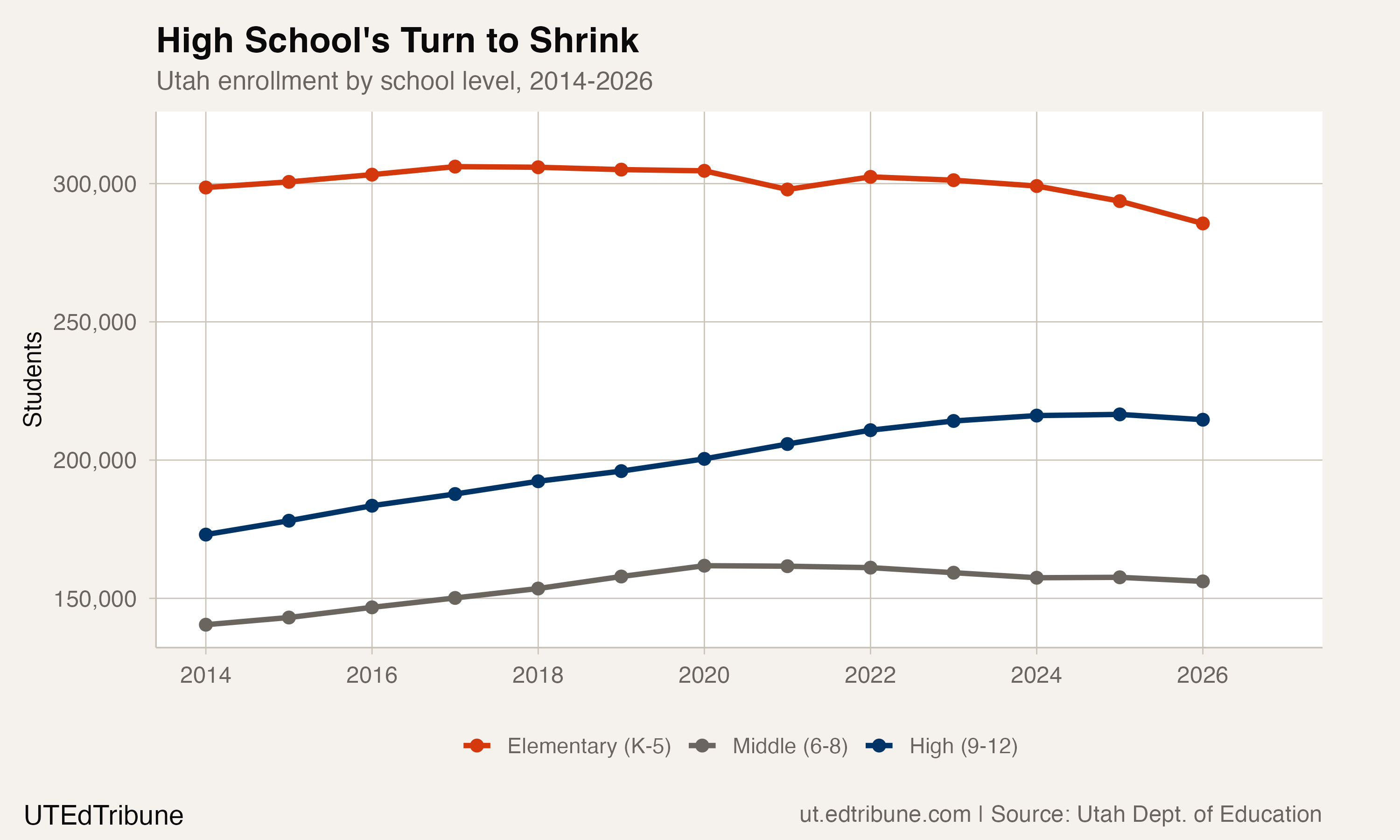
Elementary schools have been managing declining enrollment for nearly a decade. Granite School District has studied 10 elementary schools in its easternmost neighborhoods for potential consolidation, citing classrooms forced to combine multiple grade levels with a single teacher. Salt Lake City School District closed four elementary schools in 2024. Canyons School District is reviewing its own consolidation options.
High schools, by contrast, spent the last decade expanding. They absorbed the wave. Now the wave has crested. Grade 9, the feeder for high school enrollment, peaked at 55,330 in 2023 and has dropped in each of the three years since: -979 in 2024, -693 in 2025, -340 in 2026. The 9th grade class of 2026 (53,318) is 3.6% smaller than the 9th grade class of 2023. That contraction will ripple upward through 10th, 11th, and 12th grade over the next three years.
The gap between K and 12 as a leading indicator
The K-to-12 gap is more than a curiosity. It is a 12-year forecast of how many students will pass through every intervening grade.
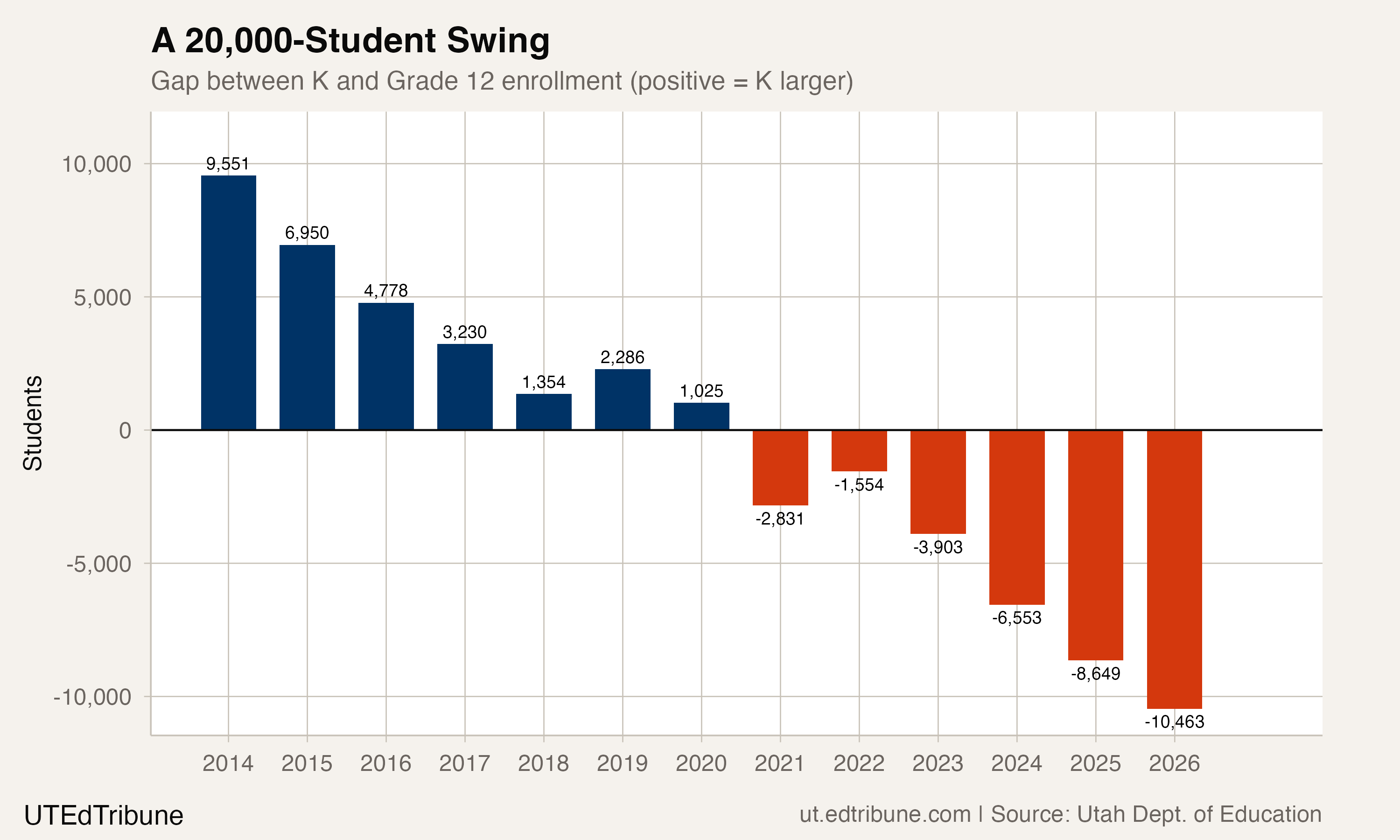
In 2014, kindergarten's 9,551-student advantage over grade 12 signaled that the system would grow for the next decade. It did, peaking at 674,650 in 2023. The 2025-26 gap of -10,463 signals the opposite: every grade in the system will, over time, see its enrollment fall closer to the size of the 2025-26 kindergarten classes than the 2025-26 senior classes.
Utah's Weighted Pupil Unit funding system ties state revenue directly to enrollment counts. State Superintendent Molly Hart has attributed the decline to "smaller birth cohorts, slowing in-migration, and increased school choice." The 2025-26 enrollment of 656,310 represents a loss of 18,340 students from the 2023 peak, and the state projects enrollment to fall by roughly 62,000 students, or 9%, through 2032.
The countdown for high schools
The operational question for the next three years is straightforward. Elementary principals have already lived through the contraction. Middle school principals are in the middle of it. High school principals are next.
The 2026 senior class of 53,982 is the largest in Utah history. It is also the last class to carry the full weight of the high-fertility era's birth cohorts. The 9th graders entering in 2027, 2028, and 2029 will be drawn from cohorts born between 2012 and 2014, when Utah's fertility rate had already been falling for several years. High school enrollment, which grew every single year from 2014 through 2025, is unlikely to see another peak for a generation.
The contraction has already reached high schools. It arrived in 2026. Elementary schools have been managing it for nearly a decade -- closing buildings, combining grades, redrawing attendance zones. High schools spent that same decade expanding. Now they are next, and the 9th grade class shrinking for the third straight year gives them roughly three years to prepare. The wave moves at the speed of a child aging one grade per year. It is not fast. But it does not stop.
Detailed code that reproduces the analysis and figures in this article is available exclusively to EdTribune subscribers.
Discussion
Sign in to join the discussion.
Loading comments...