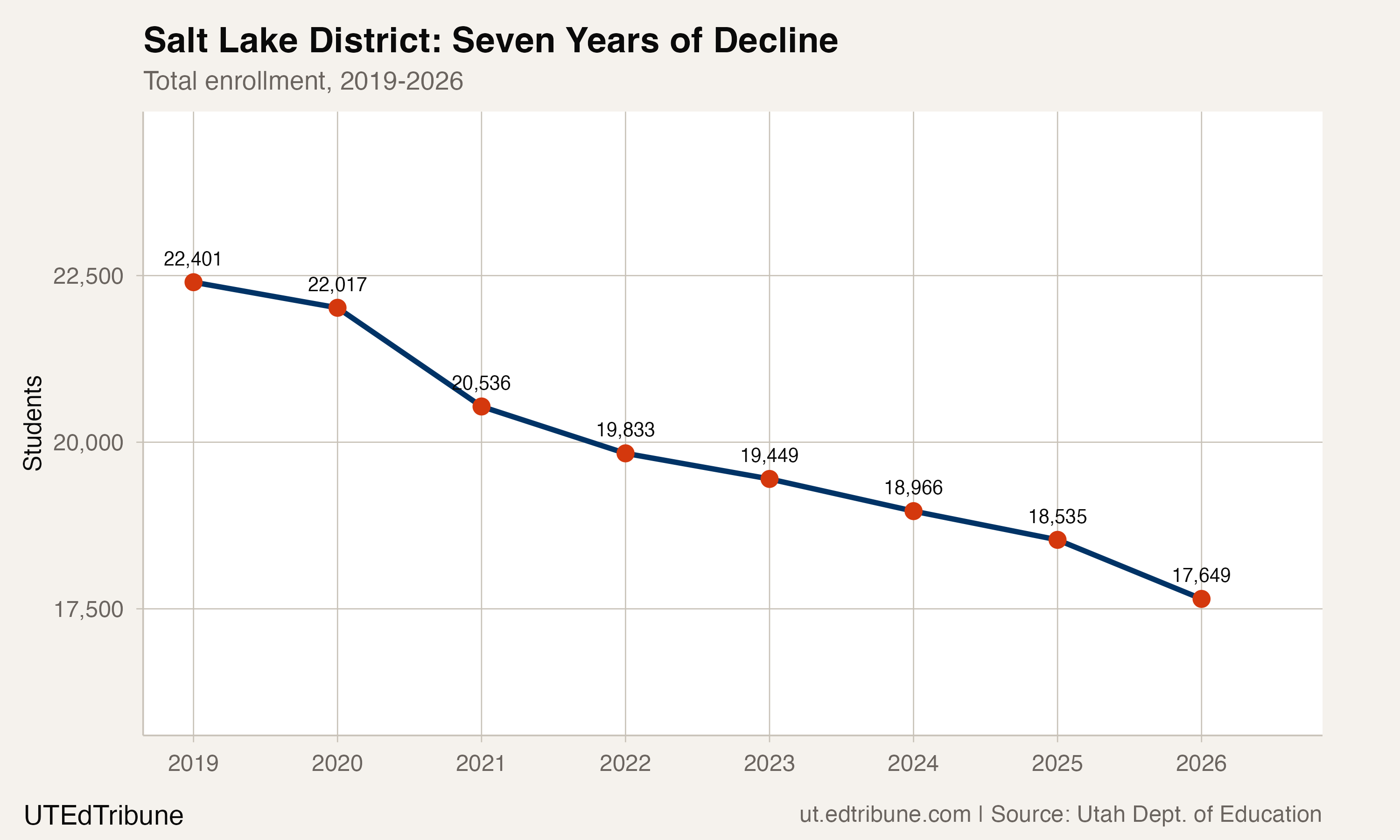
In the 2018-19 school year, Salt Lake District↗ET enrolled 22,401 students. By 2025-26, that number was 17,649. The district lost 4,752 students, a 21.2% decline, without a single year of recovery. No other large district in Utah comes close.
Granite District, which surrounds Salt Lake City on three sides, lost 15.3% over the same period. Provo lost 19.5%. But Salt Lake District's 21.2% stands apart: the steepest seven-year decline among all 20 Utah districts with at least 5,000 students. The district that once enrolled more than 40,000 students during the baby boom now ranks 10th among the state's 41 traditional districts.
Every year worse than the one before it, except for the pandemic year that was worse than all of them
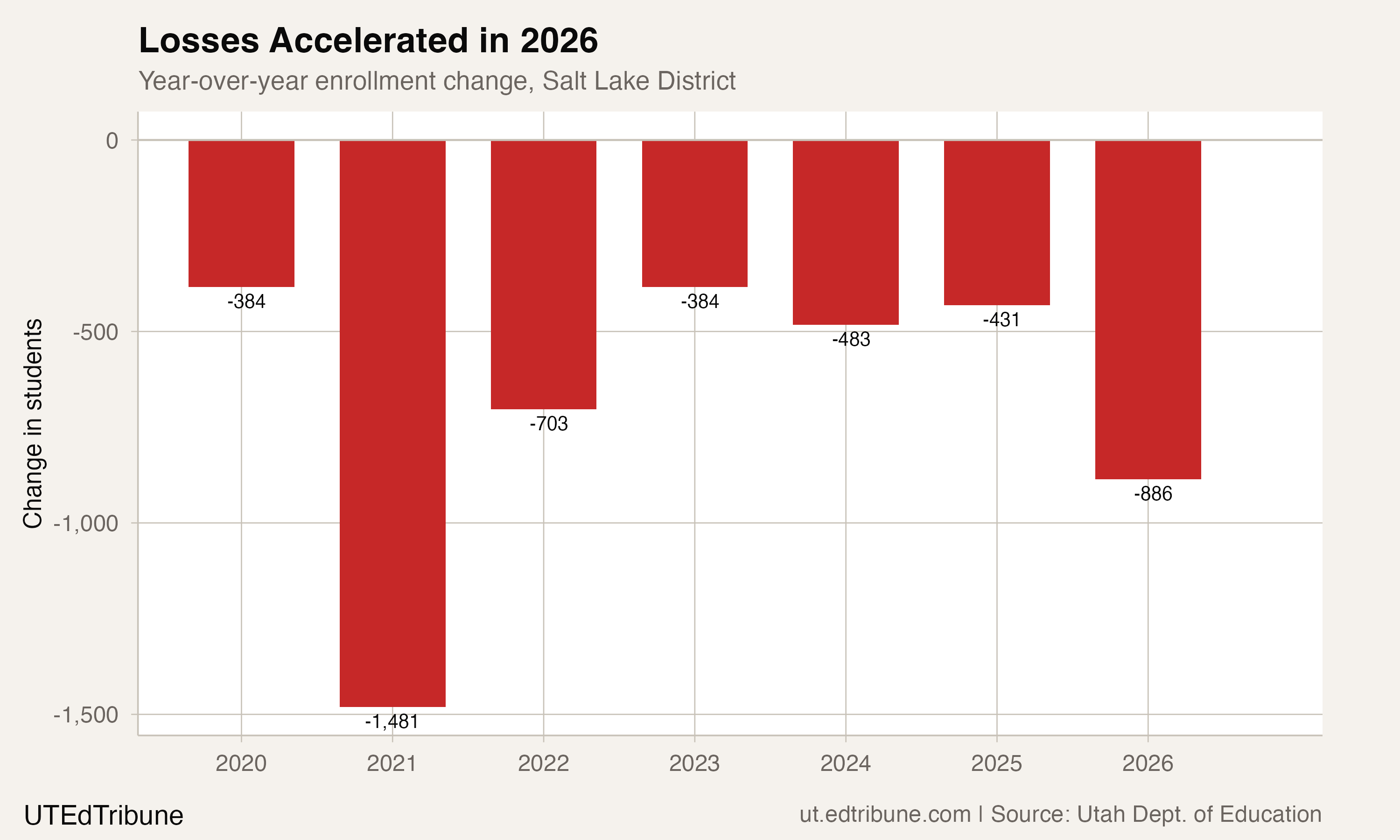
The year-over-year numbers trace a district that has never stabilized. The pandemic year of 2020-21 produced the sharpest single loss: 1,481 students, a 6.7% drop. Losses then moderated to 384 in 2022-23 and 431 in 2024-25. But the 2025-26 school year reversed that easing. Salt Lake District lost 886 students, a 4.8% decline, the worst single year since the pandemic shock.
Board member Ashley Anderson framed the pattern bluntly in October 2025: "It is definitely not an anomaly. It is a 10-year trend of decline."
The pipeline is shrinking fastest
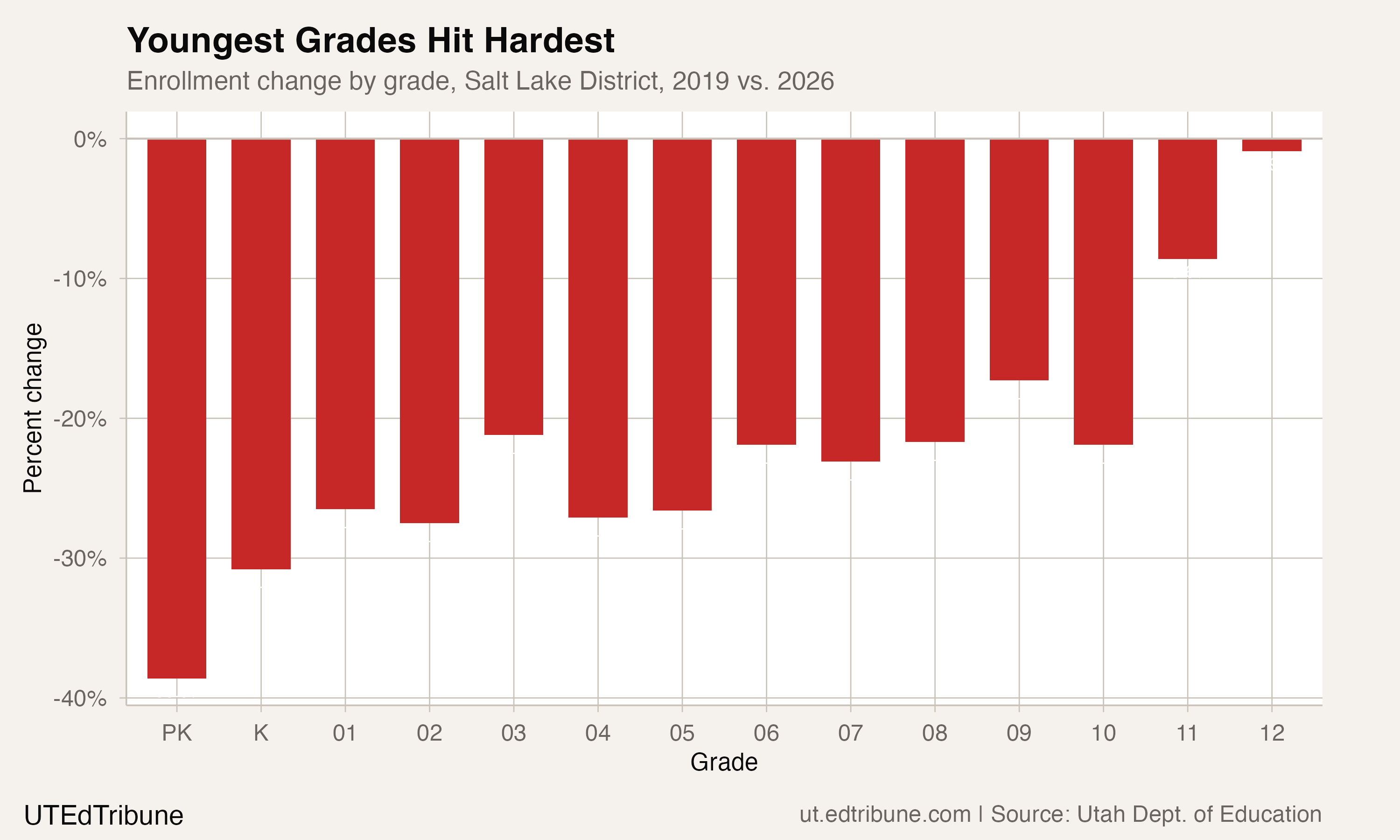
The decline is not spread evenly across grade levels. Pre-K enrollment fell 38.6%, from 792 to 486 students. Kindergarten fell 30.8%, from 1,735 to 1,201. First and second grade both dropped more than 26%. By contrast, 12th grade lost just 15 students, less than 1%.
The pattern is a pipeline signal. The students entering Salt Lake District's schools are a shrinking cohort, while the students graduating out reflect the larger classes of years past. As each smaller kindergarten class moves through the system, the losses will propagate into middle and high school over the next decade.
Where the families went
Three forces converge on Salt Lake District, and none of them is likely to reverse soon.
The most direct is housing. A January 2022 study by Applied Economics commissioned by the district identified gentrification, declining household sizes, an aging population, and falling birth rates as the primary drivers. The median home sale price in the Salt Lake metropolitan area reached $550,000 in 2025, and in-migration to the metro area remains at historic highs. But the people moving in are disproportionately young adults without children. The people moving out are families who can no longer afford a home in the district's boundaries.
"I think that demographically, there are not many places to go anymore that families can afford in Salt Lake City boundaries. I just haven't had any people with kids really call me and say, 'Hey, we need to find a house in the city.'" Source: The Salt Lake Tribune, Oct. 2023
The second force is Utah's collapsing fertility rate. The state's total fertility rate has declined for 15 consecutive years, falling to 1.801 births per woman in 2023, well below the 2.1 replacement level. Utah dropped from the fourth-most-fertile state to 10th in a single year. The decline was steepest among women aged 25 to 34, the prime family-formation cohort. Fewer births statewide means fewer kindergartners everywhere, but the effect concentrates in urban districts where housing costs compound the demographic shift.
Charter school expansion provides a competing explanation. Statewide, charter enrollment grew from 78,384 to 85,268 between 2019 and 2026, an 8.8% gain, while traditional district enrollment fell 1.6%. The enrollment data does not isolate how many Salt Lake District families chose charters, but the district's boundary overlaps with dozens of charter options. A 2025 legislative proposal to give charter schools first rights to purchase closed district buildings underscored the competitive dynamic.
Four schools closed. More are coming.
Salt Lake District operated 38 schools with students in 2019. By 2026, that number was 34. In January 2024, the board voted 4-3 to close Hawthorne, M. Lynn Bennion, Mary W. Jackson, and Riley elementary schools. Two other schools, Children Behavior Therapy Unit and Innovations High School, also disappeared from the enrollment rolls. One small new program, Sky View Academy, appeared with a single student.
Among the 32 schools that can be compared across both years by name, every one lost enrollment except four: Rose Park (+25 students), Meadowlark (+29), Nibley Park (+29), and Ensign (+60). Highland High gained 198 students, the lone bright spot at scale. But North Star Elementary lost 46.7% of its students, Horizonte Instruction and Training Center lost 45.6%, and Highland Park lost 33.1%.
Superintendent Elizabeth Grant warned in January 2024 that the closures were not the last: "This will come up again." By fall 2025, she was preparing the community for the next round: "I want our community to know these numbers so that when we do bring up the worst decision-making around closing schools, there's an understanding of why that would even be on the table."
Who remains
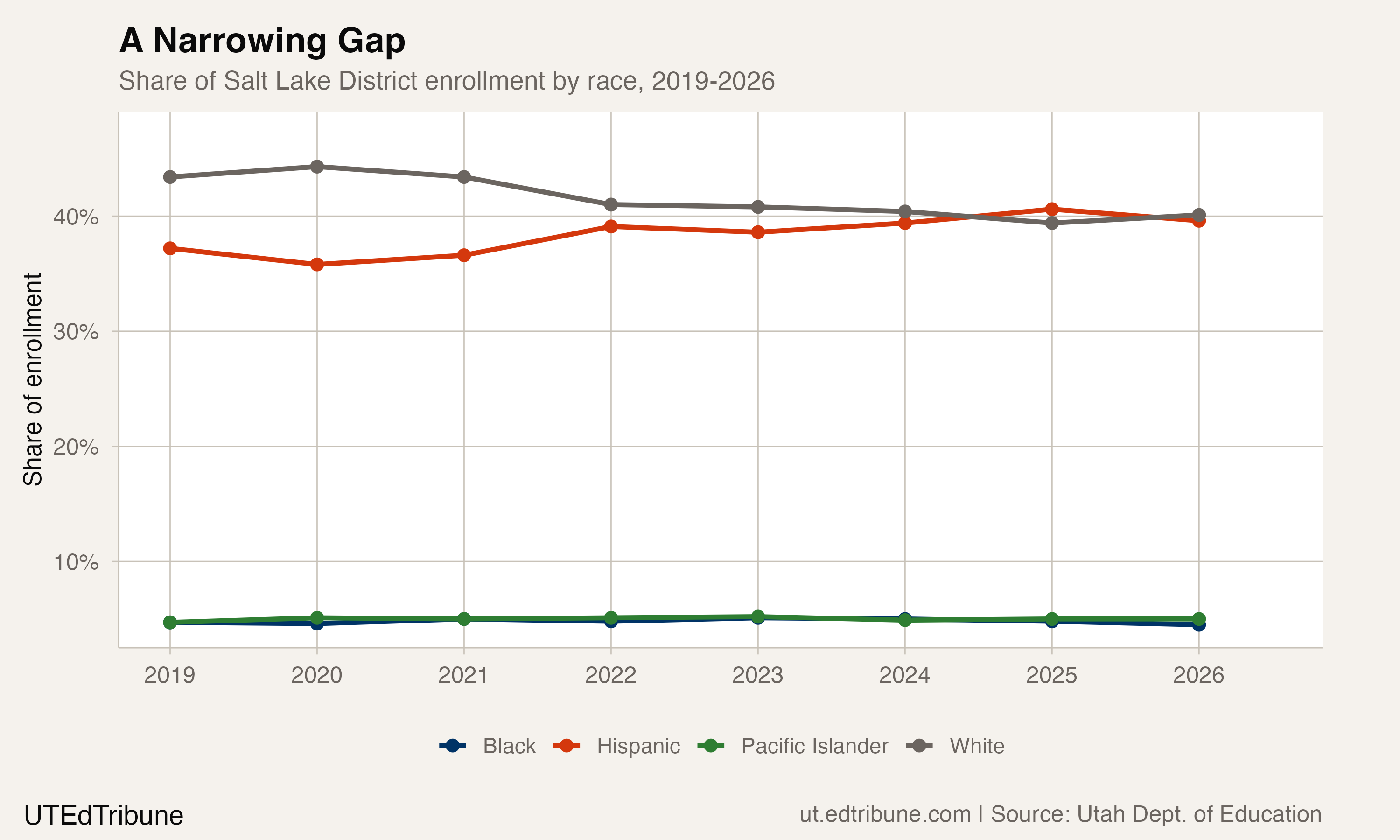
The demographic profile of the district's student body shifted as enrollment fell. White enrollment dropped from 43.4% to 40.1% of the district, a loss of 2,631 students. Hispanic enrollment fell in absolute terms, from 8,343 to 6,985, but its share rose from 37.2% to 39.6%. In 2024-25, Hispanic students briefly became the district's largest group at 40.6%, before white students regained a narrow lead in 2025-26 at 40.1% to 39.6%.
Pacific Islander students, who make up 5.0% of Salt Lake District compared to 1.7% statewide, lost 166 students but held their share steady.
The district's economically disadvantaged population tells a different story. In 2019, 13,164 students, 58.8% of enrollment, qualified as economically disadvantaged. By 2026, that number fell to 8,727, a loss of 4,437 students. The share dropped to 49.4%. Low-income families, the population most sensitive to housing costs, left at nearly the same rate as the district lost students overall. That pattern is consistent with displacement: when rents rise, families with fewer resources leave first. Board member Bryan Jensen noted that rising property values force renters to relocate even when they want to stay.
Separately, special education enrollment declined from 2,721 to 2,499 students, but its share of the student body grew from 12.1% to 14.2% as the district shrank around it. English learner enrollment fell from 4,768 to 3,732 while holding steady at roughly 21% of the total.
Deepest in the state, and not done
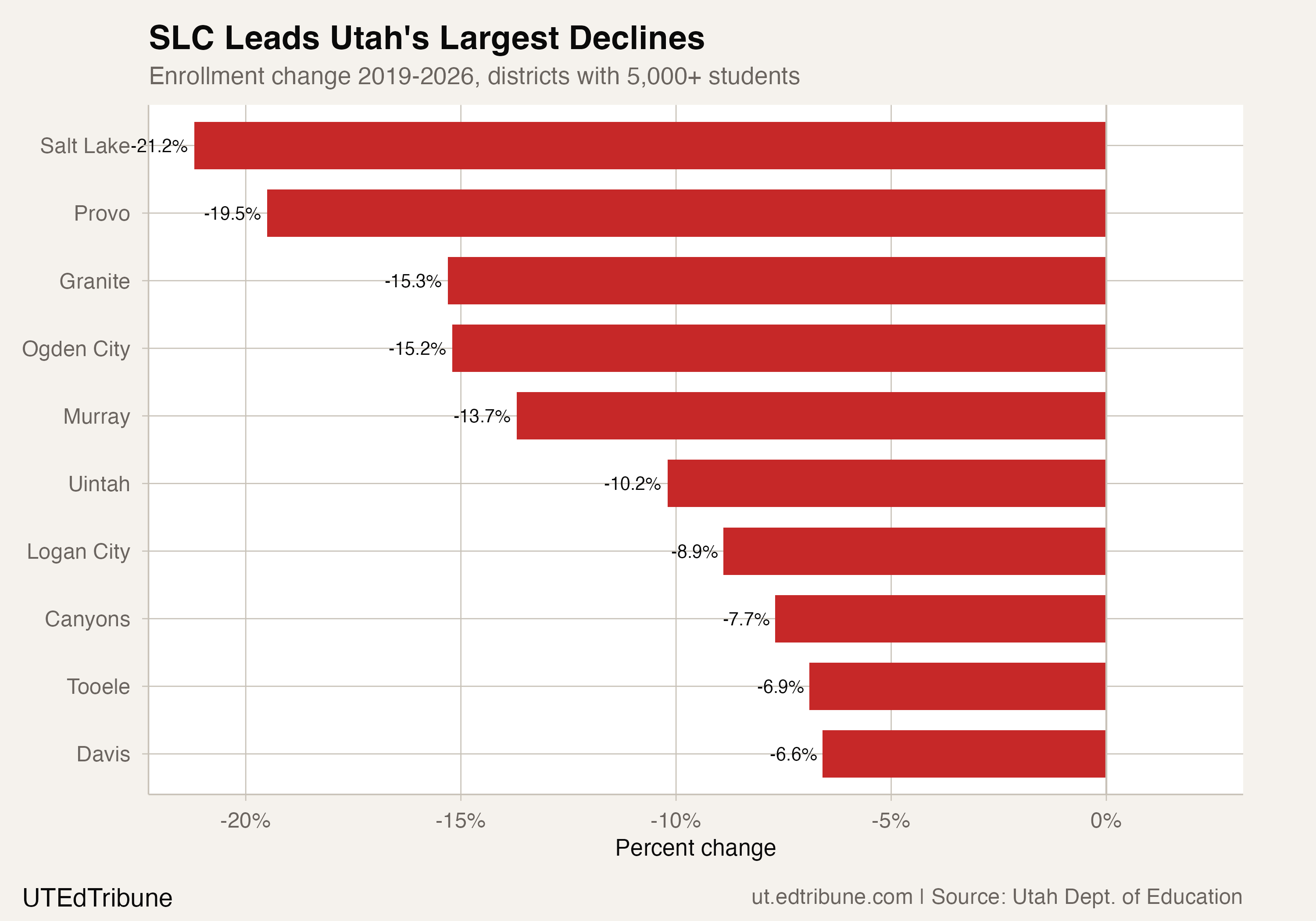
Salt Lake District's 21.2% decline is the deepest seven-year loss among Utah's large districts. The gap between Salt Lake and the second-worst performer, Provo at 19.5%, is small. But both are in a different category from Granite (-15.3%), Ogden City (-15.2%), or Murray (-13.7%).
The distinction matters because Salt Lake City is Utah's capital, its cultural center, and one of its most expensive real estate markets. The city's population is growing. The district's enrollment is not. A demographer hired by the district put it plainly: "The nature of that growth is just shifting away from the school-age population. It's obviously gentrifying."
The 2026 kindergarten class, at 1,201 students, is essentially identical to 2025's class of 1,200. That flat line does not signal a floor. It signals that the pipeline feeding Salt Lake District's elementary schools has stabilized at 30% below where it was seven years ago. Each of those smaller cohorts will flow through the system for the next 13 years. Superintendent Grant has told the community to prepare for more closures. The four schools shuttered in January 2024 will not be the last. Meanwhile, a demographer hired by the district put it simply: "It's obviously gentrifying." The city is growing. The district is not. That gap defines the next decade.
Detailed code that reproduces the analysis and figures in this article is available exclusively to EdTribune subscribers.
Discussion
Sign in to join the discussion.
Loading comments...