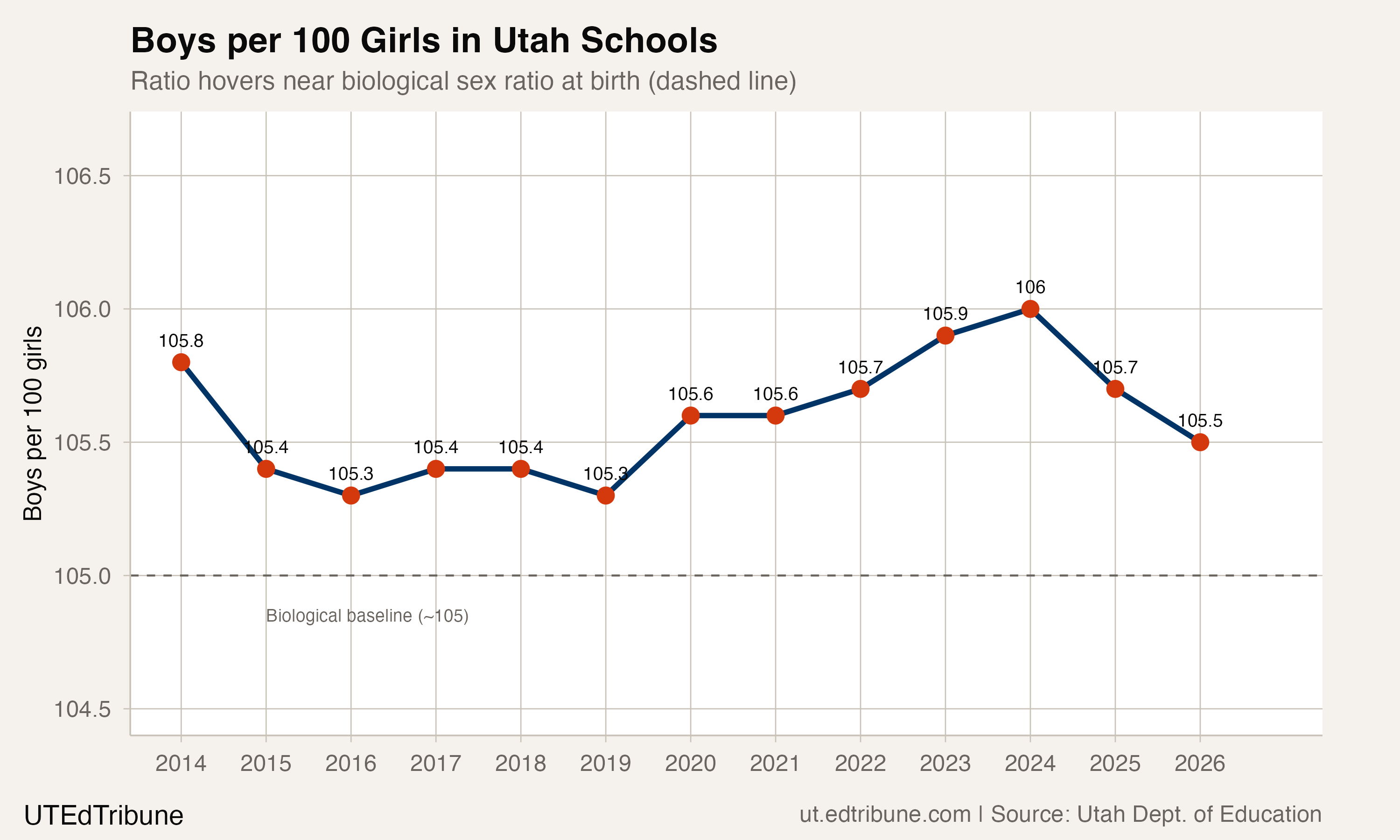
For every 100 girls sitting in a Utah classroom, there are 105.5 boys. That ratio, holding steady within a narrow band for 13 years, means Utah's public schools enroll 17,532 more male than female students in 2025-26. The gap peaked at 19,537 in 2023-24, when the ratio briefly touched 106 boys per 100 girls, the highest in the dataset.
The surplus is not a policy outcome. It is, to a first approximation, the human sex ratio at birth showing up in school enrollment data. The expected biological ratio is roughly 105 boys per 100 girls. Utah has hovered between 105.3 and 106.0 across every year since 2013-14, never straying far from that biological baseline.
Where the gap lives
The statewide ratio masks meaningful variation at the district level. Among traditional districts with more than 1,000 students, male enrollment share in 2025-26 ranges from 49.7% in Grand District to 53.8% in Carbon District. Washington District, in the fast-growing St. George corridor, runs consistently above the state average at 52.0% male, a gap of 1,354 students.
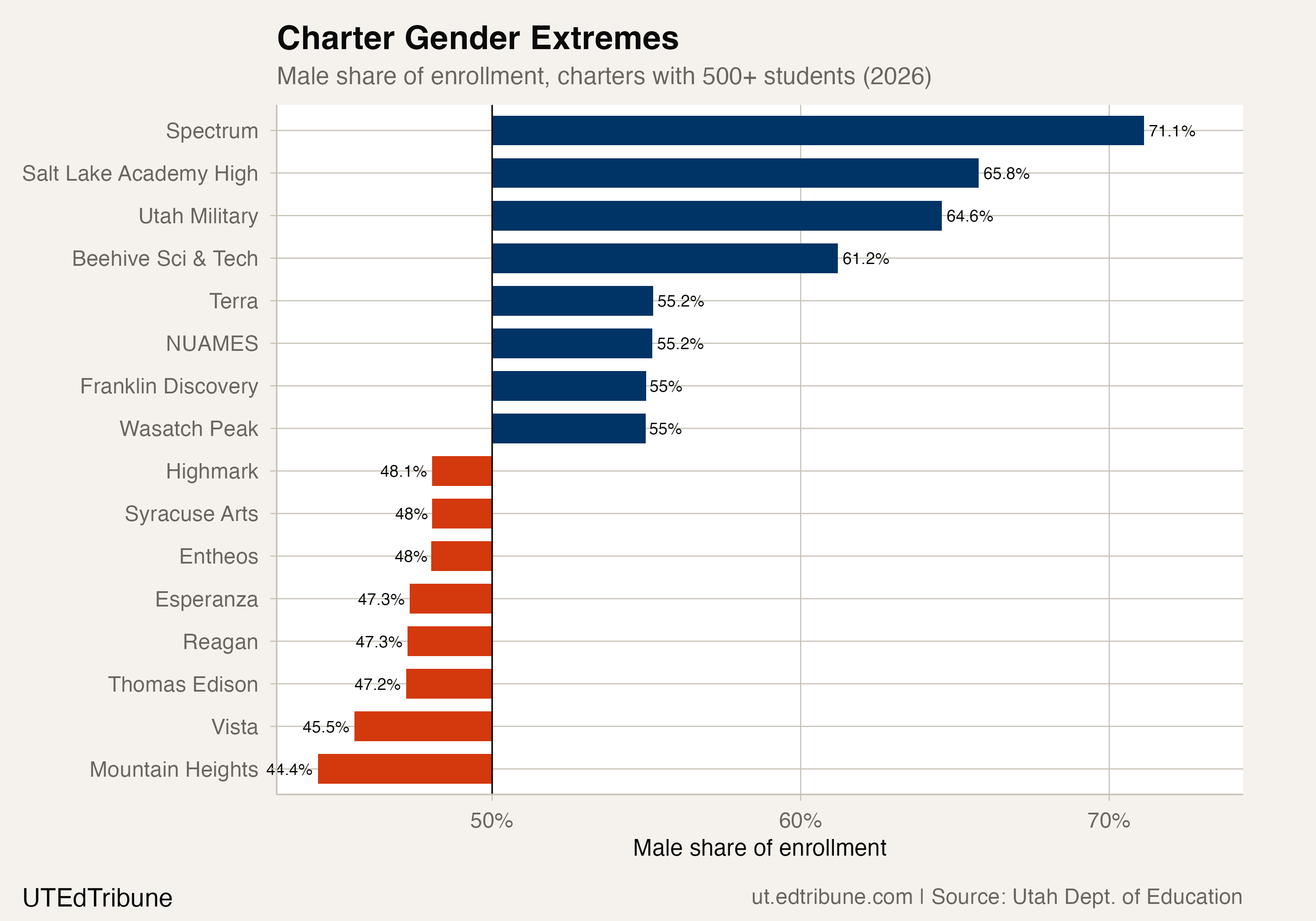
But the real extremes are in the charter sector. Spectrum Academy, a charter school founded in 2006 specifically for students with autism, enrolls 1,572 students and is 71.0% male. That skew is a direct reflection of autism's gender disparity: boys are 3.2 to 3.8 times more likely to be identified with autism than girls, according to University of Utah Health researchers. Spectrum's special education enrollment rate of 80.9% confirms the connection.
Utah Military Academy, a tuition-free charter with campuses in Riverdale and at Camp Williams, enrolls 1,163 students and is 64.6% male. Salt Lake Academy High School runs 65.8% male. Beehive Science and Technology Academy is 61.1% male.
On the other end, Mountain Heights Academy, a virtual charter, is 55.7% female. Vista School is 54.5% female. Thomas Edison, Reagan Academy, and Esperanza School all enroll more girls than boys.
The sector split
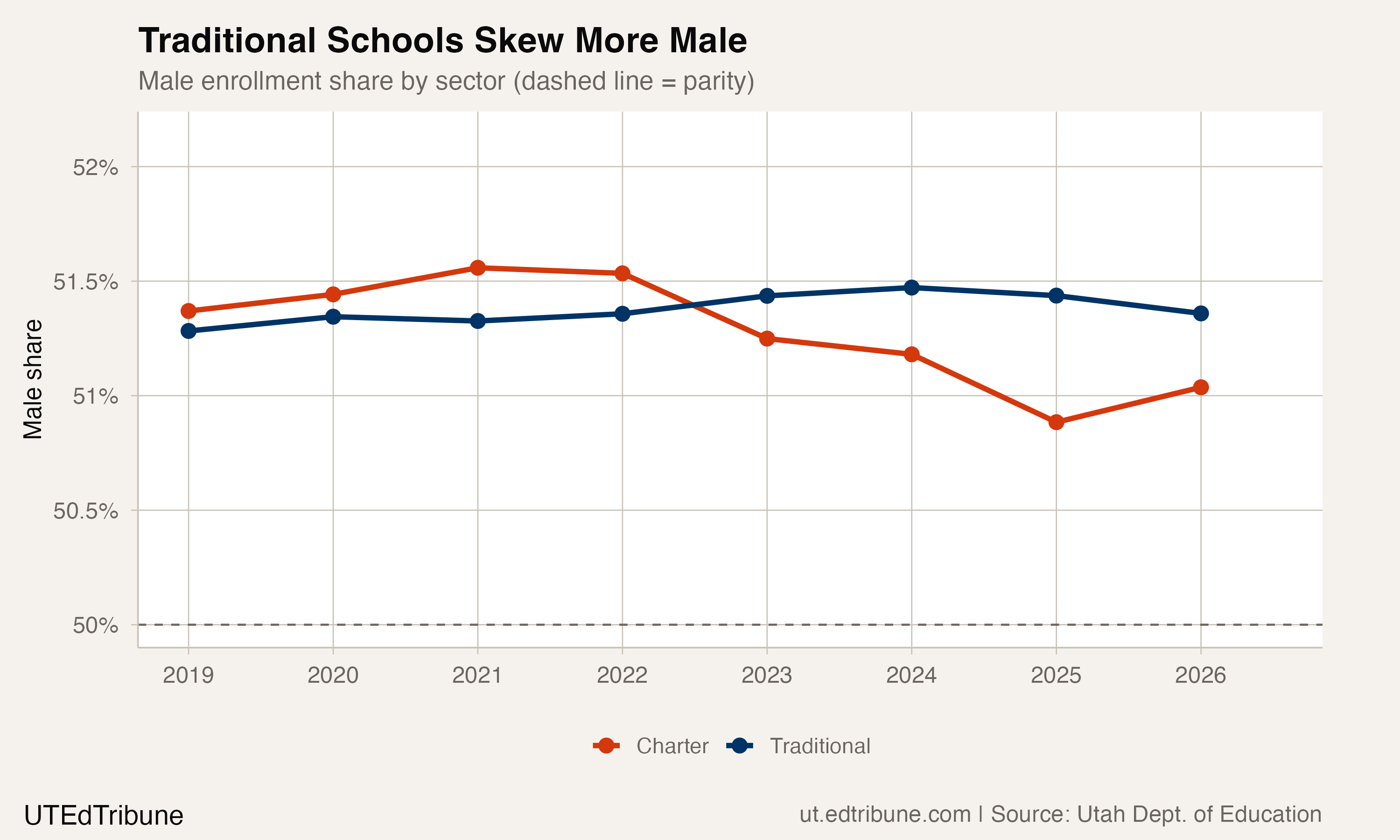
Aggregated across all campuses, traditional districts run 51.4% male and charter schools run 51.0% male. That gap has widened. In 2019-20, charters were actually slightly more male-heavy at 51.4%, matching the traditional sector. By 2025-26, charter male share had dropped to 51.0% while traditional districts held at 51.4%.
The shift likely reflects charter sector composition. Utah's charter landscape includes arts-focused, virtual, and language immersion schools that tend to enroll more girls than boys, alongside STEM and military charters that skew heavily male. As the sector has grown, the balance between these two types appears to have tilted toward parity.
The absolute gap rose, then fell
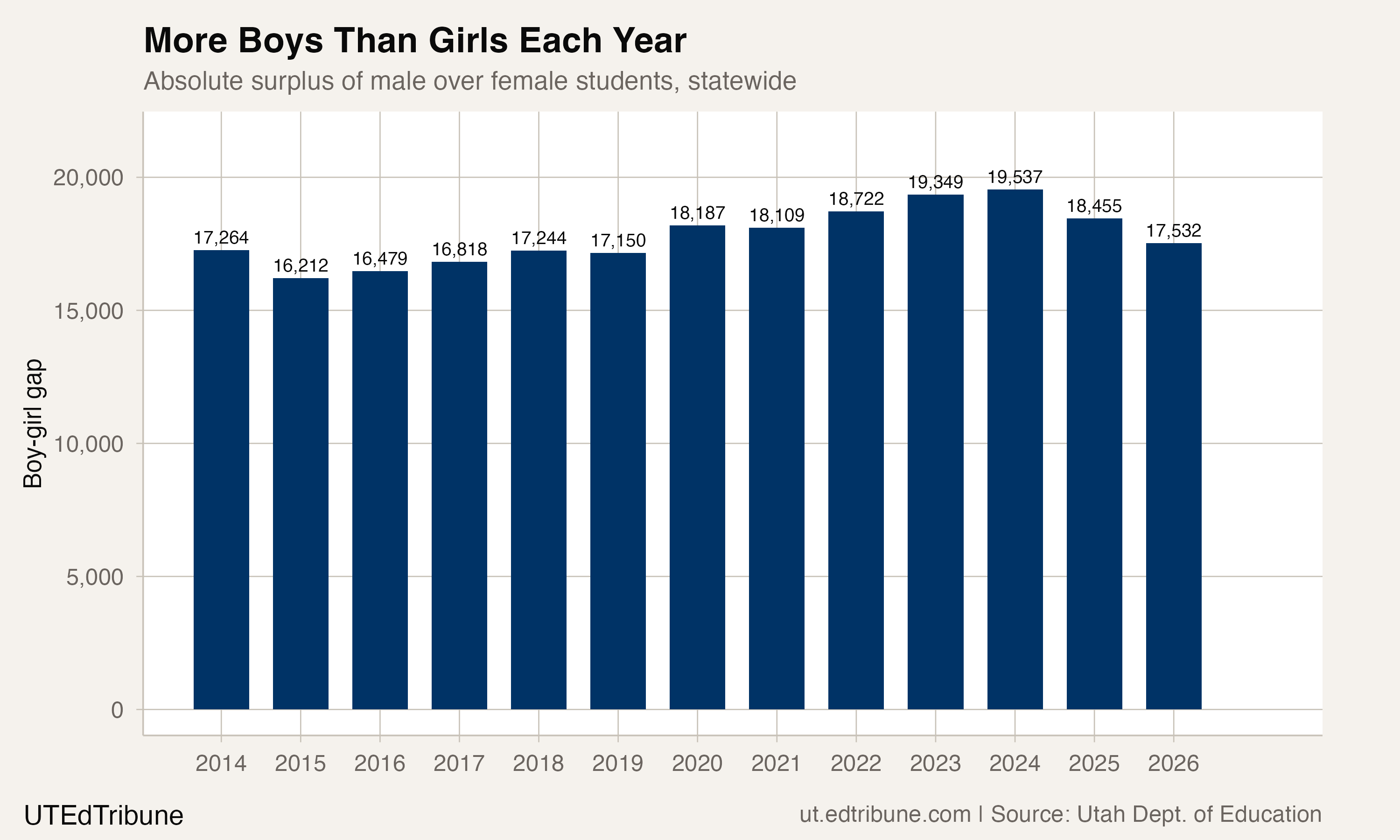
In raw numbers, the surplus of boys over girls grew from 16,212 in 2014-15 to a peak of 19,537 in 2023-24, then retreated to 17,532 in 2025-26. The recent narrowing is not because fewer boys are enrolling relative to girls. It is because total enrollment is declining and boys are leaving faster in absolute terms: Utah lost 6,202 male students and 5,279 female students in 2025-26 alone.
That asymmetry, 923 more boys lost than girls, compressed the gap by 2,005 students over two years. Whether this reflects differential attrition (boys leaving public schools at a slightly higher rate) or simply the mathematics of a declining population with a stable sex ratio is impossible to distinguish with enrollment data alone.
The special education connection
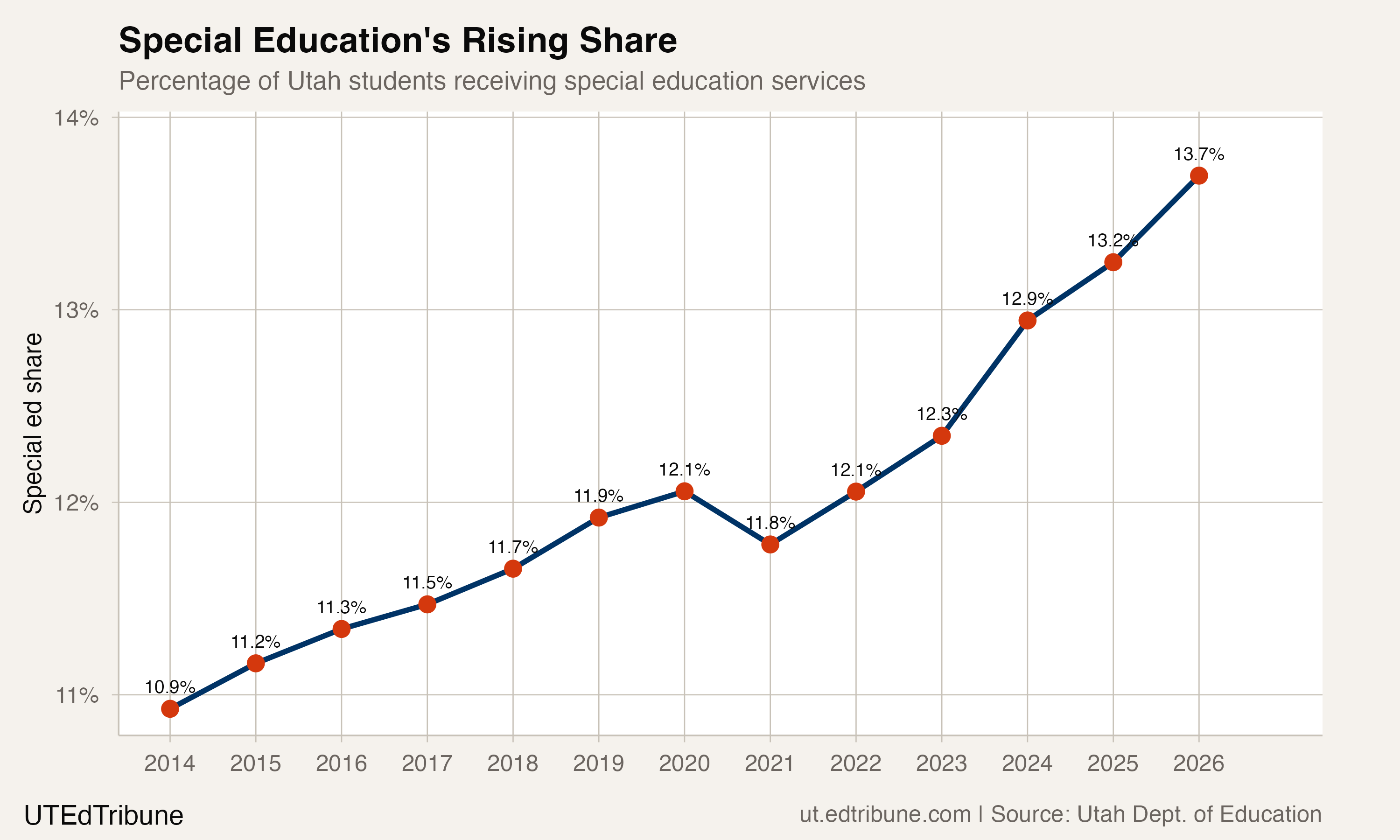
Utah's special education enrollment has risen from 10.9% of total enrollment in 2013-14 to 13.7% in 2025-26, adding 23,009 students even as the system contracted. Nationally, autism accounts for nearly 13% of all special education students, up from 5% in 2008-09, and more than four out of five students with autism are boys.
This creates a structural tilt. As identification of autism and other conditions that skew male continues to expand, the population of students receiving specialized services becomes increasingly male. The enrollment data cannot tell us whether more boys are being identified who previously went unserved, or whether identification criteria have shifted. Both are plausible. University of Utah Health researchers noted that the proportion of four-year-olds waiting for an autism evaluation dropped from 33% in 2020 to 10% in 2022, suggesting improved access to diagnostic services.
"We know that we are doing a better job of identifying ASD early. We've definitely made progress. Yet, there is still room for improvement in diagnosing autism at the youngest possible age." Deborah Bilder, M.D., University of Utah Health, March 2023
The practical consequence is that schools serving high-need populations, particularly autism-focused programs, will continue to enroll substantially more boys than girls. Spectrum Academy's 71% male enrollment is not an accident of recruitment. It is a predictable outcome of serving a condition with a 3-to-1 gender ratio.
A stable signal, not a crisis
Thirteen years of data show a gender ratio that barely moves. Utah's male enrollment share has never dropped below 51.3% or risen above 51.5%. The year-to-year fluctuation in the boys-per-100-girls ratio, from 105.3 to 106.0, is small enough to be noise. Unlike enrollment decline or demographic shifts, this is a pattern that does not demand a policy response because it reflects the baseline composition of the population entering school.
The more useful question is what happens to those 17,532 extra boys as they progress through the system. Nationally, the Brookings Institution found that girls outpace boys in on-time high school graduation by 6.5 percentage points, and that among young adults 25-34, 41% of women hold a bachelor's degree compared to 32% of men. Utah's K-12 enrollment gap is one of the smallest predictors of that divergence. The question is whether Utah's schools are structured to keep boys engaged through 12th grade, or whether the surplus at the front door masks a deficit at the back.
Detailed code that reproduces the analysis and figures in this article is available exclusively to EdTribune subscribers.
Discussion
Sign in to join the discussion.
Loading comments...