Utah's 41 traditional school districts lost 14,955 students in 2025-26, the largest single-year decline in at least a decade. The state's $100 million Utah Fits All voucher program awarded more than 14,000 scholarships for the same school year. The numbers are close enough to invite a simple story: vouchers emptied the schools.
The actual story is more tangled. About half of the 2025-26 voucher recipients are homeschoolers, many of whom were never enrolled in public school. Utah's fertility rate has fallen to 1.8, well below the 2.1 replacement level that once made the state a national outlier. And the decline is accelerating in ways that predate the voucher launch. Traditional districts lost 2,949 students in 2024, 6,988 in 2025, and 14,955 in 2026. The trajectory was already steepening before Utah Fits All reached full scale.
A decline without precedent in modern Utah
For most of the past decade, Utah's public schools grew every year. Between 2014 and 2020, statewide enrollment climbed from 612,088 to 666,858, gaining roughly 8,000 students annually. The pandemic interrupted that streak briefly, with a 1,552-student dip in 2021. But growth resumed in 2022, reaching a peak of 674,650 in 2023.
Then the floor dropped. Statewide enrollment has fallen three consecutive years: 1,988 in 2024, 4,873 in 2025, and 11,479 in 2026. At 656,310, the state has returned to roughly 2019 levels.
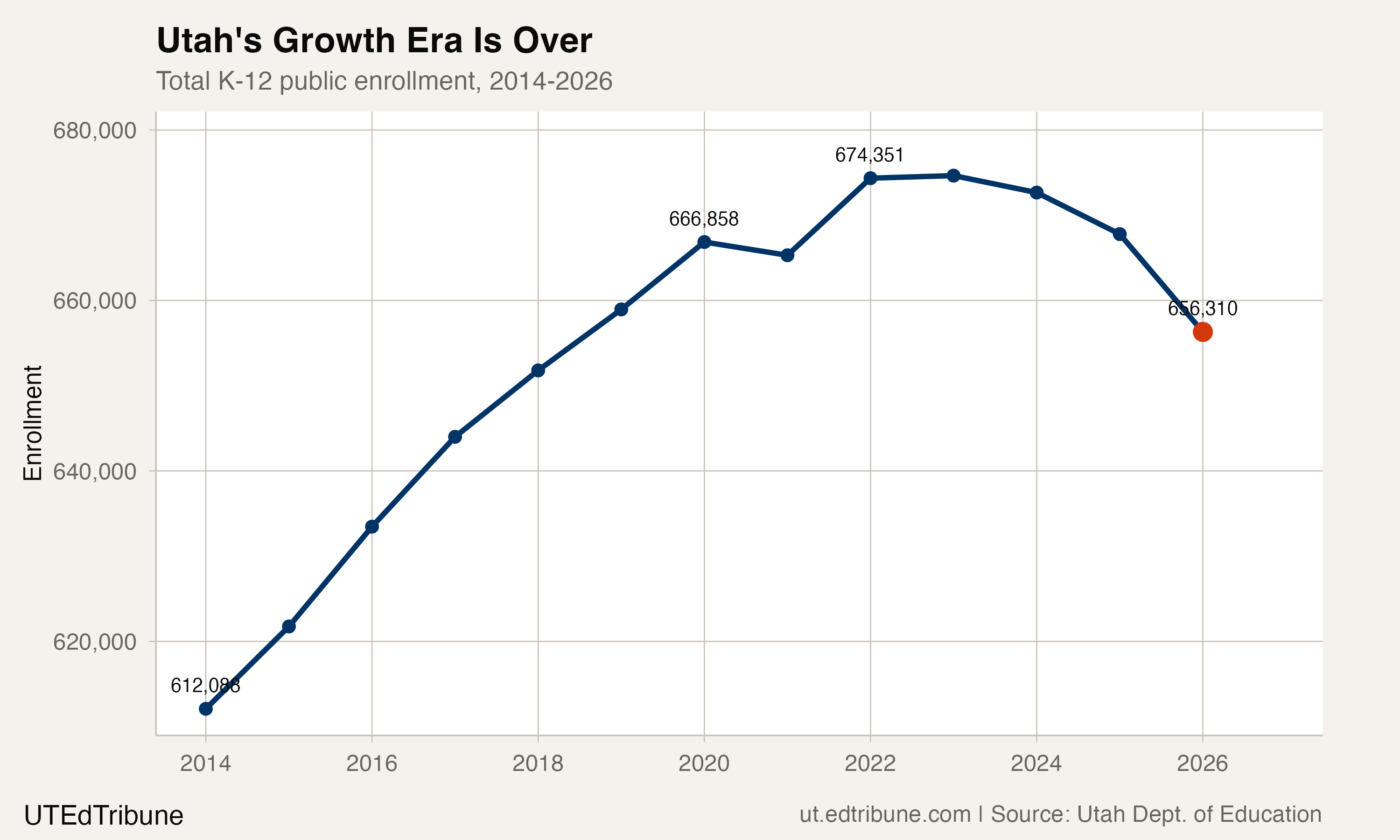
The traditional district picture is starker. These 41 districts peaked at 597,461 in 2022. Four years later they enroll 572,007, a cumulative loss of 25,454 students, or 4.3%.
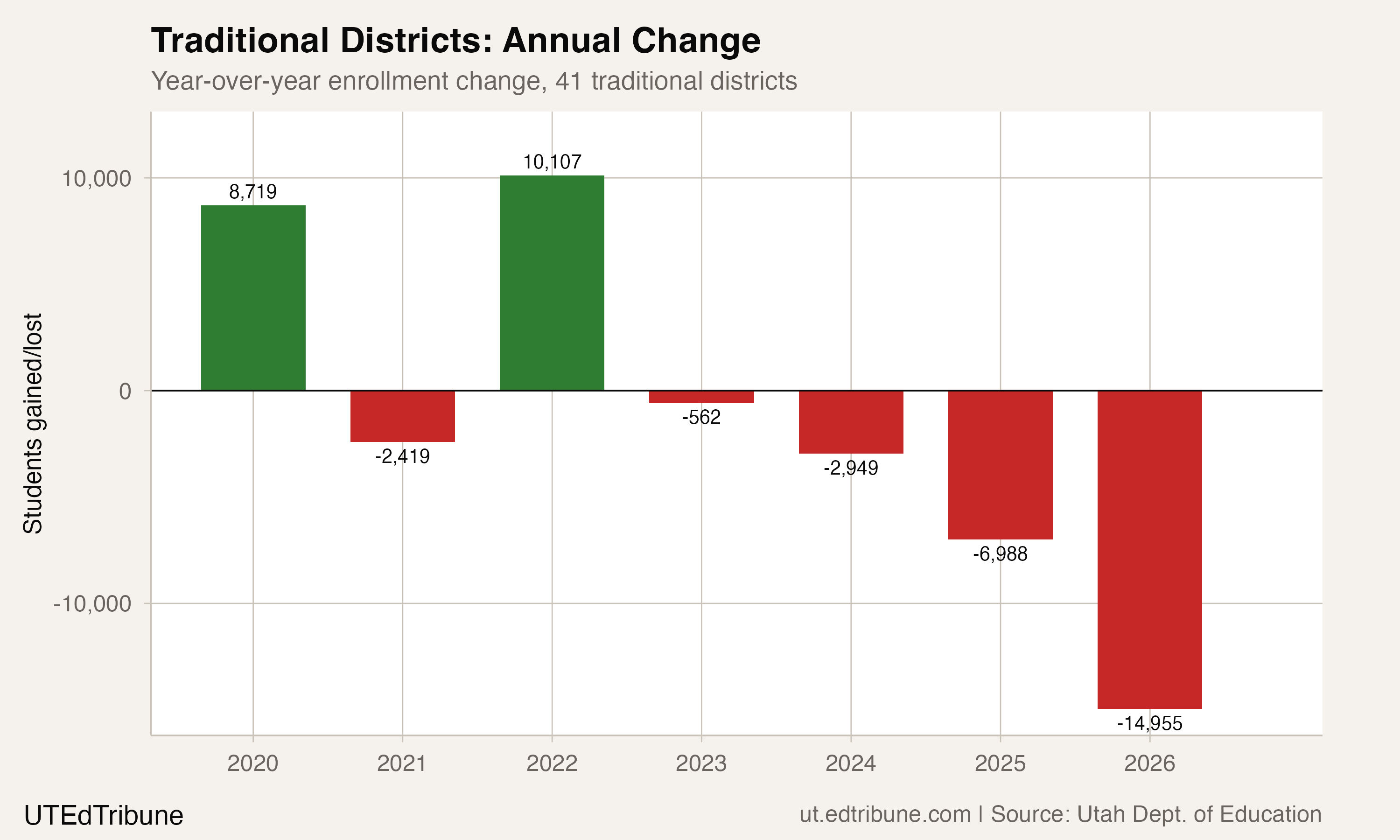
The 2026 loss of 14,955 is more than double the previous year's 6,988. That acceleration is the core of the policy puzzle.
37 of 41 districts shrank
The decline in 2026 was not concentrated in a few large districts. It was everywhere. Thirty-seven of Utah's 41 traditional districts lost students. Only Tooele (+118), Logan City (+19), Beaver (+18), and Grand (+5) grew, and their combined gain of 160 students amounts to a rounding error against the losses.
Granite District lost 2,571 students (4.5%), the largest absolute decline. Davis lost 2,136 (3.1%). Washington lost 1,610 (4.5%). Salt Lake City lost 886 students, a 4.8% drop that represents the steepest percentage decline among the state's major districts. Even Alpine, Utah's largest traditional district at 84,215 students, shed 542.
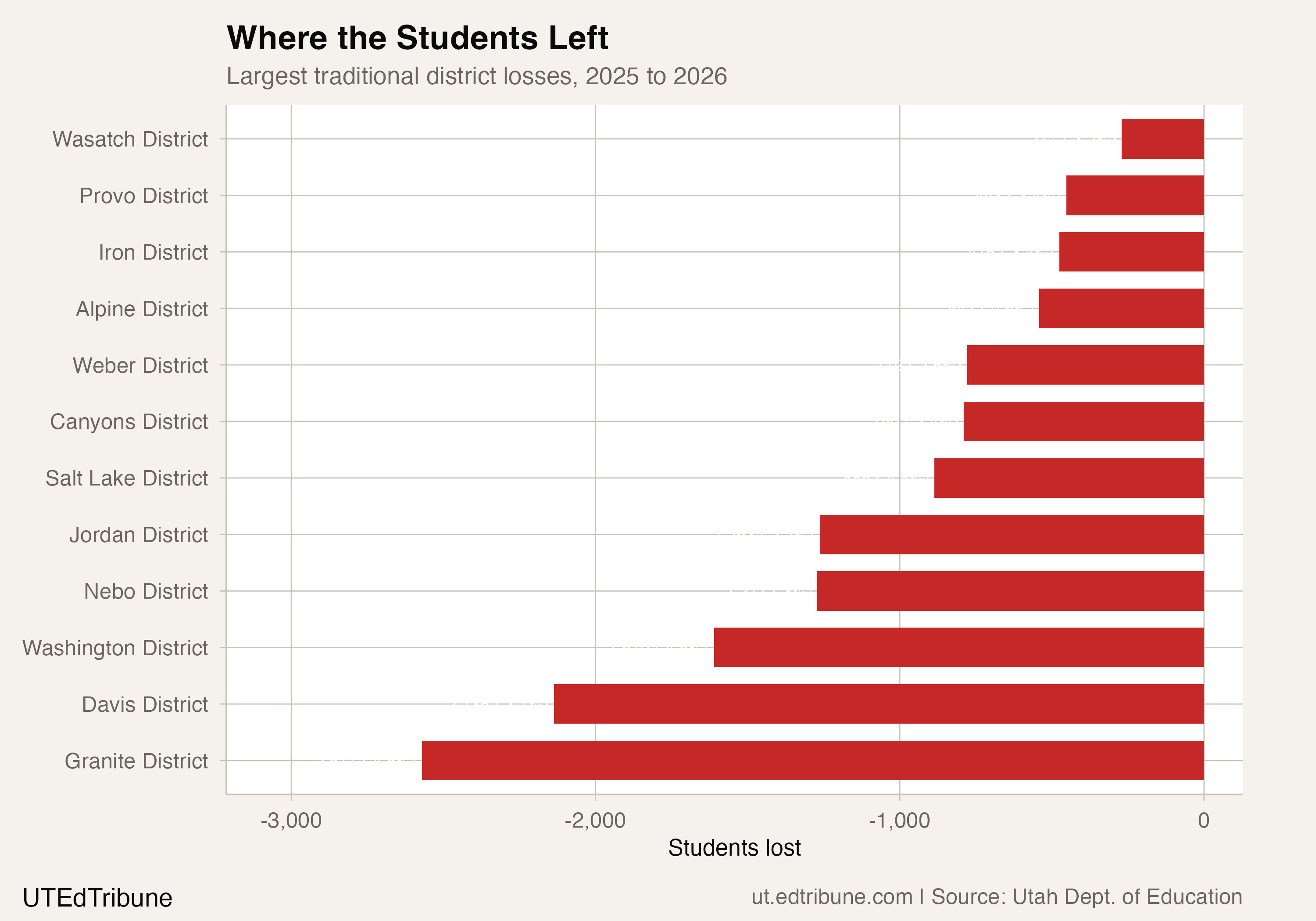
The smallest districts were not immune. Garfield District lost 242 students, a 15.5% decline in a single year, reducing its enrollment from 1,561 to 1,319. Rural districts with enrollments under 5,000 face the most acute operational pressure from losses of this magnitude: each student represents a larger share of the funding base, and staffing cannot be reduced in fractional increments.
The voucher program's footprint
Utah Fits All launched in the 2024-25 school year. In its first year, about 80% of recipients were homeschoolers. For 2025-26, that shifted substantially: roughly half of the 14,000-plus recipients are homeschoolers, with the other half attending private schools. The change followed 2025 legislation that reduced scholarship amounts for homeschoolers to $4,000-$6,000 while keeping private school scholarships at $8,000.
That shift matters for interpreting the enrollment data. If half the voucher recipients, roughly 7,000, moved from public school to private school, they would account for about 47% of the 14,955-student traditional district loss. The other half, the homeschoolers, likely were not in public school enrollment counts to begin with. The state does not track prior enrollment status of voucher recipients, so the actual transfer number is unknown.
State Superintendent Molly Hart attributed the decline to a combination of forces: "smaller birth cohorts, slowing in-migration, and increased school choice." The voucher program is part of the school choice category, but it shares that category with charter growth, private school enrollment outside the voucher program, and continued homeschooling.
Charters gained while traditional districts lost
While traditional districts hemorrhaged students, charter schools grew by 3,413, a 4.2% increase. Charter enrollment reached 85,268, or 13.0% of total district enrollment, up from 11.5% in 2022.
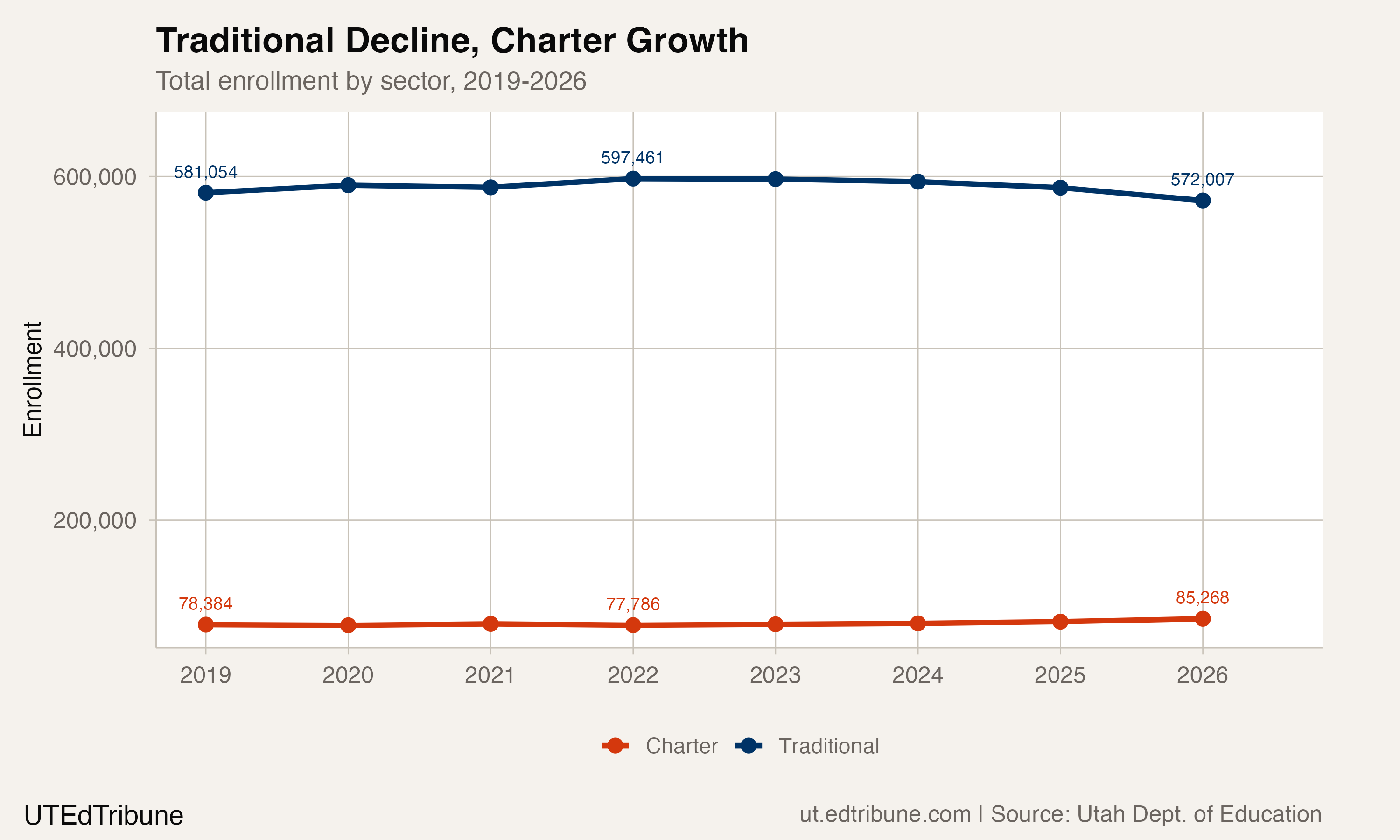
The charter share had been remarkably stable for years, hovering between 11.5% and 11.9% from 2019 through 2024. It jumped to 12.2% in 2025 and then to 13.0% in 2026. That 1.5-percentage-point leap in two years is the largest in the dataset.
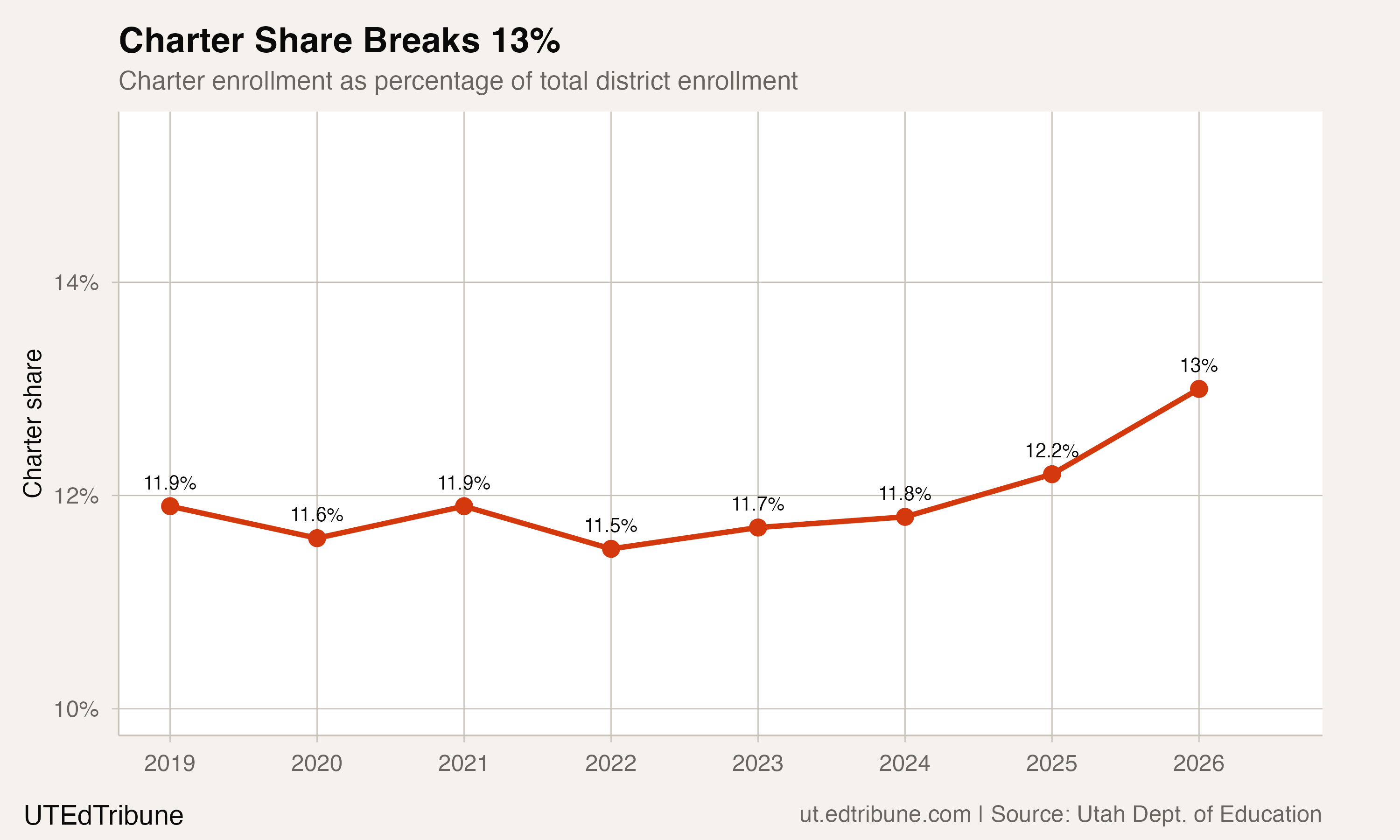
Charter growth and the voucher program are separate mechanisms pushing in the same direction. Charters are public schools; their 3,413-student gain is already reflected in the statewide total. The voucher program funds private schools and homeschooling, which are not. Together, the two programs represent a significant redistribution of where students are educated, even if only part of the redistribution shows up in public enrollment totals.
Births, not just ballots
The most likely single driver of the long-term trend is demographic. Utah's fertility rate dropped from roughly 2.65 in 2008 to 1.8 in 2023, a decline of 32%. For a state once synonymous with large families, that represents a cultural shift as much as a statistical one.
"Fertility rates have been coming down since 2008, and ... we have it going to about 1.6 ... we kind of think we will align with that." -- Mallory Bateman, director of demographic research, Kem C. Gardner Policy Institute
The kindergarten pipeline confirms this. Utah enrolled 50,363 kindergartners in 2014. The 2025-26 class is 43,519, a 13.6% decline. Those smaller cohorts will move through the system for the next 12 years, compressing enrollment at every grade level.
But the birth rate decline alone cannot explain the acceleration. Births have been falling steadily, not suddenly. The state lost 4,873 students in 2025 and 11,479 in 2026. That 2.4x jump in a single year points to something additive on top of demographics. The voucher program's expansion from its first-year launch to full $100 million operation is the most obvious candidate, though the precise contribution remains unquantified.
The funding cushion, and its limits
Utah's Weighted Pupil Unit system ties funding directly to enrollment. Each student generates WPUs, and the 2026 WPU value is $4,674. A district that loses 1,000 students does not lose exactly $4.674 million, because the formula is weighted and supplemented. But the direction is unambiguous: fewer students means less state funding.
The legislature increased the WPU by 4% for fiscal year 2026 and created a "hold harmless" provision that reinvests enrollment-decline savings into per-pupil spending for five years. That cushion prevents immediate fiscal cliffs. It does not prevent the operational reality: Granite cannot run the same number of classrooms with 2,571 fewer students. Washington County cannot staff the same number of schools after losing 1,610. The hold-harmless provision buys time. It does not buy students.
What remains unknown
The single most consequential missing number is how many voucher recipients were previously enrolled in public school. The state does not publish this. Without it, the relationship between the $100 million program and the 14,955-student loss is suggestive but not measurable. A 3rd District Court ruled the program unconstitutional in April 2025, finding it is not "open to all children of the state" as the Utah Constitution requires. The program continues operating pending appeal to the Utah Supreme Court.
The Utah Supreme Court has the voucher program's fate. A 3rd District Court has already ruled it unconstitutional. Scholarships continue going out while the appeal moves forward. Births keep declining. Charter campuses keep opening. And 37 of 41 traditional districts just posted enrollment losses, many of them the worst in their histories. The $100 million program may or may not survive the court. The 14,955 empty seats are already here.
Detailed code that reproduces the analysis and figures in this article is available exclusively to EdTribune subscribers.
Discussion
Sign in to join the discussion.
Loading comments...