In 2019, Granite District↗ET enrolled 64,281 students, nearly 9,400 more than Jordan District↗ET. Seven years later, Jordan has passed Granite to become Utah's third-largest district. The crossover happened not because Jordan surged but because Granite could not stop shrinking.
Jordan first pulled ahead in 2025, by a margin of 45 students. By fall 2026, it had widened the lead to 1,353.
The closing gap
The two districts occupy adjacent slices of Salt Lake County. Granite stretches east to west from the Wasatch foothills to Magna. Jordan covers the southwestern valley, including South Jordan, Herriman, Riverton, and West Jordan. Both sit under the same county government and the same housing market pressures. Their enrollment trajectories could not be more different.
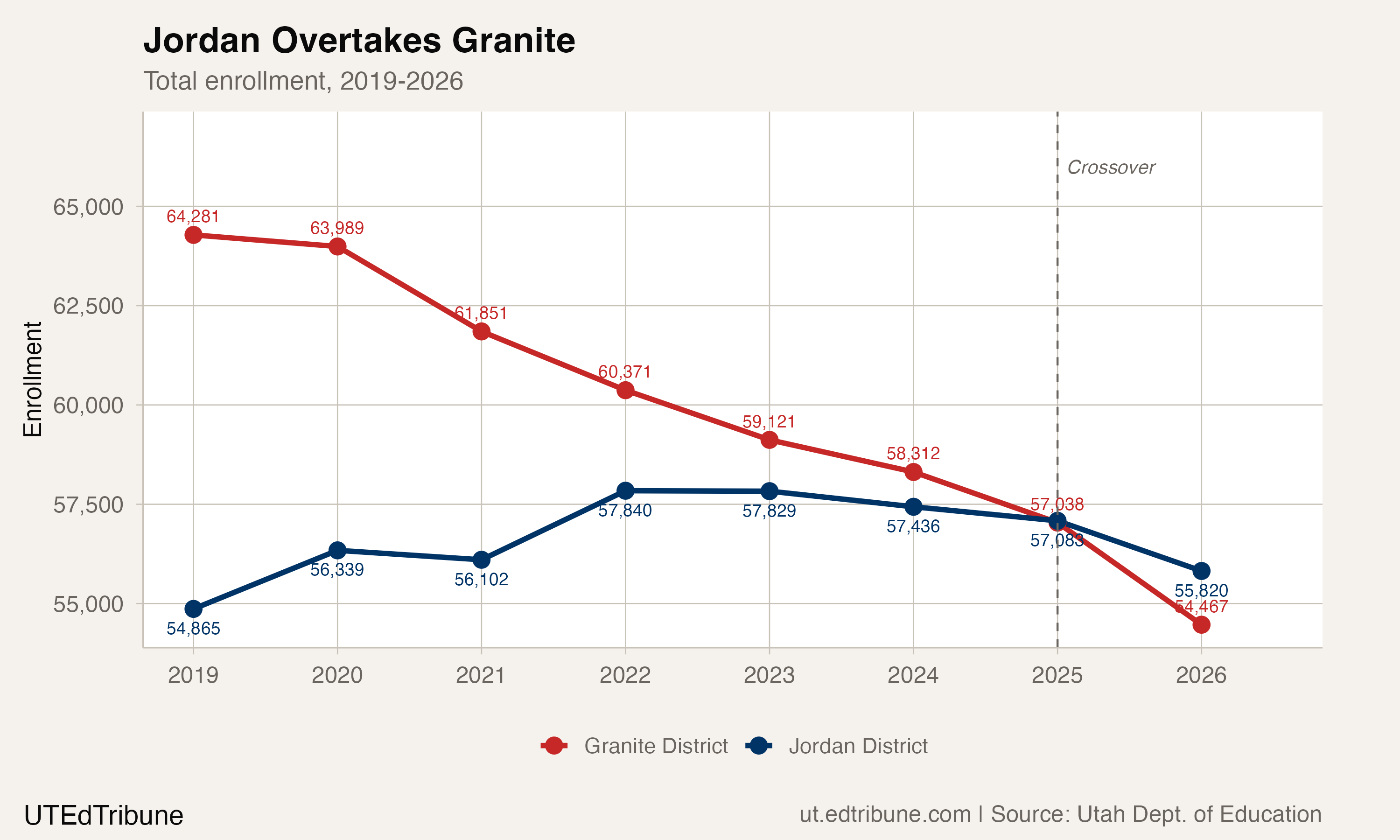
Granite has lost students every single year since 2019: 64,281 to 54,467, a decline of 9,814 students, or 15.3%. Jordan gained 955 over the same period, a net increase of 1.7%. The gap between them narrowed from 9,416 to zero, then flipped. Among Utah's 15 largest traditional districts, 14 lost enrollment in 2025-26. Granite's 4.5% single-year loss was among the steepest, matched only by Salt Lake City.
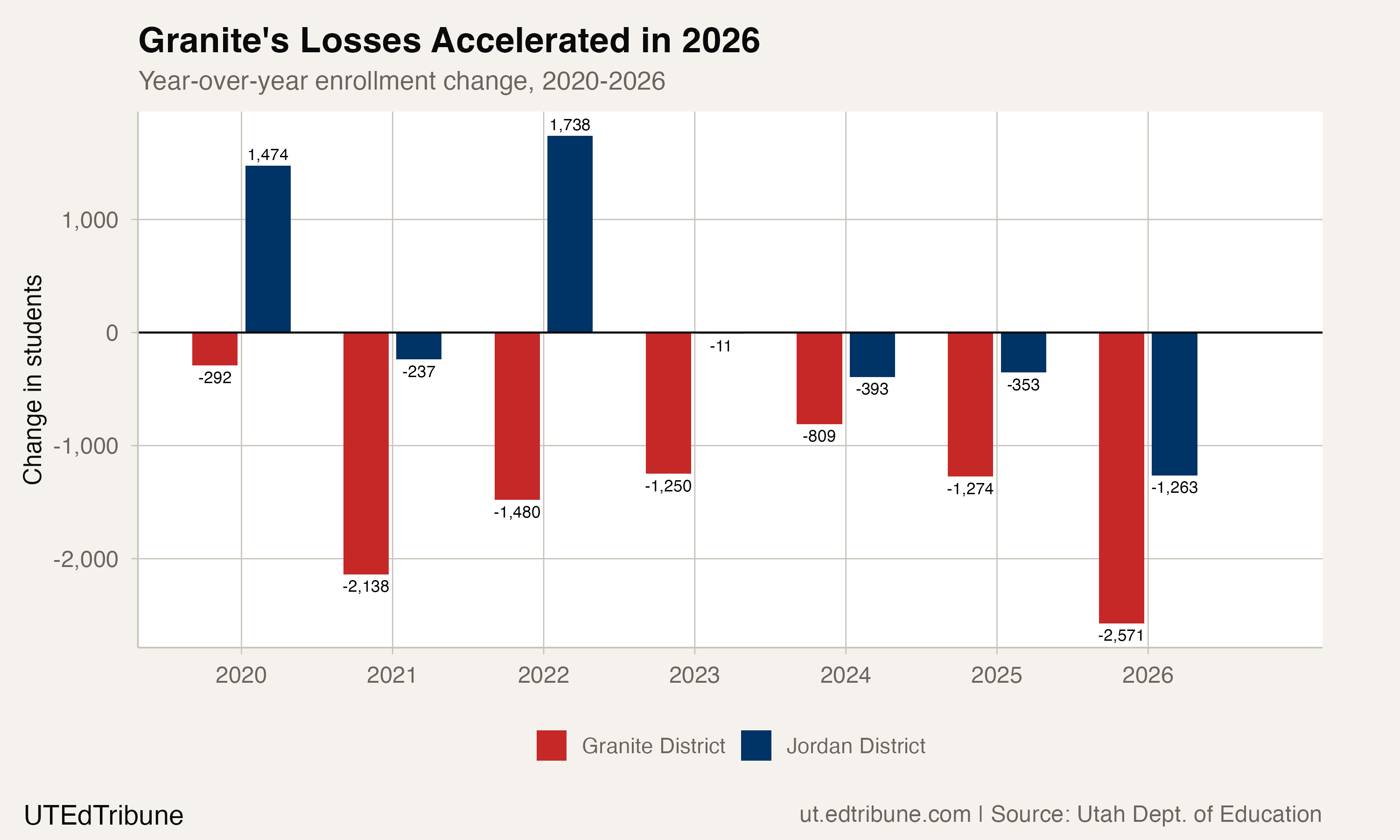
What makes Granite's trajectory stand out is the acceleration. After several years of losses averaging around 1,000 to 1,500 students per year, the district shed 2,571 in 2026 alone, the largest single-year drop in the available data.
Where the students are, and aren't
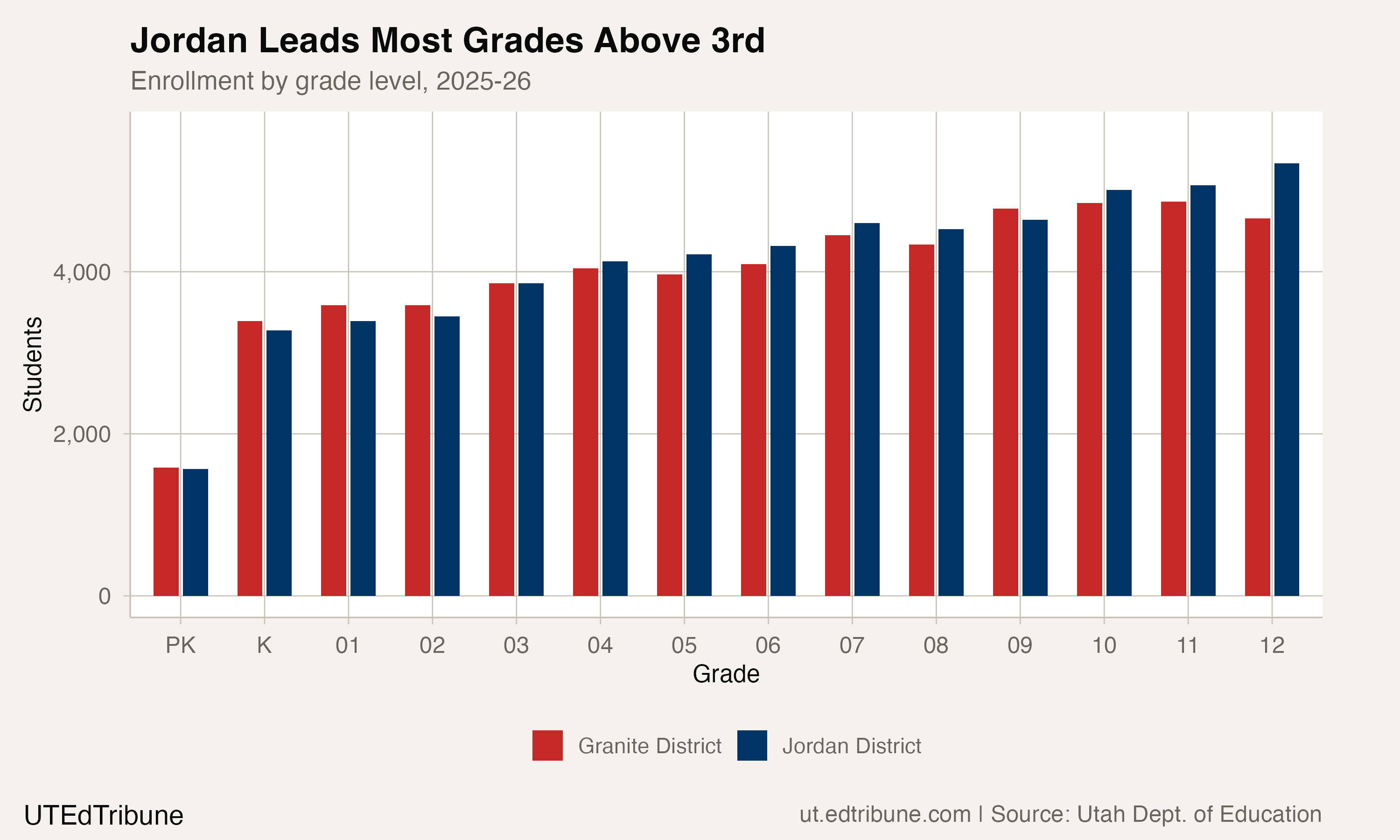
The grade-level profile tells the structural story. In 2026, Jordan enrolls more students than Granite at every grade from 4th through 12th except 9th. Jordan's 12th-grade class of 5,335 is 14.5% larger than Granite's class of 4,658. At the bottom of the pipeline, though, Granite still enrolls more kindergartners: 3,389 to Jordan's 3,277. At 3rd grade, the two districts are separated by a single student.
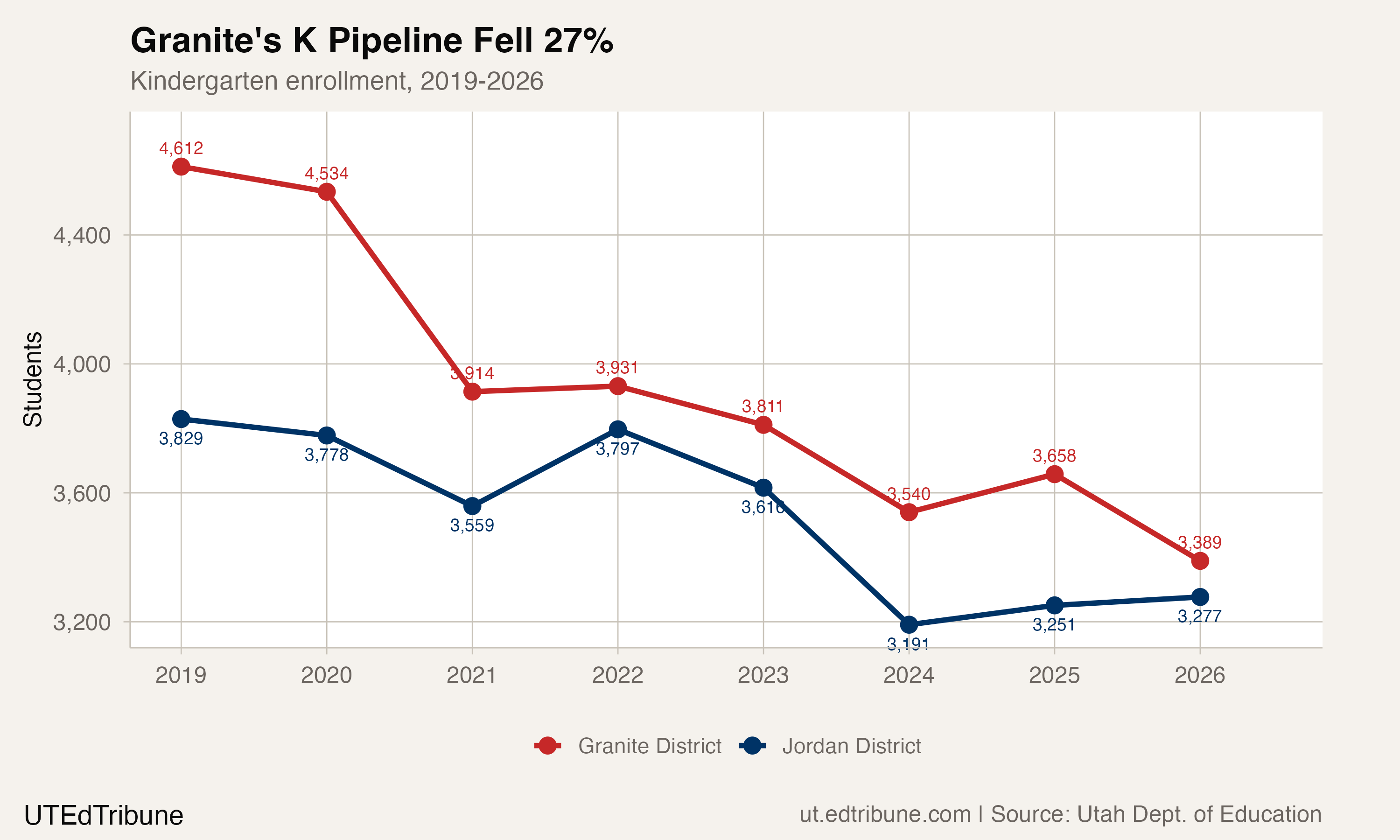
Both districts are feeding fewer kindergartners into their systems than they were seven years ago, but Granite's decline is steeper. Its K enrollment fell 26.5% from 4,612 in 2019 to 3,389, compared to a 14.4% decline for Jordan. If the current pipeline holds, Granite's elementary schools will continue to empty from the bottom up while Jordan's shrinkage proceeds more slowly.
Birth rates, housing costs, and charter competition
Utah's statewide enrollment fell by 11,478 students in 2025-26, the largest decline in 25 years. Superintendent of Public Instruction Molly Hart attributed the broader pattern to "smaller birth cohorts, slowing in-migration, and increased school choice." Utah's fertility rate has fallen to 1.85 children per woman, below the 2.1 replacement threshold and far from the rates that once made the state a national outlier.
Those statewide pressures hit Granite harder than Jordan for at least two reasons. First, Granite's east side neighborhoods, including Holladay, Millcreek, and Emigration Canyon, have median household incomes ranging from $98,500 to $184,700, with aging populations whose children have long since graduated. Second, charter schools have absorbed a growing share of Salt Lake County families. Statewide, charter enrollment grew 3.6% in 2025-26, and charters now represent 13% of Utah's total student population. One Millcreek parent calculated that competitor schools within a 14-minute drive of Granite's Skyline network enroll 8,760 students, 69% more than all Skyline network schools combined.
Jordan's southwest Salt Lake County territory, by contrast, includes cities that are still building. South Jordan's population rose from roughly 78,000 in 2020 to about 89,000 in 2025, with one in five new homes sold in the Salt Lake Valley located in the Daybreak master-planned community alone. That new construction offsets some of the birth rate pressure, even as Jordan's own kindergarten numbers trend downward.
A district under pressure on every front
Granite has closed elementary schools three years running, shuttering Westbrook and Carl Sandburg (2019), Twin Peaks, Spring Lane, and Millcreek (2022), Western Hills (2023), and Douglas T. Orchard, Redwood, and Valley Crest (2024). In 2025, the district's Population Analysis Committee studied 10 more elementary schools on the east side for potential closure or consolidation. The board unanimously voted in November 2025 to indefinitely suspend the study after months of community opposition, including a coalition of 265 families who submitted their own 50-page rebuttal of the district's projections.
"This is the wrong time to be closing schools. It's so hard to decide what to do for schools that is right by kids." -- Nicole McDermott, Granite Board President, Salt Lake Tribune, Nov. 2025
The closure debate triggered a second crisis: a movement to split Granite District in half along the Jordan River. Parents in Holladay, Millcreek, South Salt Lake, and Emigration Canyon have begun requesting feasibility studies from their city councils, with a goal of placing a secession measure on the November 2026 ballot. If it passes, two new districts would replace Granite over three years. The proposal echoes the 2009 Jordan-Canyons split, when southeastern Salt Lake County residents voted to carve Canyons District out of Jordan. That split cost an estimated $59 million and left Jordan with a $33 million budget shortfall.
Two districts, two demographic realities
The crossover in total enrollment obscures an even more striking divergence in who attends each district. Granite is 42.9% white and 41.7% Hispanic, with one of the highest English learner shares of any large district in the state: 14,136 students, or 26.0% of enrollment. Jordan is 68.1% white and 21.3% Hispanic, with English learners at 9.1%.
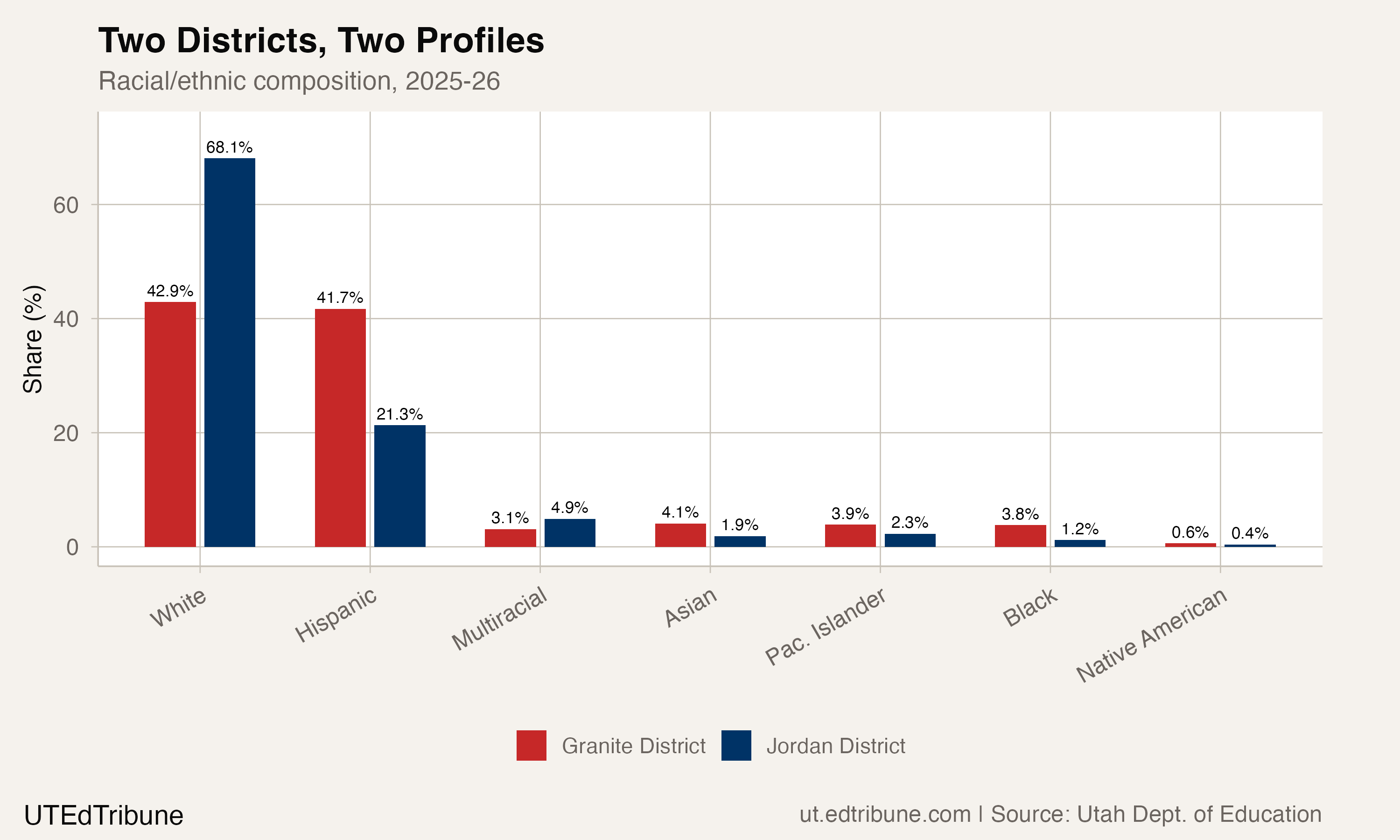
Granite lost 8,954 white students between 2019 and 2026, accounting for 91% of its total enrollment decline. Its Hispanic enrollment barely moved, from 22,213 to 22,690. The result is a district whose white share has fallen from 50.2% to 42.9% in seven years, not because Hispanic families arrived in large numbers but because white families left.
Separately, Jordan's English learner population has grown substantially, from 2,780 students (5.1%) in 2019 to 5,084 (9.1%) in 2026. That growth signals a demographic shift in the southwestern valley that will reshape Jordan's instructional needs even as its total headcount holds relatively steady.
Two districts, one valley
Granite's board faces a secession movement, a school closure fight, and a planning director who projects five more years of decline. A decade ago the district served 67,822 students. In 2025-26: 54,467. Enrollment has dropped every year since 2016.
Jordan's total enrollment has been essentially flat since 2022, hovering between 55,800 and 57,800. New housing construction in Herriman and South Jordan may keep the numbers from declining steeply, but the kindergarten pipeline tells a less optimistic story: Jordan's K enrollment of 3,277 in 2026 is 14.4% below 2019. The growth phase may be over. Jordan did not overtake Granite by growing. It overtook Granite by standing still while its neighbor fell.
Detailed code that reproduces the analysis and figures in this article is available exclusively to EdTribune subscribers.
Discussion
Sign in to join the discussion.
Loading comments...